The generative dance with ethnography and the study of talk: understanding workplaces in a morethan- human world

Titolo Rivista STUDI ORGANIZZATIVI
Autori/Curatori Viviana Meschitti, Ilaria Redaelli
Anno di pubblicazione 2025 Fascicolo 2025/1
Lingua Inglese Numero pagine 27 P. 9-35 Dimensione file 178 KB
DOI 10.3280/SO2025-001001
Il DOI è il codice a barre della proprietà intellettuale: per saperne di più clicca qui

Qui sotto puoi vedere in anteprima la prima pagina di questo articolo.

Se questo articolo ti interessa, lo puoi acquistare (e scaricare in formato pdf) seguendo le facili indicazioni per acquistare il download credit. Acquista Download Credits per scaricare questo Articolo in formato PDF
Anteprima articolo

FrancoAngeli è membro della Publishers International Linking Association, Inc (PILA)associazione indipendente e non profit per facilitare (attraverso i servizi tecnologici implementati da CrossRef.org) l’accesso degli studiosi ai contenuti digitali nelle pubblicazioni professionali e scientifiche

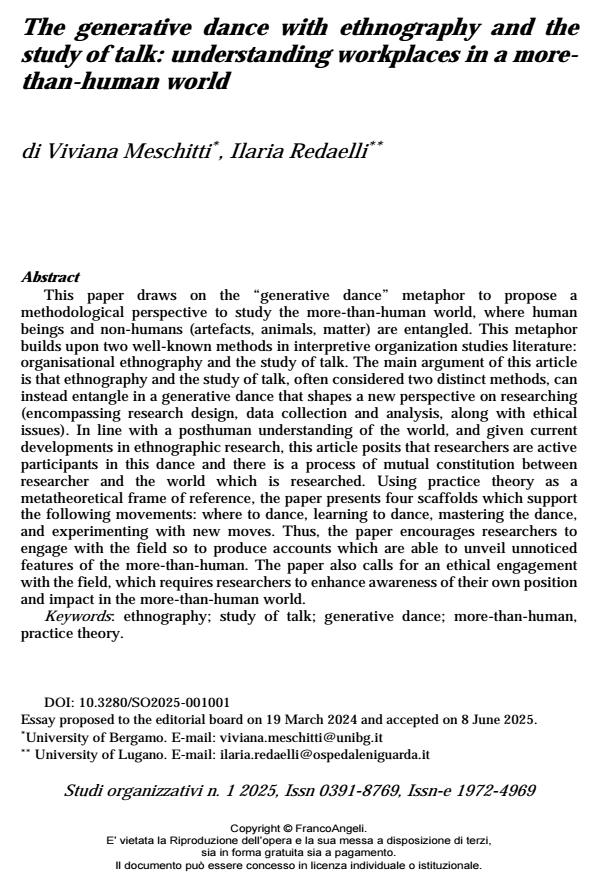
This paper draws on the “generative dance” metaphor to propose a methodological perspective to study the more-than-human world, where human beings and non-humans (artefacts, animals, matter) are entangled. This metaphor builds upon two well-known methods in interpretive organization studies literature: organisational ethnography and the study of talk. The main argument of this article is that ethnography and the study of talk, often considered two distinct methods, can instead entangle in a generative dance that shapes a new perspective on researching (encompassing research design, data collection and analysis, along with ethical issues). In line with a posthuman understanding of the world, and given current developments in ethnographic research, this article posits that researchers are active participants in this dance and there is a process of mutual constitution between researcher and the world which is researched. Using practice theory as a metatheoretical frame of reference, the paper presents four scaffolds which support the following movements: where to dance, learning to dance, mastering the dance, and experimenting with new moves. Thus, the paper encourages researchers to engage with the field so to produce accounts which are able to unveil unnoticed features of the more-than-human. The paper also calls for an ethical engagement with the field, which requires researchers to enhance awareness of their own position and impact in the more-than-human world.

Questo articolo utilizza la metafora della "danza generativa" per proporre una prospettiva metodologica di studio del more-than-human, cioè di un mondo in cui esseri umani e non umani (artefatti, animali, materia) sono intrecciati. Questa metafora si basa su due metodi ben noti nella letteratura interpretativa degli studi sull’organizzazione: l’etnografia organizzativa e lo studio del discorso. L’argomento principale di questo articolo è che l’etnografia e lo studio del discorso, spesso considerati due metodi distinti, possano invece intrecciarsi in una danza generativa che modella una nuova prospettiva sulla ricerca (che comprende la progettazione della ricerca, la raccolta e l’analisi dei dati, e le questioni etiche). In linea con una comprensione postumana del mondo, e dati gli attuali sviluppi nella ricerca etnografica, questo articolo sostiene che i ricercatori sono partecipanti attivi in questa danza e che esiste un processo di costituzione reciproca tra ricercatori e il mondo che viene ricercato. Utilizzando la teoria della pratica come quadro di riferimento metateorico, l’articolo presenta quattro piani di appoggio (scaffolds) che supportano i seguenti movimenti: dove danzare, imparare a danzare, padroneggiare la danza e sperimentare nuovi movimenti. Pertanto, l’articolo incoraggia i ricercatori ad impegnarsi nel campo di ricerca in modo da produrre resoconti che siano in grado di svelare caratteristiche inosservate del more-than-human. Questo articolo sottolinea anche l’impegno etico con il campo di ricerca: ciò richiede ai ricercatori di migliorare la consapevolezza della propria posizione e del proprio impatto nel mondo more-than-human.

Parole chiave:etnografia; studio del discorso; danza generativa; more-than-human; teoria della pratica.

  1. Alvesson, M., & Kärreman, D. (2000). Varieties of discourse: On the study of organizations through discourse analysis. Human Relations, 53(9), 1125-1149.
  2. Angouri, J., & Mondada, L. (2017). Meetings. In R. Wodak & B. Forchtner (Eds.), Routledge Handbook of Language and Politics (pp. 468–484). Routledge.
  3. Arminen, I., Kallio, A., & Mälkiä, T. (2022). Beyond Deontics: Power relations in decision-making processes in management meetings. In Institutionality: Studies of Discursive and Material (Re-) ordering (pp. 31-62). Springer.
  4. Asmuß, B., & Svennevig, J. (2009). Meeting talk. Journal of Business Communication, 46(1), 3-22.
  5. Balogun, J., Jacobs, C., Jarzabkowski, P., Mantere, S., & Vaara, E. (2014). Placing Strategy Discourse in Context: Sociomateriality, Sensemaking, and Power. Journal of Management Studies, 51(2), 175-201.
  6. Barad, K. (2007). Meeting the universe halfway: Quantum physics and the entanglement of matter and meaning. Duke University Press.
  7. Benozzo, A., Distinto, M., & Priola, V. (2024). Matter and Method: The Quest for a New-Materialist Methodology in Management Studies. British Journal of Management, 35(1), 86-98. https://doi.org/https://doi.org/10.1111/1467-8551.12775
  8. Boden, D. (1994). The business of talk: Organizations in action. Polity Press.
  9. Braidotti, R. (2019). Affirmative ethics and generative life. Deleuze and Guattari Studies, 13(4), 463-481.
  10. Brummans, B. H., & Vézy, C. (2022). Adventurous ideas for ethnographic research on the communicative constitution of ORGANIZATIONS. In The Routledge handbook of the communicative constitution of organization (pp. 262-280). Routledge.
  11. Calás, M. B., Smircich, L., Cozza, M., Gherardi, S., Katila, S., Kuismin, A., Jääskeläinen, P., Laine, P.-M., Meriläinen, S., Vola, J., Sayers, J., Wickström, A., Valtonen, A., Salmela, T., & Pullen, A. (2023). What to do about The Human in Organization Studies? Thinkingsayingdoing with the Anthropocene, pandemics, and thereafters. In M. Calas & L. Smircich (Eds.), A Research Agenda for Organization Studies, Feminisms and New Materialisms (pp. 177–194). Elgar.
  12. Clifton, J. (2012). A discursive approach to leadership: Doing assessments and managing organizational meanings. Journal of Business Communication, 49(2), 148-168.
  13. Cook-Gumperz, J., & Messerman, L. (1999). Local identities and institutional practices: constructing the record of professional collaboration. In S. Sarangi & C. Roberts (Eds.), Talk, work and institutional order: Discourse in medical, mediation and management settings. Mouton de Gruyter.
  14. Cook, S. D. N., & Brown, J. S. (1999). Bridging epistemologies: The generative dance between organizational knowledge and organizational knowing. Organization Science, 10(4), 381-400.
  15. Cozza, M., & Gherardi, S. (2023). Introduction: The Posthumanist Epistemology of Practice Theory. In M. Cozza & S. Gherardi (Eds.), The Posthumanist Epistemology of Practice Theory: Re-imagining Method in Organization Studies and Beyond (pp. 1-34). Springer Nature Switzerland. https://doi.org/10.1007/978-3-031-42276-8_1
  16. Cunliffe, A. L. (2010). Retelling Tales of the Field In Search of Organizational Ethnography 20 Years On. Organizational Research Methods, 13(2), 224-239. https://doi.org/10.1177/1094428109340041
  17. Cunliffe, A. L. (2018). Wayfaring: A scholarship of possibilities or let’s not get drunk on abstraction. M@n@gement, 21(4), 1429-1439.
  18. de Vaujany, F.-X., Leclercq-Vandelannoitte, A., & Islam, G. (2024). Experimentation in Qualitative Organization Research: Determinacy and Indeterminacy Through Walking Ethnography. Organizational Research Methods, 0, 10944281241229787. https://doi.org/10.1177/10944281241229787
  19. Denzin, N. K., & Lincoln, Y. S. (2005). The Sage handbook of qualitative research (Vol. Third). Sage Publications.
  20. Drew, P., & Heritage, J. (1992). Analyzing talk at work: An introduction. In P. Drew & J. Heritage (Eds.), Talk at work. Interaction in institutional settings (pp. 3-65). Cambridge University Press.
  21. Emirbayer, M. (1997). Manifesto for a Relational Sociology. American Journal of Sociology, 103(2), 281-317. https://doi.org/10.1086/231209
  22. Ergene, S., Banerjee, S. B., & Ergene, E. (2024). Environmental Racism and Climate (In)Justice in the Anthropocene: Addressing the Silences and Erasures in Management and Organization Studies. Journal of Business Ethics, 193(4), 785-800. https://doi.org/10.1007/s10551-024-05723-x
  23. Fairclough, N. (1992). Discourse and social change. In. Cambridge: Polity Press.
  24. Fairhurst, G. T., & Putnam, L. L. (2019). An integrative methodology for organizational oppositions: Aligning grounded theory and discourse analysis. Organizational Research Methods, 22(4), 917-940.
  25. Fox, N. J., & Alldred, P. (2022). Doing new materialist data analysis: a Spinozo-Deleuzian ethological toolkit. International Journal of Social Research Methodology, 25(5), 625-638. https://doi.org/10.1080/13645579.2021.1933070
  26. Garfinkel, H. (1967). Studies in ethnomethodology. Prentice Hall.
  27. Garfinkel, H., & Weider, D. L. (1992). Two incommensurable, asymmetrical alternate technologies of social analysis. In G. Watson & R. M. Seiler (Eds.), Text in context: Contributions to ethnomethodology (pp. 175-217). Sage.
  28. Gherardi, S. (2019). Theorizing affective ethnography for organization studies. Organization, 26(6), 741-760. https://doi.org/10.1177/1350508418805285
  29. Gherardi, S., de Vaujany, F.-X., & Silva, P. (2024). General introduction: Too-human? Inquiring in-between different disciplinary areas in managing and organizing 1. In S. Gherardi, F.-X. de Vaujany, & P. Silva (Eds.), Organization Studies and Posthumanism (pp. 1-25). Routledge.
  30. Glaser, V. L., Sloan, J., & Gehman, J. (2024). Organizations as Algorithms: A New Metaphor for Advancing Management Theory. Journal of Management Studies.
  31. Hammersley, M. (2019). Ethnomethodological criticism of ethnography. Qualitative Research, 19(5), 578-593. https://doi.org/10.1177/1468794118781383
  32. Hansen, H., Elias, S. R. S. T. A., Stevenson, A., Smith, A. D., Alexander, B. N., & Barros, M. (2024). Resisting the Objectification of Qualitative Research: The Unsilencing of Context, Researchers, and Noninterview Data. Organizational Research Methods, 0, 10944281231215119. https://doi.org/10.1177/10944281231215119
  33. Harré, R., Moghaddam, F. M., Cairnie, T. P., Rothbart, D., & Sabat, S. R. (2009). Recent Advances in Positioning Theory. Theory & Psychology, 19(1), 5-31. https://doi.org/10.1177/0959354308101417
  34. Hernes, T. (2007). Understanding organization as process: Theory for a tangled world. Routledge.
  35. Holmes, J., Schnurr, S., & Marra, M. (2007). Leadership and communication: discursive evidence of a workplace culture change. Discourse & Communication, 1(4), 433-451.
  36. Iedema, R. (2007). On the Multi-modality, Materially and Contingency of Organization Discourse. Organization Studies, 28(6), 931-946.
  37. Jakob Sadeh, L., Baikovich, A., & Zilber, T. B. (2024). Analyzing Social Interaction in Organizations: A Roadmap for Reflexive Choice. Organizational Research Methods, 10944281241245444.
  38. Janesick, V. J. (1994). The dance of qualitative research design: Metaphor, methodolatry, and meaning. In N. K. Denzin & Y. S. Lincoln (Eds.), Handbook of qualitative research (pp. 209-219). Sage. http://search.ebscohost.com/login.aspx?direct=true&db=psyh&AN=1994-98625-011&site=ehost-live
  39. Jarzabkowski, P., & Seidl, D. (2008). The Role of Meetings in the Social Practice of Strategy. Organization Studies, 29(11), 1391-1426. https://doi.org/10.1177/0170840608096388
  40. Jonas, M., Littig, B., & Wroblewski, A. (2017). Methodological reflections on practice oriented theories. Springer.
  41. Kalou, Z., & Sadler-Smith, E. (2015). Using Ethnography of Communication in Organizational Research. Organizational Research Methods, 18(4), 629-655. https://doi.org/10.1177/1094428115590662
  42. Kim, K. (2022). ‘We are in the hands of the head office (.)’: managing a multinational institution in decision-making meeting talk. In Institutionality: Studies of Discursive and Material (Re-) Ordering (pp. 63-81). Springer.
  43. Köhler, T., Smith, A., & Bhakoo, V. (2022). Templates in qualitative research methods: Origins, limitations, and new directions. Organizational Research Methods, 25(2), 183-210.
  44. Kwon, W., Clarke, I., & Wodak, R. (2014). Micro-Level Discursive Strategies for Constructing Shared Views around Strategic Issues in Team Meetings. Journal of Management Studies, 51(2), 265-290.
  45. Latour, B. (1983). Give me a laboratory and I will raise the world. In K. Knorr Cetina & M. Mulkay (Eds.), Science Observed. Perspectives on the Social Study of Science. Sage.
  46. Latour, B. (2005). Reassembling the social: An introduction to actor-network-theory. Oxford University Press.
  47. Lave, J., & Wenger, E. (1989). Situated learning: legitimate peripheral participation. Institute for Research on Learning.
  48. Llewellyn, N., & Spence, L. (2009). Practice as a Members’ Phenomenon. Organization Studies, 30(12), 1419-1439. https://doi.org/10.1177/0170840609349877
  49. Meschitti, V. (2019a). Can peer learning support doctoral education? Evidence from an ethnography of a research team. Studies in Higher Education, 44(7), 1209-1221. https://doi.org/10.1080/03075079.2018.1427711
  50. Meschitti, V. (2019b). The power of positioning: How leadership work unfolds in team interactions. Leadership, 15(5), 621-643.
  51. Moreau, J. T., & Rudge, T. (2019). How “care values” as discursive practices effect the ethics of a care-setting. Journal of Organizational Ethnography, 8(3), 298-311. https://doi.org/10.1108/JOE-04-2018-0024
  52. Nicolini, D. (2009). Zooming in and out: Studying practices by switching theoretical lenses and trailing connections. Organization Studies, 30(12), 1391-1418.
  53. Nicolini, D. (2013). Practice theory, work & organization. An introduction. Oxford University Press.
  54. Nicolini, D. (2017). Practice theory as a package of theory, method and vocabulary: Affordances and limitations. In M. Jonas, B. Littig, & A. Wroblewski (Eds.), Methodological reflections on practice oriented theories (pp. 19-34). Springer.
  55. O’Reilly, K. (2005). Ethnographic methods. Routledge.
  56. Omidvar, O., & Kislov, R. (2014). The evolution of the communities of practice approach: Toward knowledgeability in a landscape of practice An interview with Etienne Wenger-Trayner. Journal of Management Inquiry, 23(3), 266-275.
  57. Orlikowski, W. J. (2000). Using technology and constituting structures: A practice lens for studying technology in organizations. Organization Science, 11(4), 404-428. https://doi.org/10.1287/orsc.11.4.404.14600
  58. Orlikowski, W. J., & Scott, S. V. (2008). Sociomateriality: challenging the separation of technology, work and organization. Academy of Management Annals, 2(1), 433-474.
  59. Orlikowski, W. J., & Scott, S. V. (2023). The Digital Undertow and Institutional Displacement: A Sociomaterial Approach. Organization Theory, 4(2), 26317877231180898. https://doi.org/10.1177/26317877231180898
  60. Pratt, M. G., Sonenshein, S., & Feldman, M. S. (2022). Moving beyond templates: A bricolage approach to conducting trustworthy qualitative research. Organizational Research Methods, 25(2), 211-238.
  61. Puntil, D. (2023). Objects, People, Stories, Places. A Nomadic Inquiry into Language Professional Identity. In M. Cozza & S. Gherardi (Eds.), The Posthumanist Epistemology of Practice Theory: Re-imagining Method in Organization Studies and Beyond (pp. 177-202). Springer.
  62. Randall, D., Harper, R., & Rouncefield, M. (2007). Fieldwork for Design: Theory and Practice. Springer.
  63. Redaelli, I., & Carassa, A. (2018). New perspectives on plans: Studying planning as an instance of instructed action. Computer Supported Cooperative Work (CSCW), 27, 107-148.
  64. Rouleau, L., de Rond, M., & Musca, G. (2014). From the ethnographic turn to new forms of organizational ethnography. Journal of Organizational Ethnography, 3(1), 2-9. https://doi.org/10.1108/JOE-02-2014-0006
  65. Sacks, H. (1992). Lectures on Conversation. Blackwell.
  66. Sacks, H., Schegloff, E. A., & Jefferson, G. (1974). A simplest systematics for the organization of turn-taking for conversation. Language, 50(4), 696-735.
  67. Samra-Fredericks, D. (2003). Strategizing as Lived Experience and Strategists’ Everyday Efforts to Shape Strategic Direction. Journal of Management Studies, 40(1), 141-174.
  68. Samra-Fredericks, D. (2004). Understanding the production of "strategy" and "organization" through talk amongst managerial elites. Culture and organization, 10(2), 125-141.
  69. Samra-Fredericks, D. (2005a). Strategic Practice, ‘Discourse’ and the Everyday Interactional Constitution of ‘Power Effects’. Organization, 12(6), 803-841
  70. Samra-Fredericks, D. (2005b). Strategic Practice, ‘Discourse’ and the Everyday Interactional Constitution of ‘Power Effects’. Organization, 12(6), 803-841.
  71. Sandberg, J. (2005). How do we justify knowledge produced within interpretive approaches? Organizational Research Methods, 8(1), 41-68. https://doi.org/10.1177/1094428104272000
  72. Schatzki, T. R., Knorr Cetina, K., & Savigny, E. v. (2001). The practice turns in contemporary theory. Routledge.
  73. Schwartzman, H. B. (1989). The meeting. Gatherings in organizations and communities. Plenum Press.
  74. Sherman Heyl, B. (2001). Ethnographic interviewing. In P. Atkinson, A. Coffey, S. Delamont, J. Lofland, & L. Lofland (Eds.), Handbook of ethnography (pp. 369-383). Sage.
  75. Silva, P. (2024). Mapping the posthumanist conversations in Organization Studies. In F.-X. de Vaujany, S. Gherardi, & P. Silva (Eds.), Organization Studies and Posthumanism (pp. 129-161). Routledge.
  76. Stefan, J., Hirst, A., Guerci, M., & Toraldo, M. L. (2024). Navigating political minefields: applying frames of reference of the employment relation to access negotiations to workplace ethnographies. Journal of Organizational Ethnography, 13(2), 290-310. https://doi.org/10.1108/JOE-01-2023-0005
  77. Suchman, L. (1997). Centers of coordination: a case and some themes. In L. B. Resnick, R. Sa¨ljo¨, C. Pontecorvo, & B. Burge (Eds.), Discourse, tools and reasoning: essays on situated cognition (pp. 41-62). Springer Verlag.
  78. Tallberg, L., & Huopalainen, A. (2024). We are the missing people: On posthumanist onto-epistemologies in organization studies. In S. Gherardi, F.-X. de Vaujany, & P. Silva (Eds.), Organization Studies and Posthumanism (pp. 29-52). Routledge.
  79. Taylor, J. R., & Robichaud, D. (2004). Finding the organization in the communication: Discourse as action and sensemaking. Organization, 11(3), 395-413. https://doi.org/10.1177/1350508404041999
  80. ten Have, P. (2004). Understanding qualitative research and ethnomethodology. Sage.
  81. Tourish, D. (2020). The triumph of nonsense in management studies. Academy of Management Learning & Education, 19(1), 99-109.
  82. Van Maanen, J. (2011). Ethnography as work: some rules of engagement. Journal of Management Studies, 48(1), 218-234.
  83. Von Krogh, G. (2018). Artificial intelligence in organizations: New opportunities for phenomenon-based theorizing. Academy of Management Discoveries, 4(4), 404-409.
  84. Whitehead, A. N. (2010). Process and reality. Simon and Schuster.
  85. Wodak, R., Kwon, W., & Clarke, I. (2011). "Getting people on board": discursive leadership for consensus building in team meetings. Discourse & Society, 22(5).
  86. Wood, D., Bruner, J. S., & Ross, G. (1976). The role of tutoring in problem solving. Journal of Child Psychology and Psychiatry, 17(2), 89-100.
  87. Ybema, S., Yanow, D., Wels, H., & Kamsteeg, F. H. (2009). Organizational ethnography: Studying the complexity of everyday life. Sage.
  88. Zickar, M. J., & Carter, N. T. (2010). Reconnecting With the Spirit of Workplace Ethnography a Historical Review. Organizational Research Methods, 13(2), 304-319. https://doi.org/10.1177/1094428109338070

Viviana Meschitti, Ilaria Redaelli, The generative dance with ethnography and the study of talk: understanding workplaces in a morethan- human world in "STUDI ORGANIZZATIVI " 1/2025, pp 9-35, DOI: 10.3280/SO2025-001001