The temporal organisation and practices of planning work: The temporalities of digital infrastructure, the digital infrastructuring of temporality

Titolo Rivista STUDI ORGANIZZATIVI
Autori/Curatori Rob Kitchin, Juliette Davret, Carla Maria Kayanan, Samuel Mutter
Anno di pubblicazione 2025 Fascicolo 2025/2
Lingua Inglese Numero pagine 25 P. 180-204 Dimensione file 395 KB
DOI 10.3280/SO2025-002008
Il DOI è il codice a barre della proprietà intellettuale: per saperne di più clicca qui

Qui sotto puoi vedere in anteprima la prima pagina di questo articolo.

Se questo articolo ti interessa, lo puoi acquistare (e scaricare in formato pdf) seguendo le facili indicazioni per acquistare il download credit. Acquista Download Credits per scaricare questo Articolo in formato PDF
Anteprima articolo

FrancoAngeli è membro della Publishers International Linking Association, Inc (PILA)associazione indipendente e non profit per facilitare (attraverso i servizi tecnologici implementati da CrossRef.org) l’accesso degli studiosi ai contenuti digitali nelle pubblicazioni professionali e scientifiche

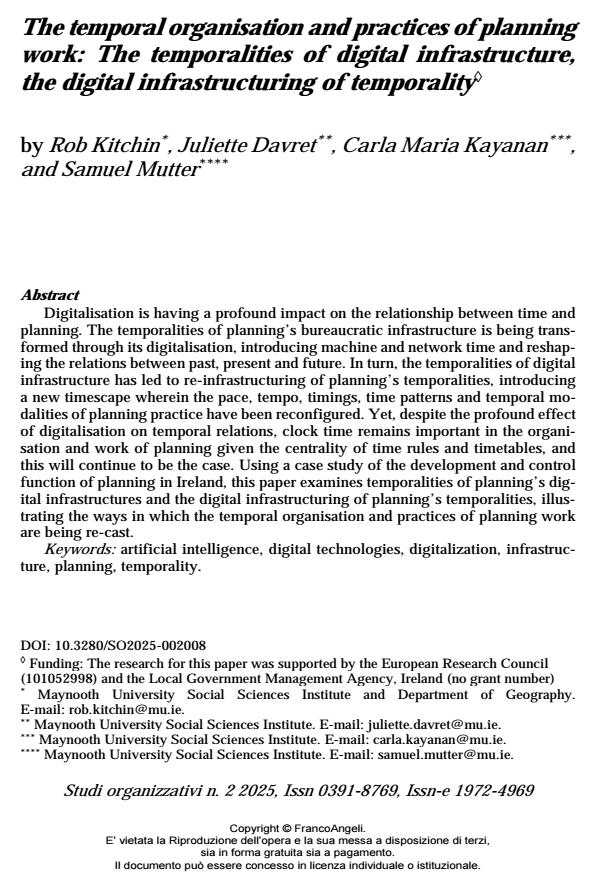
Digitalisation is having a profound impact on the relationship between time and planning. The temporalities of planning’s bureaucratic infrastructure is being transformed through its digitalisation, introducing machine and network time and reshaping the relations between past, present and future. In turn, the temporalities of digital infrastructure has led to re-infrastructuring of planning’s temporalities, introducing a new timescape wherein the pace, tempo, timings, time patterns and temporal modalities of planning practice have been reconfigured. Yet, despite the profound effect of digitalisation on temporal relations, clock time remains important in the organisation and work of planning given the centrality of time rules and timetables, and this will continue to be the case. Using a case study of the development and control function of planning in Ireland, this paper examines temporalities of planning’s digital infrastructures and the digital infrastructuring of planning’s temporalities, illustrating the ways in which the temporal organisation and practices of planning work are being re-cast.

La digitalizzazione sta avendo un impatto profondo sul rapporto tra tempo e pianificazione. Le temporalità dell’infrastruttura burocratica della pianificazione vengono trasformate attraverso la digitalizzazione, che introduce il tempo della macchina e della rete, rimodellando le relazioni tra passato, presente e futuro. A sua volta, le temporalità proprie dell’infrastruttura digitale hanno portato a una ri-infrastrutturazione delle temporalità della pianificazione, introducendo un nuovo paesaggio temporale in cui ritmo, cadenza, tempistiche, schemi temporali e modalità temporali della pratica di pianificazione vengono riconfigurati. Tuttavia, nonostante il profondo effetto della digitalizzazione sulle relazioni temporali, il tempo dell’orologio rimane importante nell’organizzazione e nel lavoro di pianificazione, data la centralità delle regole temporali e degli orari prestabiliti, e continuerà ad esserlo anche in futuro. Basandosi su un caso studio relativo alla funzione di sviluppo e controllo della pianificazione in Irlanda, questo articolo esamina le temporalità delle infrastrutture digitali della pianificazione e la digitalizzazione delle sue temporalità, illustrando i modi in cui l’organizzazione temporale e le pratiche del lavoro di pianificazione vengono ridefinite.

Parole chiave:intelligenza artificiale, tecnologie digitali, digitalizzazione, infrastruttura, pianificazione, temporalità.

  1. Abram, S., Weszkalnys, G. (2011), “Introduction: Anthropologies of planning — Temporality, imagination, and ethnography”, Focaal: Journal of Global and Historical Anthropology, 61: 3–18.
  2. Adam, B. (1998), Timescapes of Modernity: The Environment and Invisible Hazards. London: Routledge.
  3. Adam, B. (2004), Time. Cambridge: Polity.
  4. Addie, J-D., Glass, M.R., Nelles, J., Marino, L. (2024). In: Addie, J-P., Glass, M.R., Nelles J. (eds) Infrastructural Times: Temporality and the Making of Global Urban Worlds. Bristol: Bristol University Press, pp. 1-24.
  5. Arican, A. (2020), “Behind the Scaffolding: Manipulations of Time, Delays, and Power in Tarlabasi, Istanbul”, City & Society, 32(3): 482-507.
  6. Bates, J. (2018). “The politics of data friction”, Journal of Documentation, 74: 412–29. DOI: 10.1108/JD-05-2017-0080
  7. Batty, M. (1994), “A chronicle of scientific planning: The Anglo-American modeling experience”, Journal of the American Planning Association, 60(1): 7–16. DOI: 10.1080/01944369408975546.
  8. Batty, M. (2021), “The digital transformation of planning”, Environment and Planning B, 48(4): 593-597. DOI: 10.1177/23998083211016122.
  9. Boland, P., Durrant, A., McHenry, J., McKay, S., Wilson, A. (2022), “A ‘planning revolution’or an ‘attack on planning’ in England: Digitization, digitalization, and democratization”, International Planning Studies, 27(2): 155–172. DOI: 10.1080/13563475.2021.1979942
  10. Bonfiglioli, S. (1997), “Urban time policies in Italy: An overview of time-oriented research”, Transfer: European Review of Labour and Research, 3(4): 700–22. DOI: 10.1177/102425899700300405.
  11. Byrne, M. (2016), “Entrepreneurial urbanism after the crisis: Ireland's ‘Bad Bank’ and the redevelopment of Dublin’s Docklands”, Antipode, 48(4): 899-918.
  12. Carse, A. and Kneas, D. (2019), “Unbuilt and unfinished: The temporalities of infrastructure”, Environment and Society: Advances in Research, 10(1): 9–28.
  13. Coutard, O. (2024), Shifting regimes of historicity and the control of urban futures through infrastructures: Continuities, ambivalences, and tensions in the Anthropocene. In: Addie, J-P., Glass, M.R., Nelles J. (eds) Infrastructural Times: Temporality and the Making of Global Urban Worlds. Bristol: Bristol University Press, pp. 72-94.
  14. Datta, A. (2017), Introduction: Fast cities in an urban age. In: Datta, A., Shaban, A. (eds.) Mega-urbanization in the Global South: Fast Cities and New Urban Utopias of the Postcolonial State. London: Routledge, pp. 1–27.
  15. Davoudi, S., Pendlebury, J. (2010), “The evolution of planning as an academic discipline”, Town Planning Review, 81(6): 613-645.
  16. Degen, M. (2018). “Timescapes of urban change: The temporalities of regenerated streets”, The Sociological Review, 66(5): 1074-1092. DOI: 10.1177/0038026118771290.
  17. DHLGH (2024). Ministerial Action Plan on Planning Resources, October 2024. Dublin: Department of Housing, Local Government and Heritage. https://www.gov.ie/en/publication/51194-ministerial-action-plan-on-planning-resources-october-2024/.
  18. Dobson, M., Parker, G. (2024), “The temporal governance of planning in England: Planning reform, Uchronia and ‘proper time’”, Planning Theory, 24(1), 21-42. DOI: 10.1177/14730952241226570.
  19. DPER (2024). Databank. Department of Public Expenditure & Reform, Dublin. https://databank.per.gov.ie/Public_Service_Numbers.aspx?rep=SectorTrend.
  20. Du, J., Ye, X., Jankowski, P., Sanchez, T.W., Mai, G. (2024), “Artificial intelligence enabled participatory planning: a review”, International Journal of Urban Sciences, 28(2): 183-210. DOI: 10.1080/12265934.2023.2262427.
  21. Durrant, D., Saxe, S., Siemiatycki, M., Dean, M. (2024). “Planning, ethics and infrastructural time”, Time & Society, 33(1): 25-47. DOI: 10.1177/0961463X231178132.
  22. Edwards, P.N. (2010), A Vast Machine: Computer Models, Climate Data, and the Politics of Global Warming. Cambridge, MA: The MIT Press.
  23. Ekman, P. (2025), Sequencing Like a State: Ciudad Guayana and the Infrastructures of Arrival. In Addie, J-P., Glass, M.R. and Nelles, J. (ed) Infrastructural Times: Temporality and the Making of Global Urban Worlds. Bristol: Bristol University Press, pp. 119-139.
  24. Engels, J.I. (2020), “Technical infrastructures as products and producers of time”, NTM Zeitschrift für Geschichte der Wissenschaften, Technik und Medizin, 28(1): 69– 90.
  25. Ertiö, T-P. (2015), “Participatory Apps for Urban Planning—Space for Improvement”, Planning Practice & Research, 30(3): 303-321. DOI: 10.1080/02697459.2015.1052942.
  26. Flood, J. (2011), The Fires: How a Computer Formula, Big Ideas, and the Best of Intentions Burned Down New York City and Determined the Future of Cities. New York: Riverhead.
  27. Forrester, J. W. (1969), Urban Dynamics. Cambridge, MA: MIT Press.
  28. Goldman, M. (2011), “Speculative urbanism and the making of the next world city”, International Journal of Urban and Regional Research, 35(3): 555–81.
  29. 10.1111/j.1468-2427.2010.01001.x.
  30. Goldman, M., Narayan, D. (2021), “Through the optics of finance: Speculative urbanism and the transformation of markets”, International Journal of Urban and Regional Research, 45(2): 209–31. DOI: 10.1111/1468-2427.13012.
  31. Guyer, J. (2007), “Prophecy and the near future: Thoughts on macroeconomic, evangelical, and punctuated time”. American Ethnologist, 34(3): 409–421.
  32. Hall, P. (2002), Urban and Regional Planning, 4th edition. Routledge, London.
  33. Hassan, R., Purser, R. (eds.) (2007), 24/7: Time and Temporality in the Network Society. Stanford: Stanford University Press.
  34. Hassan, R. (2009), Empires of Speed: Time and the Acceleration of Politics and Society. Leiden: Brill.
  35. Hearne, R. (2020), Housing Shock: The Irish Housing Crisis and How to Solve It. Bristol: Policy Press.
  36. Kayanan, C.M., Eichenmüller, C., Chambers, J. (2018), “Silicon slipways and slippery slopes: techno-rationality and the reinvigoration of neoliberal logics in the Dublin Docklands”, Space and Polity, 22(1): 50-66. DOI: 10.1080/13562576.2018.1488556.
  37. Kitchin, R. (2023), Digital Timescapes: Technology, Temporality and Society. Cambridge: Polity Books.
  38. Kitchin, R., Hearne, R., O’Callaghan, C. (2016), Housing. In: Roche, W.K., O’Connell, P., Prothero (eds.) Austerity and Recovery in Ireland: Europe’s Poster Child and the Great Recession. Oxford: Oxford University Press, pp. 272-289.
  39. Kitchin, R., Young, G., Dawkins, O. (2021), “Planning and 3D spatial media: progress, prospects, and the knowledge and experiences of local government planners in Ireland”, Planning Theory and Practice, 22(3): 349-367. DOI: 10.1080/14649357.2021.1921832.
  40. Kitchin, R., Davret, J., Kayanan, C., Mutter, S. (2025a, online first), “Data mobilities: Rethinking the movement and circulation of data”, Mobilities. DOI: 10.1080/17450101.2025.2481309.
  41. Kitchin, R., Davret, J., Kayanan, C.M., Mutter, S. (2025b, online first), “A genealogy of a data ecosystem: The digitalisation of the Ireland’s planning development and control, 2000-2024”, Big Data & Society.
  42. Kitchin, R., Davret, J., Kayanan, C. and Mutter, S. (2025c) Assemblage theory, data systems and data ecosystems: The data assemblages of Irish planning system. Big Data & Society 12(3): 1-12. DOI: 10.1177/2053951725135282
  43. Koselleck, R. (2018), Sediments of Time: On Possible Histories. Stanford: Stanford University Press.
  44. Kriv?, M. (2018), “Towards a critique of cybernetic urbanism: The smart city and the society of control”, Planning Theory, 17(1): 8–30. DOI: 10.1177/1473095216645631.
  45. Lauermann, J., Vogelpohl, A. (2019). “Fast activism: Resisting mobile policies”, Antipode, 51(4): 1231–50.
  46. Laurian, L., Inch, A. (2019). “On time and planning: Opening futures by cultivating a ‘sense of now’”, Journal of Planning Literature, 34(3): 267–85. DOI: 10.1177/0885412218817775.
  47. Lawton, P. (2017). “Uneven development, suburban futures and the urban region: The case of an Irish ‘sustainable new town’.” European Urban and Regional Studies, 25(2), 140-154. DOI: 10.1177/0969776417694679.
  48. Lee, D.B. (1973). Requiem for large-scale models. Journal of the American Planning Association, 39: 163–78. DOI: 10.1080/01944367308977851.
  49. Leyshon, A. (1995). Annihilating space? The speed-up of communications. In: Allen, J., Hamnett, C. (eds.) A Shrinking World? Global Unevenness and Inequality. Oxford: Oxford University Press, pp. 11–54.
  50. Light, J.S. (2003). From Warfare to Welfare: Defense Intellectuals and the Urban Problems in Cold War America. Baltimore: Johns Hopkins University Press.
  51. Mackenzie, A. (2007). Protocols and the Irreducible Traces of Embodiment: The Viterbi Algorithm and the Mosaic of Machine Time. In Hassan, R., Purser, R. (eds.) 24/7: Time and Temporality in the Network Society. Stanford: Stanford University Press, pp. 89-107.
  52. Mandarano, L., Meenar, M., Steins, C. (2010), “Building Social Capital in the Digital Age of Civic Engagement”, Journal of Planning Literature, 25(2): 123-135. DOI: 10.1177/0885412210394102.
  53. Marshall, T., Cowell, R., Westley, J. (2015), “Infrastructure Planning and the Command of Time”, Environment and Planning C: Government and Policy, 34(8): 1843–66. DOI: 10.1177/0263774X16642768.
  54. Mayer, H., Knox, P. (2006), “Slow cities: Sustainable places in a fast world”, Journal of Urban Affairs, 28(4): 321–34.
  55. Moore-Cherry, N., Bonnin, C. (2020). “Playing with time in Moore Street, Dublin: Urban redevelopment, temporal politics and the governance of space-time”, Urban Geography, 41(9): 1198–217. DOI: 10.1080/02723638.2018.142976
  56. Monstadt, J. (2022), “Urban and Infrastructural Rhythms and the Politics of Temporal Alignment”, Journal of Urban Technology, 29(1): 69-77. DOI: 10.1080/10630732.2021.2007205.
  57. Moss, T. (2024), Usable infrastructure pasts: Mobilizing history for urban technology futures. In: Addie, J-P., Glass, M.R., Nelles J. (eds) Infrastructural Times: Temporality and the Making of Global Urban Worlds. Bristol: Bristol University Press, pp. 49-714.
  58. Pink, S. (2008), “Sense and sustainability: The case of the Slow City movement”. Local Environment, 13(2): 95–106. DOI: 10.1080/13549830701581895.
  59. Pink, S., Ruckenstein, M., Willim, R., Duque, M. (2018), “Broken data: Conceptualising data in an emerging world”, Big Data & Society, 5(2): 1–13. DOI: 10.1177/2053951717753228.
  60. Poli, R. (2015), “Social foresight”, On the Horizon, 23(2): 85–99. DOI: 10.1108/OTH-01-2015-0003.
  61. Potts, R. (2020), “Is a New ‘Planning 3.0’ Paradigm Emerging? Exploring the Relationship between Digital Technologies and Planning Theory and Practice”, Planning Theory & Practice, 21(2): 272–289. DOI: 10.1080/14649357.2020.1748699.
  62. Raco M., Durrant D., Livingstone N. (2018), “Slow cities, urban politics and the temporalities of planning: Lessons from London”, Environment and Planning C, 36(7): 1176-1194. DOI: 10.1177/2399654418775105.
  63. Radoccia, R. (2013), Time policies in Italy: The case of the middle Adriatic regions. In Henckel, D., Thomaier, S., Konecke, B., Zedda, R. and Stabilini, S. (eds.) Space-Time Design of the Public City. Amsterdam: Springer, pp. 245–54.
  64. Rast, J. (2012), “Why history (still) matters: Time and temporality in urban political analysis”, Urban Affairs Review, 48(1): 3–36. DOI: 10.1177/1078087411418178.
  65. Robinson, P., Johnson, P. (2023). “The Platformization of Public Participation: Considerations for Urban Planners Navigating New Engagement Tools”. In: Goodspeed, R., Sengupta, R., Kyttä, M. and Pettit, C. (eds) Intelligence for Future Cities: Planning Through Big Data and Urban Analytics. Berlin: Springer. pp. 71-87. DOI: 10.1007/978-3-031-31746-0_5.
  66. Sanchez, T.W., Shumway, H., Gordner, T., Lim, T. (2022), “The prospects of artificial intelligence in urban planning”, International Journal of Urban Sciences, 27(2), 179–194. DOI: 10.1080/12265934.2022.2102538.
  67. Schabacher, G. (2021), Time and Technology: The Temporalities of Care. In Vollmar, A., Stine, K. (eds.) Media Infrastructures and the Politics of Digital Time: Essays on Hardwired Temporalities. Amsterdam: University of Amsterdam Press, pp. 55–75.
  68. Sharma, S. (2014), In the Meantime: Temporality and Cultural Politics. Durham, NC: Duke University Press.
  69. Smith, M.L. (2016), “Urban infrastructure as materialized consensus”, World Archaeology, 48(1): 164– 78. DOI: 10.1080/00438243.2015.1124804.
  70. Southerton, D. (2020), Time, Consumption and the Coordination of Everyday Life. London: Palgrave Macmillan.
  71. Stine, K., Vollmar, A. (2021), Infrastructures of time: An introduction to hardwired temporalities. In Vollmar, A. and Stine, K. (eds.) Media Infrastructures and the Politics of Digital Time: Essays on Hardwired Temporalities. Amsterdam: University of Amsterdam Press. pp. 9–38.
  72. Trapenberg Frick, K. (2016), “Citizen activism, conservative views and mega planning in a digital era”, Planning Theory & Practice, 17(1): 93–118. DOI: 10.1080/14649357.2015.1125520.
  73. van Schalkwyk, F., Willmers, M., McNaughton, M. (2016), “Viscous open data: The roles of intermediaries in an open data ecosystem”, Information Technology for Development, 22(S1): 68–83. DOI: 10.1080/02681102.2015.1081868.
  74. Yang, H., Redmond, D., Williams, B. (2024), “Planning Policies and Housing Development: Evaluating Ireland’s Fast-Track Planning Scheme 2017–2021”, Land, 13(12): 2044.

Rob Kitchin, Juliette Davret, Carla Maria Kayanan, Samuel Mutter, The temporal organisation and practices of planning work: The temporalities of digital infrastructure, the digital infrastructuring of temporality in "STUDI ORGANIZZATIVI " 2/2025, pp 180-204, DOI: 10.3280/SO2025-002008