Fostering quality and well-being: remote work strategies in italian SMEs

Titolo Rivista STUDI ORGANIZZATIVI
Autori/Curatori Marino Pezzolo, Ugo Ascoli
Anno di pubblicazione 2025 Fascicolo 2025/2
Lingua Inglese Numero pagine 31 P. 59-89 Dimensione file 941 KB
DOI 10.3280/SO2025-002003
Il DOI è il codice a barre della proprietà intellettuale: per saperne di più clicca qui

Qui sotto puoi vedere in anteprima la prima pagina di questo articolo.

Se questo articolo ti interessa, lo puoi acquistare (e scaricare in formato pdf) seguendo le facili indicazioni per acquistare il download credit. Acquista Download Credits per scaricare questo Articolo in formato PDF

Anteprima articolo

FrancoAngeli è membro della Publishers International Linking Association, Inc (PILA)associazione indipendente e non profit per facilitare (attraverso i servizi tecnologici implementati da CrossRef.org) l’accesso degli studiosi ai contenuti digitali nelle pubblicazioni professionali e scientifiche

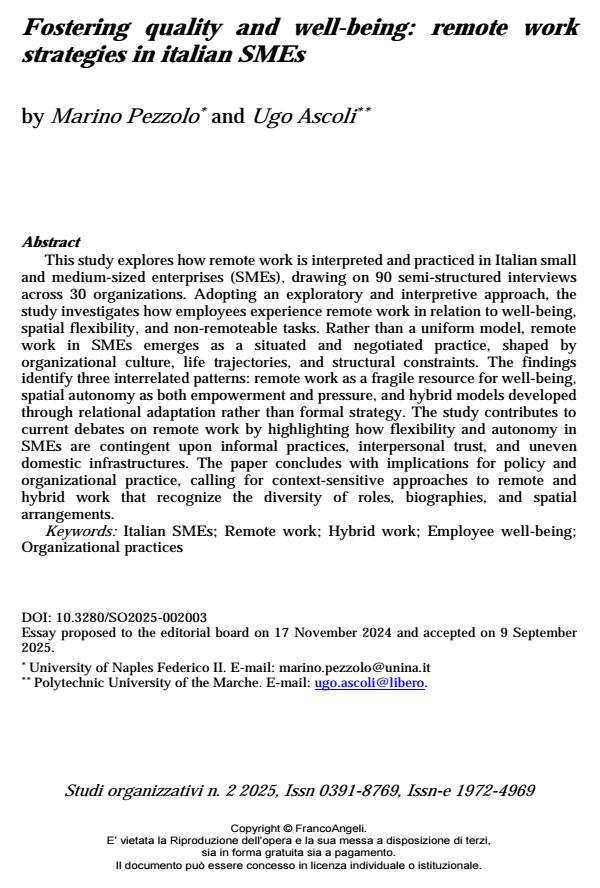
This study explores how remote work is interpreted and practiced in Italian small and medium-sized enterprises (SMEs), drawing on 90 semi-structured interviews across 30 organizations. Adopting an exploratory and interpretive approach, the study investigates how employees experience remote work in relation to well-being, spatial flexibility, and non-remoteable tasks. Rather than a uniform model, remote work in SMEs emerges as a situated and negotiated practice, shaped by organizational culture, life trajectories, and structural constraints. The findings identify three interrelated patterns: remote work as a fragile resource for well-being, spatial autonomy as both empowerment and pressure, and hybrid models developed through relational adaptation rather than formal strategy. The study contributes to current debates on remote work by highlighting how flexibility and autonomy in SMEs are contingent upon informal practices, interpersonal trust, and uneven domestic infrastructures. The paper concludes with implications for policy and organizational practice, calling for context-sensitive approaches to remote and hybrid work that recognize the diversity of roles, biographies, and spatial arrangements.

Questo studio esplora come il lavoro a distanza viene interpretato e praticato nelle piccole e medie imprese (PMI) italiane, attingendo a 90 interviste semi-strutturate in 30 organizzazioni. Adottando un approccio esplorativo e interpretativo, lo studio indaga come i dipendenti vivono il lavoro a distanza in relazione al benessere, alla flessibilità spaziale e alle mansioni non remotizzabili. Piuttosto che un modello uniforme, il lavoro a distanza nelle PMI emerge come una pratica situata e negoziata, plasmata dalla cultura organizzativa, dalle traiettorie di vita e dai vincoli strutturali. I risultati identificano tre modelli correlati: il lavoro a distanza come risorsa fragile per il benessere, l’autonomia spaziale come empowerment e allo stesso tempo pressione, e modelli ibridi sviluppati attraverso l’adattamento relazionale piuttosto che strategie formali. Lo studio contribuisce agli attuali dibattiti sul lavoro a distanza evidenziando come la flessibilità e l’autonomia nelle PMI dipendano da pratiche informali, fiducia interpersonale e infrastrutture domestiche disuguali. L’articolo si conclude con implicazioni per le policy e la pratica organizzativa, richiedendo approcci sensibili al contesto per il lavoro ibrido e a distanza, che riconoscano la diversità dei ruoli, delle biografie e delle configurazioni spaziali.

Parole chiave:PMI italiane; lavoro a distanza; lavoro ibrido; benessere dei dipendenti; pratiche organizzative.

  1. Albano, R., Parisi, T., Tirabeni, L. (2019). “Gli smart workers tra solitudine e collaborazione”, Cambio: Rivista Sulle Trasformazioni Sociali, 9(17): 61-73.
  2. Angelici, M., Profeta, P. (2023). “Smart working: Work flexibility without constraints”, Management Science, 70(3): 1680-1705. DOI: 10.1287/MNSC.2023.4767
  3. Bailey, D.E., Kurland, N.B. (2002). “A review of telework research: Findings, new directions, and lessons for the study of modern work”, Journal of Organizational Behavior, 23(4): 383-400.
  4. Bakker, A.B., Demerouti, E., Sanz-Vergel, A.I. (2014). “Burnout and Work Engagement: The JDR Approach”, Annual Review of Organizational Psychology and Organizational Behavior, 1: 389-411.
  5. Flyvbjerg, B. (2006). “Five Misunderstandings About Case-Study Research”, Qualitative Inquiry, 12(2): 219-245. DOI: 10.1177/1077800405284363
  6. Barabaschi, B., Barbieri, L., Cantoni, F., Platoni, S., Virtuani, R. (2022). “Remote working in Italian SMEs during COVID-19. Learning challenges of a new work organization”, Journal of Workplace Learning, 34(6), 497–512. DOI: 10.1108/JWL-10-2021-0132
  7. Bertolini, S., Fullin, G., Goglio, V., Pacetti, V., Tosi, S., Vercelli, M. (2021). “Il lavoro da remoto alla prova dell’emergenza: implicazioni sociali e organizzative”, Cambio: Rivista Sulle Trasformazioni Sociali, 11(22): 69-82. DOI: 10.36253/CAMBIO-11489
  8. Bonacini, L., Gallo, G., Scicchitano, S. (2021). “Working from home and income inequality: risks of a ‘new normal’ with COVID-19”, Journal of Population Economics, 34(1): 303-360. DOI: 10.1007/S00148-020-00800-7
  9. Brass, D.J., Butterfield, K.D., Skaggs, B.C. (1998). “Relationships and Unethical Behavior: A Social Network Perspective”, The Academy of Management Review, 23(1): 14-31. DOI: 10.2307/259097
  10. Bronzini, M., Torre, T., Sarti, D., Cori, E. (2022). “Isolamento professionale e inclusione nell’esperienza del lavoro da remoto durante la pandemia in Italia”, Prisma: Economia, Società, Lavoro, 1: 68-89. DOI: 10.3280/PRI2022-001005
  11. Cappelli, P. (2021). The Future of the Office: Work from Home, Remote Work, and the Hard Choices We All Face. Philadelphia: Wharton School Press.
  12. Catturi, G. (2021). “Potere aziendale, pandemia e smart working”, Management Control, 31(2): 16-38. DOI: 10.3280/MACO2021-002-S1002
  13. Cellini, M., Pisacane, L., Crescimbene, M., Di Felice, F. (2021). “Exploring Employee Perceptions towards Smart Working during the COVID-19 Pandemic: a Comparative Analysis of Two Italian Public Research Organizations”, Public Organization Review, 21(4): 815-833. DOI: 10.1007/S11115-021-00559-9
  14. Corbetta, P. (2014). Metodologia e tecniche della ricerca sociale. Bologna: Il Mulino.
  15. Costa, G.G., Bertoni, I. (2020). “Smart-working forzato e massivo durante l’emergenza Covid-19 ed impatti sulla creatività individuale: uno studio empirico”, Economia e Società Regionale, 38(2): 21-27. DOI: 10.3280/ES2020-002003
  16. De Masi, D. (2020). Smart working: La rivoluzione del lavoro intelligente. Venezia: Marsilio.
  17. Del Baldo, M. (2015). “Beyond CSR: The virtues-based approach to corporate responsibility and sustainability in Italian SMEs”, International Journal of Environment and Health, 7(4): 394-414. DOI: 10.1504/IJENVH.2015.077132
  18. Di Matteo, D., La Regina, R., Mariotti, I., Militello, E. (2021). “Which Determinants for South Working? A New Development Proposal for the South, Inner Areas and the Country”, Rivista Economica Del Mezzogiorno, 35(4): 678-701. DOI: 10.1432/104472
  19. Dornelles, J. de A., Ayala, N.F., Frank, A.G. (2022). “Smart Working in Industry 4.0: How digital technologies enhance manufacturing workers’ activities”, Computers & Industrial Engineering, 163: 107804. DOI: 10.1016/J.CIE.2021.107804
  20. Ebojoh, S., Högberg, K. (2024). “Exploring Leadership in the Hybrid Workplace”, International Journal of Advanced Corporate Learning, 17(4): 16-41. DOI: 10.3991/IJAC.V17I4.50857
  21. Felstead, A. (2022). Remote Working: A Research Overview. London: Routledge.
  22. Felstead, A., Henseke, G. (2017). “Assessing the growth of remote working and its consequences for effort, well-being and work-life balance”, New Technology, Work and Employment, 32(3): 195-212. DOI: 10.1111/NTWE.12097
  23. Ferrara, B., Pansini, M., De Vincenzi, C., Buonomo, I., Benevene, P. (2022). “Investigating the Role of Remote Working on Employees’ Performance and Well-Being: An Evidence-Based Systematic Review”, International Journal of Environmental Research and Public Health, 19(19): 12373. DOI: 10.3390/IJERPH191912373
  24. Frigotto, M.L., Tomaselli, A., Solari, L., Gabbriellini, S. (2021). “Lo smart working nel panorama italiano: un’analisi della letteratura”, Studi Organizzativi, 32(2): 9-37. DOI: 10.3280/SO2021-002001
  25. Gandini, A. (2015). “The rise of coworking spaces: A literature review”, Ephemeral, 1: 193-205.
  26. Ganotakis, P., Angelidou, S., Saridakis, C., Piperopoulos, P., Dindial, M. (2023). “Innovation, digital technologies, and sales growth during exogenous shocks”, Technological Forecasting and Social Change, 193: 122656. DOI: 10.1016/J.TECHFORE.2023.122656
  27. Garzoni, A., De Turi, I., Secundo, G., Del Vecchio, P. (2020). “Fostering digital transformation of SMEs: a four levels approach”, Management Decision, 58(8): 1543-1562. DOI: 10.1108/MD-07-2019-0939
  28. Gould, S.J.J., Rudnicka, A., Cook, D., Cecchinato, M.E., Newbold, J.W., Cox, A.L. (2023). “Remote Work, Work Measurement and the State of Work Research in Human-Centred Computing”, Interacting with Computers, 35(5): 725-734. DOI: 10.1093/IWC/IWAD014
  29. Great Place to Work. (2023). Great Place to Work Italia. Available at: https://www.greatplacetowork.it/classifiche-migliori-aziende
  30. ISTAT. (2019). Descrizione dei dati geografici dei confini delle unità amministrative a fini statistici. Available at: https://www.istat.it/notizia/confini-delle-unita-amministrative-a-fini-statistici-al-1-gennaio-2018-2/
  31. Izak, M., Reissner, S., Shortt, H. (2023). “Flexible lives: spatial, temporal, and behavioural boundaries in a fluid world of work and home”, Culture and Organization, 29(5): 375-379. DOI: 10.1080/14759551.2023.2211375
  32. Januszkiewicz, K. (2019). “Flexibility and work - life balance - opportunities and threats”, Journal of Positive Management, 10(3): 31-44. DOI: 10.12775/JPM.2019.006
  33. Kawaguchi, D., Motegi, H. (2021). “Who Can Work from Home? The Roles of Job Tasks and HRM Practices”, Journal of The Japanese and International Economies, 62: 101162. DOI: 10.1016/J.JJIE.2021.101162
  34. Kniffin, K.M., Narayanan, J., Anseel, F., Antonakis, J., Ashford, S.P., Bakker, A.B., Bamberger, P., Bapuji, H., Bhave, D.P., Choi, V.K., Creary, S.J., Demerouti, E., Flynn, F.J., Gelfand, M.J., Greer, L.L., Johns, G., Kesebir, S., Klein, P.G., Lee, S.Y., ... Vugt, M.V. (2021). “COVID-19 and the workplace: Implications, issues, and insights for future research and action”, American Psychologist, 76(1): 63-77. DOI: 10.1037/AMP0000716
  35. Lee, S.M., Trimi, S. (2021). “Convergence innovation in the digital age and in the COVID-19 pandemic crisis”, Journal of Business Research, 123: 14-22. DOI: 10.1016/J.JBUSRES.2020.09.041
  36. Leonardi, P.M. (2020). “COVID-19 and the New Technologies of Organizing: Digital Exhaust, Digital Footprints, and the Rise of Remote Work”, Journal of Management Studies, 58(1): 249-253. DOI: 10.1111/JOMS.12648
  37. Leonelli, S., Campagnolo, D., Gianecchini, M. (2024). “Entrepreneur and organizational resilience: A multilevel perspective on Italian SMEs”, Journal of Small Business Management, 62(14): 2893-2917. DOI: 10.1080/00472778.2024.2351483
  38. Maino, F., Razetti, F. (2020). “Iniziative di welfare aziendale, smart working e responsabilità sociale: piccole e grandi organizzazioni di fronte alle sfide del COVID-19”, Quaderni Di Ricerca Sull’artigianato, 8(2): 215-247. DOI: 10.12830/98468
  39. Marino, L., Capone, V., Zammitti, A., Lodi, E., Martos Martínez, Á. (2021). “Smart Working and Well-Being before and during the COVID-19 Pandemic: A Scoping Review”, European Journal of Investigation in Health, Psychology and Education, 11(4): 1516-1536. DOI: 10.3390/EJIHPE11040108
  40. Mariotti, I., Di Marino, M., Bednár, P. (2022). The COVID-19 Pandemic and the Future of Working Spaces. London: Routledge.
  41. Molino, M., Ingusci, E., Signore, F., Manuti, A., Giancaspro, M.L., Russo, V., Zito, M., Cortese, C.G. (2020). “Wellbeing Costs of Technology Use during Covid-19 Remote Working: An Investigation Using the Italian Translation of the Technostress Creators Scale”, Sustainability, 12(15): 5911-5911. DOI: 10.3390/SU12155911
  42. Pacetti, V., Rossi, P., Romens, A.I. (2023). “To remote, or not to remote, that is the question. Companies and unions facing hybrid remotisation of work”, Stato e Mercato, 43(3): 421-449. DOI: 10.1425/112849
  43. Palumbo, R., Flamini, G., Gnan, L., Pellegrini, M.M. (2023). “Looking for meanings at work: unraveling the implications of smart working on organizational meaningfulness”, International Journal of Organizational Analysis, 31(3): 624-645. DOI: 10.1108/IJOA-04-2021-2708
  44. Pezzolo, M. (2024). “Il punto di vista della working class sul ruolo dello smart working: un caso studio”, In: Corazza L., Di Salvatore L., Tantillo F., Zucaro R. (eds) Smart working, tempi di vita e del lavoro e riequilibrio demografico dei territori, Vol. 66, pp. 62-73. Roma: Fondazione Giacomo Brodolini,
  45. Pierrette, M., Parizet, E., Chevret, P., Chatillon, J. (2014). “Noise effect on comfort in open-space offices: Development of an assessment questionnaire”, Ergonomics, 58(1): 96-106. DOI: 10.1080/00140139.2014.961972
  46. Rinaldini, M., Montanari, F., Rodighiero, S., Scapolan, A.C. (2021). “Il time crafting negli spazi di coworking”, Studi Organizzativi, 23(2): 67-92. DOI: 10.3280/SO2021-002003
  47. Santoni, C., Crespi, I. (2022). “Reconciling family and work between smart working and diversity management. A reflection on practices and new semantics”, Autonomie Locali e Servizi Sociali, 45(1): 45-66. DOI: 10.1447/104028
  48. Sardi, A., Sinicropi, S., Garengo, P. (2021). “(Re)thinking work in SMEs”, Impresa Progetto - Electronic Journal of Management, 1: 01-18. DOI: 10.15167/1824-3576/IPEJM2021.1.1348
  49. Schein, E.H., Schein, P.A. (2016). Organizational Culture and Leadership (5th ed.). Hoboken, NJ: Wiley
  50. Singh, P., Bala, H., Dey, B.L., Filieri, R. (2022). “Enforced remote working: The impact of digital platform-induced stress and remote working experience on technology exhaustion and subjective wellbeing”, Journal of Business Research, 151: 269-286. DOI: 10.1016/J.JBUSRES.2022.07.002
  51. Spence, L.J. (1999). “Does size matter? The state of the art in small business ethics”, Business Ethics: A European Review, 8(3): 173-181. DOI: 10.1111/1467-8608.00144
  52. Spence, L.J., Rutherfoord, R. (2003). “Small Business and Empirical Perspectives in Business Ethics: Editorial”, Journal of Business Ethics, 47(1): 1-5. DOI: 10.1023/A:1026205109290
  53. Sullivan, C. (2012). Remote working and work-life balance. In: N.P. Reilly; M.J. Sirgy and C.A. Gorman (eds.) Work and quality of life: Ethical practices in organizations. pp. 275-290. London: Springer.
  54. Thompson, B.Y. (2018). “Digital Nomads: Employment in the Online Gig Economy”, Glocalism: Journal of Culture, Politics and Innovation, 8(1). DOI: 10.12893/GJCPI.2018.1.11
  55. Tirabeni, L., Miele, F. (2020). “Tecnologie digitali e potere nelle organizzazioni: dinamiche di controllo ed effetto ‘contraccolpo’”, Studi Organizzativi, 22(1): 9-37. DOI: 10.3280/SO2020-001001
  56. Toscano, F., Zappalà, S. (2020). “Smart working in Italy: Origin, diffusion and potential outcomes”, Psicologia Sociale, 15(2): 203-223. DOI: 10.1482/96843
  57. Urrila, L., Siiriäinen, A., Mäkelä, L., Kangas, H. (2025). “Sense of belonging in hybrid work settings”, Journal of Vocational Behavior, 157: 104096.
  58. Vrontis, D., Basile, G., Simona Andreano, M., Mazzitelli, A., Papasolomou, I. (2020). “The profile of innovation driven Italian SMEs and the relationship between the firms’ networking abilities and dynamic capabilities”, Journal of Business Research, 114: 313-324. DOI: 10.1016/J.JBUSRES.2020.04.009
  59. Wang, B., Liu, Y., Qian, J., Parker, S.K. (2021). “Achieving Effective Remote Working During the COVID-19 Pandemic: A Work Design Perspective”, Applied Psychology, 70(1): 16-59. DOI: 10.1111/APPS.12290
  60. Welfare PMI Index. (2023). “Welfare aziendale per le Piccole e Medie Imprese”. Available at: https://www.welfareindexpmi.it/welfare-index-pmi/
  61. Yin, R.K. (2018). Case study research and applications: design and methods (6th ed.). Thousand Oaks, CA: Sage Publications.

Marino Pezzolo, Ugo Ascoli, Fostering quality and well-being: remote work strategies in italian SMEs in "STUDI ORGANIZZATIVI " 2/2025, pp 59-89, DOI: 10.3280/SO2025-002003