Eco-social work, apprendimento collettivo e progettazione sociale. Primi elementi per un approccio trasformativo

Titolo Rivista ECONOMIA E SOCIETÀ REGIONALE
Autori/Curatori Andrea Conficoni, Marco Emilio
Anno di pubblicazione 2025 Fascicolo 2025/2
Lingua Italiano Numero pagine 31 P. 93-123 Dimensione file 398 KB
DOI 10.3280/ES2025-002008
Il DOI è il codice a barre della proprietà intellettuale: per saperne di più clicca qui

Qui sotto puoi vedere in anteprima la prima pagina di questo articolo.

Se questo articolo ti interessa, lo puoi acquistare (e scaricare in formato pdf) seguendo le facili indicazioni per acquistare il download credit. Acquista Download Credits per scaricare questo Articolo in formato PDF
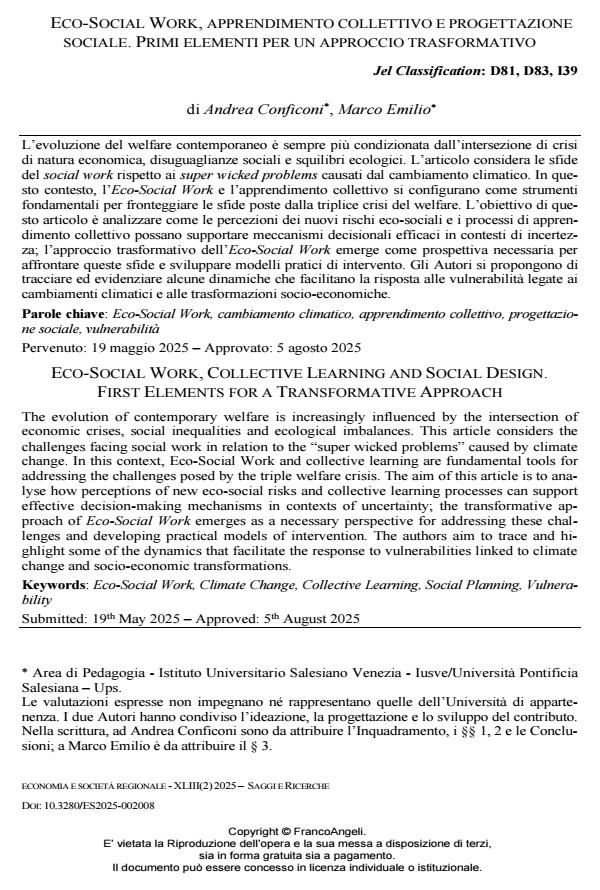
Anteprima articolo

FrancoAngeli è membro della Publishers International Linking Association, Inc (PILA)associazione indipendente e non profit per facilitare (attraverso i servizi tecnologici implementati da CrossRef.org) l’accesso degli studiosi ai contenuti digitali nelle pubblicazioni professionali e scientifiche

L’evoluzione del welfare contemporaneo è sempre più condizionata dall’intersezione di crisi di natura economica, disuguaglianze sociali e squilibri ecologici. L’articolo considera le sfide del social work rispetto ai super wicked problems causati dal cambiamento climatico. In questo contesto, l’EcoSocial Work e l’apprendimento collettivo si configurano come strumenti fondamentali per fronteggiare le sfide poste dalla triplice crisi del welfare. L’obiettivo di questo articolo è analizzare come le percezioni dei nuovi rischi ecosociali e i processi di apprendimento collettivo possano supportare meccanismi decisionali efficaci in contesti di incertezza; l’approccio trasformativo dell’EcoSocial Work emerge come prospettiva necessaria per affrontare queste sfide e sviluppare modelli pratici di intervento. Gli Autori si propongono di tracciare ed evidenziare alcune dinamiche che facilitano la risposta alle vulnerabilità legate ai cambiamenti climatici e alle trasformazioni socioeconomiche.

Parole chiave:EcoSocial Work, cambiamento climatico, apprendimento collettivo, progettazione sociale, vulnerabilità

Jel codes:D81, D83, I39

  1. Branca P. (2000). Organizzare la partecipazione o partecipare l’organizzazione?. Animazione Sociale, XXX(3): 4756.
  2. Adame B.J., Mattson L.D. (2025). Vested Interest Theory as a Framework for Understanding Anthropogenic Climate Change Risk Perceptions. Health Communication, 40(4): 598607. DOI: 10.1080/10410236.2024.2357443
  3. Adger W.N. (2000). Social and ecological resilience: are they related?. Progress in Human Geography, 24(3): 347364. DOI: 10.1191/030913200701540465
  4. Aguiton C. (2001). Il mondo ci appartiene. I nuovi movimenti sociali. Milano: Feltrinelli.
  5. Aldern C.P. (2024). The weight of nature: how a changing climate change our brains. New York: Dutton. Trad. it. (2025). Se il tempo è matto. Come il cambiamento climatico cambia la nostra mente e il nostro corpo. Sansepolcro (AR): Aboca Edizioni.
  6. Andreoletti M., Chiffi D., Taebi B. (2022). Introduction: Severe Uncertainty in Science, Medicine, and Technology. Perspectives on Science, 30(2): 201209.
  7. Banks S., Bertotti T., Cairns L., Shears J., Shum M., Sobocan A.M., Strom K., Úriz M.J. (2024). Social work beyond the pandemic: Exploring social work values for a new ecosocial world. International Social Work, 67(4): 890904. DOI: 10.1177/00208728241227062
  8. Bateson G. (1972). Steps to an Ecology of Mind. New York: Chandler. Trad. it. (1977). Verso un’ecologia della mente. Milano: Adelphi.
  9. Bateson G. (1979). Mind and Nature. A necessary Unit. New York: Dutton. Trad. it. (1984). Mente e Natura. Un’unità necessaria. Milano: Adelphi.
  10. Belchior Rocha H. (2018). Social Work Practices and the Ecological Sustainability of Socially Vulnerable Communities. Sustainability, 10(5).
  11. Bell K. (2022). Postanthropocentric Social Work. In: Hölscher D. et al., Eds. Social Work Theory and Ethics. DOI: 10.1007/9789811630590_61
  12. Besthorn F.H. (2002). Radical Environmentalism and the Ecological Self: Rethinking the Concept of SelfIdentity or Social Work Practice. Journal of Progressive Human Services, 13(1): 5372.
  13. Besthorn F.H. (2013). Radical equalitarian ecological justice: A social work call to action. In: Gray M., Coates J., Hetherington T., Eds. Environmental Social Work. London: Routledge.
  14. Besthorn F.H. (2014). Ecopsycology, Meet Ecosocialwork: What You Might Not Know – A Brief Overview and Reflective Comment. Ecopsychology, 6(4): 199206.
  15. Boetto H. (2017). A Transformative EcoSocial Model: Challenging Modernist Assumptions in Social Work. The British Journal of Social Work, 47(1): 48 67.
  16. Boetto H. (2025). Promoting sustainable development in the Australian MurrayDarling basin: Envisioning an EcoSocial work approach. Sustainable Development, 33(1): 904915.
  17. Boetto H., Närhi K., Bowles W. (2022). Creating ‘Communities of Practice’ to Enhance Ecosocial Work: A Comparison between Finland and Australia. The British Journal of Social Work, 52(8): 48154835.mate adaptation policy process. Critical Policy Studies, 8(4), 407426. DOI: 10.1080/19460171.2014.950304
  18. Bonetti M., Villa M. (2014). In the shadow of legalism: understanding community participation in an overlybureaucratic context. Critical policy studies, 8 (4). DOI: 10.1080/19460171.2014.950305
  19. Bonzanigo L., Bojovic D., Maziotis A., Giupponi C. (2016a). Agricultural policy informed by farmers’ adaptation experience to climate change in Veneto, Italy. Regional Environmental Change, 16(1): 245258.
  20. Bonzanigo L., Giupponi C., Balbi S. (2016). Sustainable tourism planning and climate change adaptation in the Alps: a case study of winter tourism in mountain communities in the Dolomites. Journal of Sustainable Tourism, 24(4): 637652. DOI: 10.1080/09669582.2015.1122013
  21. Branca P. (2001). Cambiare/conservare: le trappole neutralizzanti nella ricercaazione. Animazione Sociale, XXXI(5): 3544.
  22. Butler J. (2004). Precarious life: the powers of mourning and violence. London: Verso. Butler J. (2009). Frames of war: when il life grievable?. London: Verso.
  23. Butler J., Gambetti Z., Sabsay L., Eds. (2016). Vulnerability in resistance. Durham and London: Duke University Press.
  24. Casareale C., Marchetti N., Colocci A. (2023). Sense of Belonging and Response to Climate Change: How the Relation with Local Territories Influences Climate Resilience. In: Dahiya B., de Pascale F., De Pietro O., Farabollini P., Lugeri F.R., Mercatanti L., Eds. Disaster Resilience and Human Settlements: Emerging Perspectives in the 302. DOI: 10.1007/9789819922482_13
  25. Chertkovskaya E., Johnsen C.G., Stoborod K. (2017). Hosting Emergence with Hospitality. Ephemera: Theory & politics in organization, 17(4): 733749.
  26. Coates J. (2003). Ecology and Social Work: Towards a New Paradigm. Halifax: Fernwood Publishing.
  27. Crano W.D. (1995). Attitude strength and vested interest. In: Petty R.E., Krosnick J.A., Eds. Attitude strength: Antecedents and consequences. Mahwah, NJ: Lawrence Erlbaum.
  28. Cucca R., Kazepov Y., Villa M. (2023). Towards a Sustainable Welfare System? The Challenges and Scenarios of Ecosocial Transitions. Politiche Sociali. Social Policies, 1: 326. DOI: 10.7389/107136
  29. della Porta D., Eds. (2015). Global Justice Movement: Crossnational and Transnational Perspectives. London: Routledge.
  30. Descola P. (2005). Pardelà nature et culture. Paris: Gallimard. Trad. it. (2021). Oltre natura e cultura. Milano: Raffaello Cortina Editore.
  31. Dominelli L. (2002a). AntiOppressive Social Work Theory and Practice. New York: Palgrave Macmillan.
  32. Dominelli L. (2002b). Feminist Social Work Theory and Practice. New York: Palgrave Macmillan.
  33. Dominelli L. (2012). Green Social Work: From Environmental Crises to Environmental Justice. Cambridge: Polity Press.
  34. Dominelli L. (2024), Social Work Practice During Times of Disaster. A Transformative Green Social Work Model for Theory, Education and Practice in Disaster Interventions. London: Routledge.
  35. Efstathiou S. (2016). Is it possible to give scientific solutions to Grand Challenges? On the idea of grand challenges for life science research. Studies in History and Philosophy of Biological and Biomedical Sciences, 56: 4861.
  36. Efstathiou S., Mirmalek Z. (2014). Interdisciplinarity in action. In: Montuschi E., Cartwright N., Eds. Philosophy of social science: A new introduction. Oxford: Oxford University Press.
  37. Emilio M. (2022). Fragilità ontologicamente resistenti. In: Crocetta C., Emilio M., Miatto E., a cura di. Fragile o vulnerabile. Traiettorie per una semantica interdisciplinare. Lecce: Pensa Multimedia.
  38. Emilio M. (2024). The Collective Challenge of Interlocked Risks. Teoria. Rivista Di Filosofia, 44(2): 4157.
  39. Engster D. (2019). Care Ethics, Dependency, and Vulnerability. Ethics and Social Welfare, 13(2): 100114. DOI: 10.1080/17496535.2018.1533029
  40. Eriksen T.H. (2016). Overheating: An Anthropology of Accelerated Change. London: Pluto Press. Trad. it. (2017). Fuori controllo. Un’antropologia del cambiamento accelerato. Torino: Einaudi.
  41. Farnsworth K. (2013). Bringing Corporate Welfare In. Journal of Social Policy, 42(1): 122. DOI: 10.1017/S0047279412000761
  42. Nöjd T. (2016). A systematic literature review on social work considering environmental issues and sustainable development <https://jyx.jyu.fi/handle/ 123456789/52488>.
  43. Farnsworth K., Irving Z. (2012). Varieties of crisis, varieties of austerity: social policy in challenging times. Journal of Poverty and Social Justice, 20(2): 133147. DOI: 10.1332/175982712X652041
  44. Ferdinand M. (2019). Une écologie décoloniale. Penser l’écologie depuis le monde caribéen. Paris: Èditions du Seuil. Trad. it. (2024). Un’ecologia decoloniale. Pensare l’ecologia dal mondo caraibico. Napoli: Tamu.
  45. Fineman M.A. (2010), The Vulnerable Subject and the Responsive State. Emory
  46. L.J. 60(2): 251275 <https://scholarlycommons.law.emory.edu/elj/vol60/ iss2/1>.
  47. Forti M. (2004). La signora di Narmada. Le lotte degli sfollati ambientali nel Sud del mondo. Milano: Feltrinelli.
  48. Ghelfi A. (2023). Ecologia politica in mondi piùcheumani. In: Pellizzoni L., a cura di. Introduzione all’ecologia politica. Bologna: il Mulino.
  49. Gilligan J.M., Vandenbergh M.P. (2020). Beyond Wickedness: Managing Complex Systems and Climate Change. Vanderbilt Law Research Paper. Vanderbilt Law Review, 2047.
  50. Girardi G. (2002). Resistenza e alternativa al neoliberismo e ai terrorismi. Milano: Edizioni Punto Rosso.
  51. Gough I. (2016). Foreword. In: Koch M., Mont O., Eds. Sustainability and the Political Economy of Welfare. London: Routledge.
  52. Gough I., Meadowcroft J. (2011). Decarbonizing the welfare state. In: Dryzek J.S., Norgaard R.B., Schlosberg D., Eds. The Oxford Handbook of Climate Change and Society. Oxford handbooks in politics & international relations. Oxford: Oxford University Press.
  53. Helgeson C. (2020). Structuring decisions under deep uncertainty. Topoi, 39(2): 257269.
  54. Hindriks F. (2024). Sustainable Institutions: How to Secure Values. The Journal of Ethics, 28(2), 287308.
  55. Hirvilammi T., Häikiö L., Johansson H., Koch M., Perkiö J. (2023). Social Policy in a Climate Emergency Context: Towards an Ecosocial Research Agenda. Journal of Social Policy, 52(1): 123. DOI: 10.1017/S0047279422000721
  56. Hocking V.T., Brown V.A., Harris J.A. (2016). Tackling wicked problems through collective design. Intelligent Buildings International, 8(1): 2436. DOI: 10.1080/17508975.2015.1058743
  57. Hulme M. (2009). Why We Disagree about Climate Change: Understanding Controversy, Inaction and Opportunity. Cambridge: Cambridge University Press.
  58. Hulme M. (2013). Exploring Climate Change through Science and in Society. An anthology of Mike Hulme’s essays, interviews and speeches. Abingdon: Routledge.
  59. Hulme M. (2015). Climate and its changes: a cultural appraisal. Geo: Geography and Environment, 2(1): 111.
  60. Hulme M. (2023). Climate Change Isn’t Everything: Liberating. Climate Politics from Alarmism. Cambridge: Polity Press.
  61. Ingold T. (2016). Ecologia della cultura. Milano: Meltemi.
  62. Ipcc (2023). Climate Change Synthesis Report. Contribution of Working Groups I, II and III to the Sixth Assessment Report of the Intergovernmental Panel on Climate Change (First). Intergovernmental Panel on Climate Change (Ipcc). DOI: 10.59327/IPCC/AR69789291691647
  63. Johansson H., Khan J., Hildingsson R. (2016). Climate change and the welfare state: Do we see a new generation of social risks emerging?. In: Koch M., Mont O., Eds. Sustainability and the political economy of welfare. London: Routledge.
  64. Keller K., Helgeson C., Srikrishnan V. (2021). Climate Risk Management. Annual Review of Earth and Planetary Sciences, 49: 95116.
  65. Kenter J.O., O’Connor S. (2022). The Life Framework of Values and living as nature; towards a full recognition of holistic and relational ontologies. Su stainability Science, 17: 25292542.
  66. Koch M., Mont O., Eds. (2016). Sustainability and the political economy of welfare. London: Routledge.
  67. Kohn E. (2013). How forests think: Toward an Anthropology Beyond the Human. University of California Press. Trad. it. (2021). Come pensano le foreste. Per un’antropologia oltre l’umano. Milano: nottetempo.
  68. Kothari A., Salleh A., Escobar A., Demaria F., Acosta A., Eds. (2019). Pluriverse. A PostDevelopment Dictionary. New Delhi: Tulika Books. Trad. it. (2021). Pluriverso. Dizionario del postsviluppo. Napoli: Orthotes Editrice.
  69. Lanzara G.F. (1985). La progettazione come indagine: modelli cognitivi e strategie d’azione. Rassegna Italiana di Sociologia, 26(3): 335368.
  70. Latour B. (1999). Politiques de la nature. Paris: Éditions La Découverte. Trad. it. (2000). Le politiche della natura. Per una democrazia delle scienze. Milano: Raffaello Cortina Editore.
  71. Latour B. (2005). Reassembling the Social: An Introduction to ActorNetwork Theory. Oxford: Oxford University Press. Trad. it. (2022). Riassemblare il sociale. ActorNetwork Theory. Milano: Meltemi.
  72. Leiserowitz A., Maibach E., RoserRenouf C., Feinberg G., Rosenthal S. (2016). Climate change in the American mind. New Haven: Yale University and George Mason University.
  73. Leone L., Prezza M. (2003). Costruire e valutare i progetti nel sociale. Milano: FrancoAngeli.
  74. Levin K., Cashore B., Bernstein S., Auld G. (2012). Overcoming the tragedy of super wicked problems: Constraining our future selves to ameliorate global climate change. Policy Sciences, 45(2): 123152.
  75. Lloyd M., Eds. (2015). Butler and Ethics. Edinburgh: Edinburgh University Press. Lupu L. (2019). The concept of social risk: A geographical approach. In Quaestiones Geographicae, 38(4): 513.
  76. Malabou C. (2009). Ontologie de l’accident. Essai sur la plasticité destructrice. Paris: Édition Léo Scheer.
  77. Manghi S., a cura di (1998). Attraverso Bateson. Ecologia della mente e relazioni sociali. Milano: Raffaello Cortina Editore.
  78. Mann M.E. (2021). The New Climat War – The Fight to Take Back Our Planet. London: Scribe. Trad. it. (2021). La nuova guerra del clima. La battaglia per riprenderci il pianeta. Milano: Edizioni Ambiente.
  79. Martínez Alier J. (2002). The Environmentalism of the Poor. London: Elgar. Trad. it. (2009). L’ecologia dei poveri. Milano: Jaca Book.
  80. Martínez Alier J., Anguelovski I., Bond P., Del Bene D. (2014). Between Activism and Science: Grassroots Concepts for Sustainability Coined by Environmental Justice Organizations. Journal of Political Ecology, 21(1A): 19 60.
  81. Matutini E., a cura di (2023). Ecosocial work. Politica e lavoro sociale nella crisi ecologica. Varazze: Pm Edizioni.
  82. Matutini E., Busacca M., Da Roit B. (2023). Ready, Steady, Go? Obstacles to the Spread of EcoSocial Work Approaches: An Italian Case Study. Sustainability, 15, 3050.
  83. Mittelstrass J. (2011). On transdisciplinarity. Trames, 15(4): 329338.
  84. Morton T. (2013). Hyperobjects. Philosophy and Ecology after the End of the World. Minneapolis: University of Minnesota Press. Trad. it. (2018). Iperoggetti. Filosofia ed ecologia dopo la fine del mondo. Roma: Nero.
  85. Nijland F., Vermeulen M. (2025). Constructing collective learning. Social Sciences & Humanities Open, 11, 101260.
  86. O’Connor S., Kenter J.O. (2019). Making intrinsic values work; integrating intrinsic values of the morethanhuman world through the Life Framework of Values. Sustainability Science, 14: 12471265.
  87. Osborne P. (2015). Problematizing disciplinarity, transdisciplinary problematics. Theory, Culture & Society, 32(56): 335. DOI: 10.1177/0263276415592245
  88. Pagliacci F., Salpina D. (2024). Producer, farm, production or perception? What really drives adaptation to climate change in the case of producers of Geographical Indications?. BioBased and Applied Economics, 3(3): 265283.
  89. Peters K.E. (2018). Living with the Wicked problem of climate change. Zygon: Journal of Religion and Science, 53(2): 427442. 15101521.
  90. Pleyers G. (2010). AlterGlobalization: Becoming Actors in a Global Age. Cambridge: Polity Press.
  91. Quesada J., Hart L.K., Bourgois P. (2011). Structural Vulnerability and Health: Latino Migrant Laborers in the United States. Medical Anthropology, 30(4): 339362. DOI: 10.1080/01459740.2011.576725
  92. Rambaree K., Powers M.C.F., Smith R.J., Eds. (2023). Ecosocial work in community practice. Embracing Ecosocial worldviews and promoting sustainability. London: Routledge.
  93. Ramsay S., Boddy J. (2017). Environmental Social Work: A concept Analysis. British Journal of Social Work, 47: 6886. <http://www.jstor.org/stable/ 26363622>.
  94. Ricart S., Gandolfi C., Castelletti A. (2025). What drives farmers’ behavior under climate change? Decoding risk awareness, perceived impacts, and adaptive capacity in northern Italy. Heliyon, 11(1)
  95. Rockström J. et al. (2009). Planetary Boundaries: Exploring the Safe Operating Space for Humanity. Ecology and Society, 14(2). Jstor, <http://www.jstor. org/stable/26268316>.
  96. Rocque R.J., Beaudoin C., Ndjaboue R., Cameron L., PoirierBergeron L., PoulinRheault R.A., Fallon C., Tricco A.C., Witteman H.O. (2021). Health effects of climate change: An overview of systematic reviews. BMJ Open, 11(6), e046333.
  97. Salpina D., Pagliacci F. (2022). Are We Adapting to Climate Change? Evidence from the HighQuality AgriFood Sector in the Veneto Region. Sustainability, 14(18).
  98. Searle J.R. (2010). Making the Social World: The Structure of Human Civilization. Oxford: Online Edition Oxford Academic.
  99. Shteynberg G., Hirsh J.B., Bentley R.A., Garthoff J. (2020). Shared Worlds and Shared Minds: A Theory of Collective Learning and a Psychology of Common Knowledge. Psychological Review, 127(5): 918931.56. DOI: 10.1177/10888683211065921
  100. Siza T. (2018). Manuale di progettazione sociale, Milano: FrancoAngeli.
  101. SmithCarrier T., MacArthur J. (2023). The state of ecosocial work training in Canada: Transformative praxis for climate constrained futures. International Social Work, 67(4): 905921.
  102. Thiault L., Jupiter S.D., Johnson J.E., Cinner J.E., Jarvis R.M., Heron S.F., Maina J.M., Marshall N.A., Marshall P.A., Claudet J., (2021). Harnessing the potential of vulnerability assessments for managing socialecological systems. Ecology and Society, 26(2):1. DOI: 10.5751/ES12167260201
  103. Truell R., Banks S. (2021). From ethical challenges on the social work frontline to joint action for a new ecosocial world. Journal of Social Intervention: Theory and Practice, 30(5): 826.
  104. Villa M. (2020). Crisi ecologica e nuovi rischi sociali: verso una ricerca integrata in materia di politica sociale e sostenibilità. In: Tomei G., a cura di. Le reti della conoscenza nella società globale. Roma: Carocci.
  105. Villa M. (2022). La comprensione ecologica deve essere ecologica: note metodologiche su inerenza, immanenza e incorporazione dei processi conoscitivi. In: Perullo N., Fadini U., a cura di. Storia, natura, ecologia. Scritti per Manlio Iofrida. Modena: Mucchi Editore.
  106. Villa M. (2023). La sfida del welfare sostenibile. In: Pellizzoni L., a cura di. Introduzione all’ecologia politica. Bologna: il Mulino.
  107. Wisner B., Blaikie P., Cannon T., Davis I. (2004). At Risk: Natural Hazards, People’s Vulnerability and Disasters (2nd ed.). London: Routledge. DOI: 10.4324/9780203714775
  108. Wu H., Greig M., Bryan C. (2022). Promoting Environmental Justice and Sustainability in Social Work Practice in Rural Community: A Systematic Review. Social Sciences, 11(8): 336.
  109. Zengiaro N. (2024). En búsqueda de los límites de la semiótica: desde el umbral inferior de Eco hasta la ecosemiótica materialista. Metatheoria – Revista De Filosofía E Historia De La Ciencia, 14(2): 7592.
  110. Zimmermann M.A. (1999). Empowerment e partecipazione della comunità. Animazione sociale, 2: 1024.

Andrea Conficoni, Marco Emilio, Eco-social work, apprendimento collettivo e progettazione sociale. Primi elementi per un approccio trasformativo in "ECONOMIA E SOCIETÀ REGIONALE " 2/2025, pp 93-123, DOI: 10.3280/ES2025-002008