From ambition to reality: Exploring diffusion patterns of battery electric cars in Italy

Titolo Rivista ECONOMICS AND POLICY OF ENERGY AND THE ENVIRONMENT
Autori/Curatori Monica Bonacina, Mert Demir, Antonio Sileo, Angela Zanoni
Anno di pubblicazione 2025 Fascicolo 2025/2
Lingua Inglese Numero pagine 23 P. 109-131 Dimensione file 501 KB
DOI 10.3280/EFE2025-002006
Il DOI è il codice a barre della proprietà intellettuale: per saperne di più clicca qui

Qui sotto puoi vedere in anteprima la prima pagina di questo articolo.

Se questo articolo ti interessa, lo puoi acquistare (e scaricare in formato pdf) seguendo le facili indicazioni per acquistare il download credit. Acquista Download Credits per scaricare questo Articolo in formato PDF
Anteprima articolo

FrancoAngeli è membro della Publishers International Linking Association, Inc (PILA)associazione indipendente e non profit per facilitare (attraverso i servizi tecnologici implementati da CrossRef.org) l’accesso degli studiosi ai contenuti digitali nelle pubblicazioni professionali e scientifiche

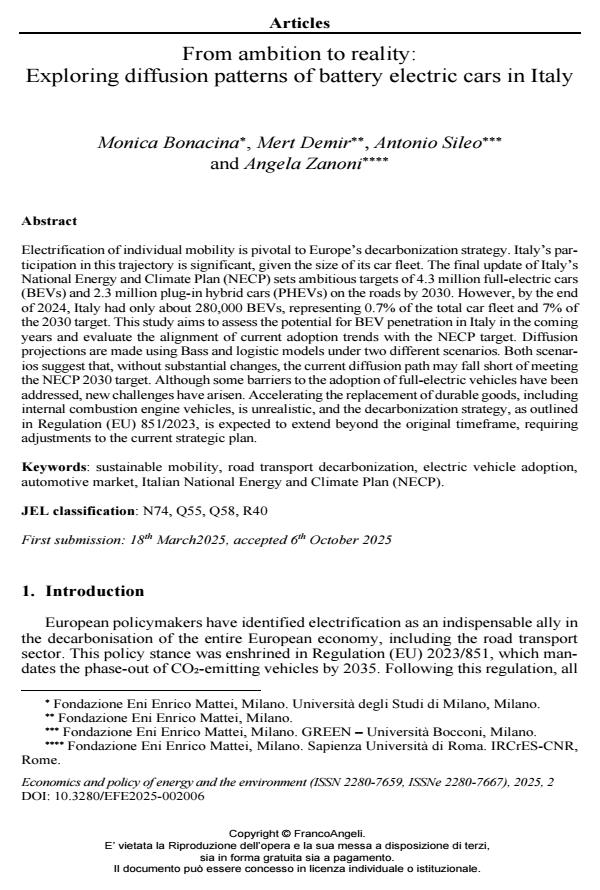
Electrification of individual mobility is pivotal to Europe’s decarbonization strategy. Italy’s participation in this trajectory is significant, given the size of its car fleet. The final update of Italy’s National Energy and Climate Plan (NECP) sets ambitious targets of 4.3 million fullelectric cars (BEVs) and 2.3 million plugin hybrid cars (PHEVs) on the roads by 2030. However, by the end of 2024, Italy had only about 280,000 BEVs, representing 0.7% of the total car fleet and 7% of the 2030 target. This study aims to assess the potential for BEV penetration in Italy in the coming years and evaluate the alignment of current adoption trends with the NECP target. Diffusion projections are made using Bass and logistic models under two different scenarios. Both scenarios suggest that, without substantial changes, the current diffusion path may fall short of meeting the NECP 2030 target. Although some barriers to the adoption of fullelectric vehicles have been addressed, new challenges have arisen. Accelerating the replacement of durable goods, including internal combustion engine vehicles, is unrealistic, and the decarbonization strategy, as outlined in Regulation (EU) 851/2023, is expected to extend beyond the original timeframe, requiring adjustments to the current strategic plan.

Parole chiave:sustainable mobility, road transport decarbonization, electric vehicle adoption, automotive market, Italian National Energy and Climate Plan (NECP).

Jel codes:N74, Q55, Q58, R40

  1. ACEA (2024). Vehicles on European roads. February 2024.
  2. Adami, C., Schossau, J., Hintze, A. (2016). Evolutionary game theory using agentbased methods. Physics of Life Reviews, 19, 126. DOI: 10.1016/J.PLREV.2016.08.015
  3. AlAlawi, B. M., Bradley, T. H. (2013). Review of hybrid, plugin hybrid, and electric vehicle market modeling Studies. Renewable and Sustainable Energy Reviews, 21, 190203. DOI: 10.1016/J.RSER.2012.12.048
  4. ASviS (2023). Il Territorio e gli Obiettivi di Sviluppo Sostenibile: i report regionali 2023. Le indicazioni sono spesso presenti nelle sezioni relative all’Obiettivo 7 (Energia pulita e accessibile) e 11 (Città e comunità sostenibili). Disponibile su www.asvis.it.
  5. Bass, F. M. (1969). A new product growth for model consumer durables. Management Science, 15(5), 215227. https://www.jstor.org/stable/2628128
  6. Bento, A., Roth, K., Zuo, Y. (2018). Vehicle Lifetime and Scrappage Behavior: Trends in the
  7. U.S. Used Car Market. The Energy Journal, 39(1), 159183. DOI: 10.5547/01956574.39.1.ABEN
  8. Berger, R. D. (1981). Comparison of the Gompertz and logistic equations to describe plant disease progress. The Florida Agricultural Experiment Station, 71(7), 716719.
  9. Bitencourt, L., Abud, T., Santos, R., Borba, B. (2021). Bass diffusion model adaptation considering public policies to improve electric vehicle sales – A Brazilian case study. Energies, 14(17), 5435.
  10. Bonacina, M., Demir, M., Sileo, A., Zanoni, A. (2024). The slow lane: a study on the diffusion of fullelectric cars in Italy. FEEM Working Papers, 19/2024.
  11. Bonacina, M., Sileo, A. (2024). Why the EU risks missing its 2050 carbon neutrality target by focusing only on new (electric) car sales. Economics and Policy of Energy and the Environment (EPEE), 1, 97114. DOI: 10.3280/EFE2024001007
  12. Bonus, H. (1973). QuasiEngel curves, diffusion, and the ownership of major consumer durables. Journal of Political Economy, 81(3), 655677. DOI: 10.1086/260063
  13. Cao Van, T. L., Barthelmes, L., Gnann, T., Speth, D., Kagerbauer, M. (2023). Enhancing electric vehicle market diffusion modeling: A German case study on environmental policy integration. Energy Strategy Reviews, 50, 101244. DOI: 10.1016/J.ESR.2023.101244
  14. Dalla Chiara, B., Deflorio, F., Eid, M. (2019). Analysis of real driving data to explore travelling needs in relation to hybridelectric vehicle solutions, Transport Policy, 80, 97116.
  15. Deng, R., Shen, N., Zhao, Y. (2024). Diffusion model to analyse the performance of electric vehicle policies: An evolutionary game simulation. Transportation Research Part D: Transport and Environment, 127, 104037. DOI: 10.1016/J.TRD.2023.104037
  16. Domarchi, C., Cherchi, E. (2023). Electric vehicle forecasts: a review of models and methods including diffusion and substitution effects. Transport Reviews, 43(6), 11181143. DOI: 10.1080/01441647.2023.2195687
  17. European Union, 2018/2001/EU, European Union, Directive (EU) n. 2018/2001 of the European Parliament and of the Council of 11 December 2018 on the promotion of the use of energy from renewable sources (Text with EEA relevance).
  18. European Union, 2023/2413/EU, Directive (EU) n. 2023/2413 of the European Parliament and of the Council of 18 October 2023 amending Directive (EU) 2018/2001, Regulation (EU) 2018/1999 and Directive 98/70/EC as regards the promotion of energy from renewable sources, and repealing Council Directive (EU) 2015/652.
  19. European Union, 2023/851/EU, Regulation (EU) n. 2023/851 of the European Parliament and of the Council of 19 April 2023 amending Regulation (EU) 2019/631 as regards strengthening the CO2 emission performance standards for new passenger cars and new light commercial vehicles in line with the Union’s increased climate ambition.
  20. Franceschini, D., Cirimele, V., Longo, M. (2021). Analysis of Possible Scenarios on the Future Development of Electric Mobility: Focus on the Italian Context. AEIT International Annual Conference (AEIT), Milan, Italy, pp. 16. DOI: 10.23919/AEIT53387.2021.9626849
  21. Gnann, T., Stephens, T. S., Lin, Z., Plötz, P., Liu, C., Brokate, J. (2018). What drives the market for plugin electric vehicles? A review of international PEV market diffusion models. Renewable and Sustainable Energy Reviews, 93, 158164. DOI: 10.1016/J.RSER.2018.03.055
  22. Greenspan, A., Cohen, D. (1999). Motor vehicle stocks, scrappage, and sales. The Review of Economics and Statistics, 81(3), 369383. DOI: 10.1162/003465399558300
  23. Haghani, M., Sprei, F., Kazemzadeh, K., Shahhoseini, Z., Aghaei, J. (2023). Trends in electric vehicles research. Transportation Research Part D: Transport and Environment, 123, 103881.
  24. Huang, J., Cui, Y., Zhang, L., Tong, W., Shi, Y., Liu, Z. (2022). An overview of agentbased models for transport simulation and analysis. Journal of Advanced Transportation, 1252534. DOI: 10.1155/2022/1252534
  25. Jensen, A. F., Cherchi, E., Mabit, S. L., de Dios Ortúzar, J. (2016). Predicting the Potential Market for Electric Vehicles. Transport Science, 51(2), 427440. DOI: 10.1287/TRSC.2015.0659
  26. Kumar, R. R., Guha, P., Chakraborty, A. (2022). Comparative assessment and selection of electric vehicle diffusion models: A global outlook. Energy, 238, 121932. DOI: 10.1016/J.ENERGY.2021.121932
  27. Lamberson, P. J. (2008). The diffusion of hybrid electric vehicles. Future Research Directions in Sustainable Mobility and Accessibility.
  28. Lee, J. H., Hardman, S. J., Tal, G. (2019). Who is buying electric vehicles in California? Characterising early adopter heterogeneity and forecasting market diffusion. Energy Research & Social Science, 55, 218226. DOI: 10.1016/J.ERSS.2019.05.011
  29. Lee, S., Marcu, M., Lee, S. (2011). An empirical analysis of fixed and mobile broadband diffusion. Information Economics and Policy, 23(34), 227233.
  30. Liao, F., Molin, E., van Wee, B. (2016). Consumer preferences for electric vehicles: A literature review. Transport Reviews, 37(3), 252275. ment, 16(3), 236243. DOI: 10.1016/J.TRD.2010.12.001
  31. Mahajan, V., Sharma, S. (1986). Simple algebraic estimation procedure for innovation diffusion models of new product acceptance. Technological Forecasting and Social Change, 30, 331346. DOI: 10.1016/00401625(86)900314
  32. Massiani, J., Gohs, A. (2016). The choice of Bass model coefficients to forecast diffusion for inovative products: An empirical investigation for new automotive technologies. Department of Economics Ca’ Foscari University of Venice Working Papers, 37.
  33. Meade, N., Islam, T. (2006). Modelling and forecasting the diffusion of innovation–A 25year review. International Journal of Forecasting, 22(3), 519545.
  34. Michalakelis, C., Varoutas, D., Sphicopoulos, T. (2008). Diffusion models of mobile telephony in Greece. Telecommunication Policy, 32(34), 234245.
  35. Miconi, F., Dimitri, G. M. (2023). A machine learning approach to analyse and predict the electric cars scenario: The Italian case. PLOS ONE, 18(1), e0279040. DOI: 10.1371/JOURNAL.PONE.0279040
  36. Ministero dell’Ambiente e della Sicurezza Energetica (2024). National Energy and Climate Plan. June 2024.
  37. MotusE (2021). PNRR e infrastruttura di ricarica per la mobilità elettrica in Italia @2030: opportunità e indirizzi strategici, 10.
  38. MotusE and Quintenergia Spa (2022). La mobilità elettrica: inevitabile o no? Analisi dal punto di vista dei consumatori, 2.
  39. MotusE and Strategy& (PwC) (2024). Mobilità Elettrica 2024: il punto sul mercato e le proiezioni. Disponibile sui siti ufficiali di MotusE e PwC.
  40. MotusE, Strategy and Politecnico di Milano (2023). Report. Il riciclo delle batterie dei veicoli elettrici @2050: scenari evolutivi e tecnologie abilitanti, 3.
  41. Norton, J. A., Bass, F. M. (1987). A diffusion theory model of adoption and substitution for successive generations of hightechnology products. Management Science, 33(9), 10691086.
  42. Pearl, R., Lawrence, S. (1976). The Growth of Populations. The Quarterly Review of Biology, 51, 624. JSTOR http://www.jstor.org/stable/2823040.
  43. Politecnico di Milano (2023). Smart Mobility Report 2023. La “via italiana” per la decarbo nizzazione dei trasporti nel nuovo scenario geopolitico internazionale.
  44. Qian, L., Soopramanien, D. (2014). Using diffusion models to forecast market size in emerging markets with applications to the Chinese car market. Journal of Business Research, 67(6), 12261232.
  45. Rie – Ricerche Industriali ed Energetiche and Unem – Unione Energie per la Mobilità (2022). Decarbonizzare i trasporti. Più soluzioni per un obiettivo comune, Studio, 7.
  46. Rietmann, N., Hügler, B., Lieven, T. (2020). Forecasting the trajectory of electric vehicle sales and the consequences for worldwide CO2 emissions. Journal of Cleaner Production, 261, 121038. DOI: 10.1016/J.JCLEPRO.2020.121038
  47. Robinson, L. (2009). A summary of “Diffusion of innovations”. https://www.enabling change.com.au/Summary_Diffusion_Theory.pdf.
  48. Rogers, E. M. (1976). New product adoption and diffusion. Journal of Consumer Research, 2, 336347. DOI: 10.1086/208642
  49. Rogers, E. M. (1983). Diffusion of Innovations (3rd ed.). New York: The Free Press. Rogers, E. M. (2003). Diffusion of innovations (5th ed.). New York: Free Press.
  50. Rogers, E. M., Singhal, A., Quinlan, M. M. (2014). Diffusion of innovations. In An integrated approach to communication theory and research (pp. 432448). Routledge. DOI: 10.4324/9780203887011
  51. Rotaris, L., Giansoldati, M., Scorrano, M. (2021). The slow uptake of electric cars in Italy and Slovenia. Evidence from a statedpreference survey and the role of knowledge and environmental awareness. Transportation Research Part A: Policy and Practice, 144, 118.
  52. Scorrano, M., Danielis, R. (2022). Simulating electric vehicle uptake in Italy in the smalltomedium car segment: A system dynamics/agentbased model parametrized with discrete choice data. Research in Transportation Business & Management, 43, 100736.
  53. Srinivasan, V., Mason, C. H. (1986). Nonlinear least squares estimation of new product diffusion models. Marketing Science, 15(4), 169178.
  54. Tran, M., Banister, D., Bishop, J. D. K., McCulloch, M. D. (2012). Realizing the electricvehicle revolution. Nature Climate Change, 2(5), 328333. neering Informatics, 22(4), 421430.
  55. Turk, T., Trkman, P. (2012). Bass model estimates for broadband diffusion in European countries. Technological Forecasting & Social Change, 79(1), 8596.
  56. Zhu, Y., Tokimatsu, K., Matsumoto, M. (2015). A diffusion model for natural gas vehicle: a case study in Japan. Energy Procedia, 75, 29872992.

Monica Bonacina, Mert Demir, Antonio Sileo, Angela Zanoni, From ambition to reality: Exploring diffusion patterns of battery electric cars in Italy in "ECONOMICS AND POLICY OF ENERGY AND THE ENVIRONMENT" 2/2025, pp 109-131, DOI: 10.3280/EFE2025-002006