Accessibilità alla comunicazione e alla partecipazione: Il Modello della Partecipazione e l’importanza della formazione
Titolo Rivista SALUTE E SOCIETÀ
Autori/Curatori Giuseppina Castellano, Federica Aiello, Raffaella Leo
Anno di pubblicazione 2025 Fascicolo 2025/3
Lingua Italiano Numero pagine 14 P. 117-130 Dimensione file 415 KB
DOI 10.3280/SES2025-003008
Il DOI è il codice a barre della proprietà intellettuale: per saperne di più
clicca qui
Qui sotto puoi vedere in anteprima la prima pagina di questo articolo.
Se questo articolo ti interessa, lo puoi acquistare (e scaricare in formato pdf) seguendo le facili indicazioni per acquistare il download credit. Acquista Download Credits per scaricare questo Articolo in formato PDF
FrancoAngeli è membro della Publishers International Linking Association, Inc (PILA), associazione indipendente e non profit per facilitare (attraverso i servizi tecnologici implementati da CrossRef.org) l’accesso degli studiosi ai contenuti digitali nelle pubblicazioni professionali e scientifiche.
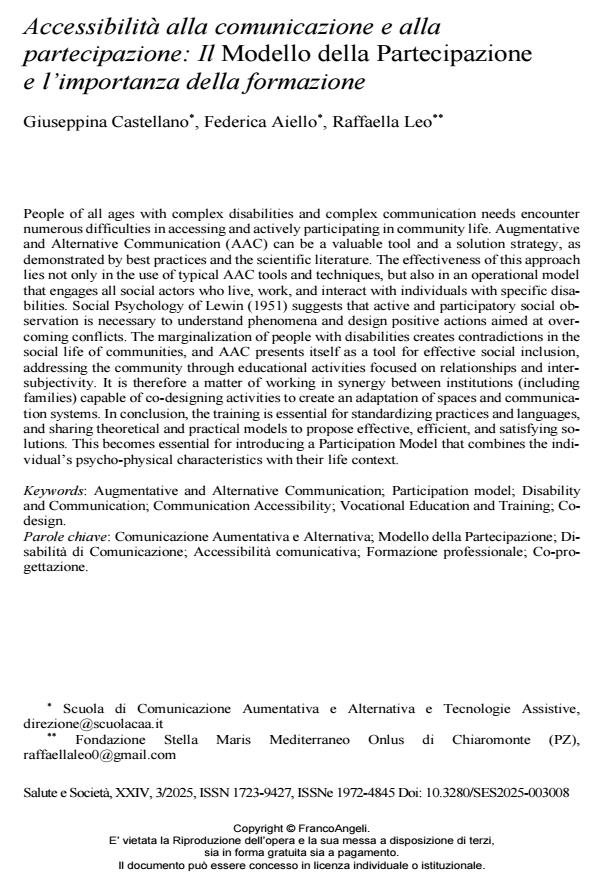
People of all ages with complex disabilities and complex communication needs encounter numerous difficulties in accessing and actively participating in community life. Augmentative and Alternative Communication (AAC) can be a valuable tool and a solution strategy, as demonstrated by best practices and the scientific literature. The effectiveness of this approach lies not only in the use of typical AAC tools and techniques, but also in an operational model that engages all social actors who live, work, and interact with individuals with specific disabilities. Social Psychology of Lewin (1951) suggests that active and participatory social observation is necessary to understand phenomena and design positive actions aimed at overcoming conflicts. The marginalization of people with disabilities creates contradictions in the social life of communities, and AAC presents itself as a tool for effective social inclusion, addressing the community through educational activities focused on relationships and intersubjectivity. It is therefore a matter of working in synergy between institutions (including families) capable of co-designing activities to create an adaptation of spaces and communication systems. In conclusion, the training is essential for standardizing practices and languages, and sharing theoretical and practical models to propose effective, efficient, and satisfying solutions. This becomes essential for introducing a Participation Model that combines the individual’s psycho-physical characteristics with their life context.
Parole chiave:Comunicazione Aumentativa e Alternativa; Modello della Partecipazione; Disabilità di Comunicazione; Accessibilità comunicativa; Formazione professionale; Co-progettazione.
Giuseppina Castellano, Federica Aiello, Raffaella Leo, Accessibilità alla comunicazione e alla partecipazione: Il Modello della Partecipazione e l’importanza della formazione in "SALUTE E SOCIETÀ" 3/2025, pp 117-130, DOI: 10.3280/SES2025-003008