Living digital timescapes of research: taking care of asynchronies and crooked spaces in early career

Titolo Rivista STUDI ORGANIZZATIVI
Autori/Curatori Ilenia Picardi
Anno di pubblicazione 2025 Fascicolo 2025/2
Lingua Inglese Numero pagine 29 P. 139-167 Dimensione file 281 KB
DOI 10.3280/SO2025-002006
Il DOI è il codice a barre della proprietà intellettuale: per saperne di più clicca qui

Qui sotto puoi vedere in anteprima la prima pagina di questo articolo.

Se questo articolo ti interessa, lo puoi acquistare (e scaricare in formato pdf) seguendo le facili indicazioni per acquistare il download credit. Acquista Download Credits per scaricare questo Articolo in formato PDF
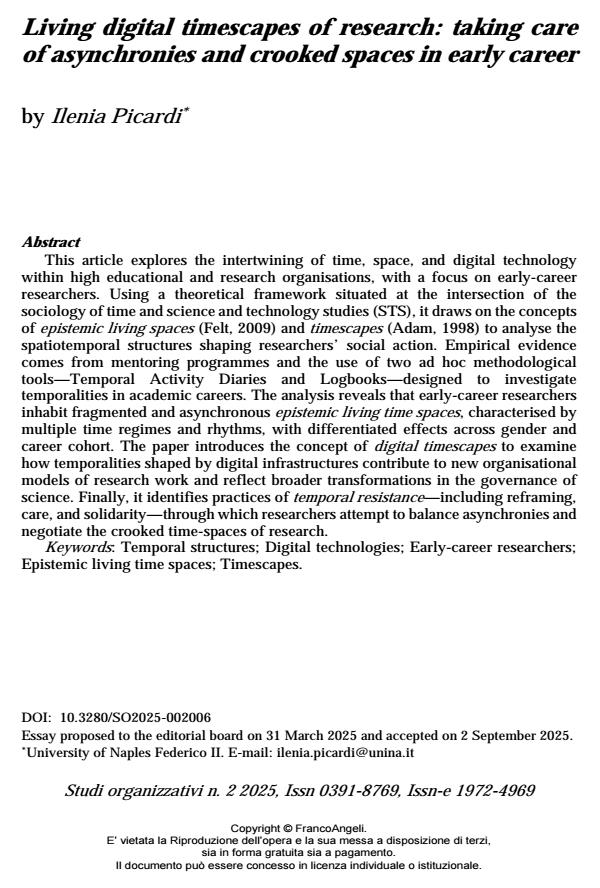
Anteprima articolo

FrancoAngeli è membro della Publishers International Linking Association, Inc (PILA)associazione indipendente e non profit per facilitare (attraverso i servizi tecnologici implementati da CrossRef.org) l’accesso degli studiosi ai contenuti digitali nelle pubblicazioni professionali e scientifiche

This article explores the intertwining of time, space, and digital technology within high educational and research organisations, with a focus on early-career researchers. Using a theoretical framework situated at the intersection of the sociology of time and science and technology studies (STS), it draws on the concepts of epistemic living spaces (Felt, 2009) and timescapes (Adam, 1998) to analyse the spatiotemporal structures shaping researchers’ social action. Empirical evidence comes from mentoring programmes and the use of two ad hoc methodological tools—Temporal Activity Diaries and Logbooks—designed to investigate temporalities in academic careers. The analysis reveals that early-career researchers inhabit fragmented and asynchronous epistemic living time spaces, characterised by multiple time regimes and rhythms, with differentiated effects across gender and career cohort. The paper introduces the concept of digital timescapes to examine how temporalities shaped by digital infrastructures contribute to new organisational models of research work and reflect broader transformations in the governance of science. Finally, it identifies practices of temporal resistance—including reframing, care, and solidarity—through which researchers attempt to balance asynchronies and negotiate the crooked time-spaces of research.

Questo articolo esplora l’intreccio tra tempo, spazio e tecnologia digitale all’interno delle istituzioni di istruzione superiore e ricerca, con un’attenzione particolare ai ricercatori nelle fasi iniziali della carriera. Adottando un quadro teorico situato all’intersezione tra la sociologia del tempo e gli studi sulla scienza e la tecnologia (STS), il lavoro si fonda sui concetti di spazi di vita epistemici (Felt, 2009) e di paesaggi temporali (Adam, 1998) per analizzare le strutture spazio-temporali che modellano l’azione sociale dei ricercatori. L’evidenza empirica deriva da programmi di mentoring e dall’uso di due strumenti metodologici ad hoc — i diari di attività temporale e i logbook — progettati per indagare le temporalità nelle carriere accademiche. L’analisi rivela che i ricercatori all’inizio della carriera abitano spazi-tempi epistemici di vita frammentati e asincroni, caratterizzati da molteplici regimi e ritmi temporali, con effetti differenziati in base al genere e alla coorte di carriera. L’articolo introduce il concetto di paesaggi temporali digitali per esaminare come le temporalità plasmate dalle infrastrutture digitali contribuiscano a nuovi modelli organizzativi del lavoro di ricerca e riflettano più ampie trasformazioni nella governance della scienza. Infine, identifica pratiche di resistenza temporale — tra cui riformulazione, cura e solidarietà — attraverso le quali i ricercatori cercano di bilanciare le asincronie e negoziare i tempi-spazi distorti della ricerca.

Parole chiave:strutture temporali, tecnologie digitali, ricercatori all’inizio della carriera, spazi-tempi epistemici di vita, paesaggi temporali.

  1. Adam, B. (2000). “The temporal gaze: the challenge for social theory in the context of GM food”, The British Journal of Sociology, 51: 125-142.
  2. Adam B (2008). “Of Timescapes, Futurescapes and Timeprints”, Paper presented at Lueneburg University, 17 June 2008.
  3. Luhmann, N. (1982). The Differentiation of Society, New York: Columbia Press.
  4. Knorr Cetina K. (1999). Epistemic cultures: How the sciences make knowledge. Harvard University Press.
  5. Adam, B., Groves, C., Adams, J., & Schmueker, K. Adam, B. (1990). Time and Social Theory, Cambridge: Polity Press.
  6. Adam, B. (1994/95). “Time for Feminist Approaches to Technology, ‘Nature’and Work”, Arena journal 4: 91–104.
  7. Adam, B. (1996). “Beyond the Present”. Time & Society 5: 319–338. DOI: 10.1177/0961463X96005003003.
  8. Adam, B. (1998). “Timescapes of Modernity: The Environment and Invisible”. Systems Research, 10, 11-34.
  9. Picardi, I., Agodi M.C., (2020). Gender perspective in the mentoring relationships. A case study of GENOVATE@UNINA, in H. Lawton Smith, C. Henry, H. Etzkowitz and A. Poulovassilis (edit by) Gender, Science & Innovation. New Perspectives, Cheltenham UK - Northampton MA, USA, Edward Elgar Publishing, ISBN: 978 1 78643 896 6.
  10. Amaral, A., Bleiklie, I. and Musselin C., (2008). From Governance to Identity. A Festschrift for Mary Henkel: Springer.
  11. Baraitser, L. (2017). Enduring time. Bloomsbury Academic.
  12. Bergmann, W. (1992). “The Problem of Time in Sociology: An Overview of the Literature on the State of Theory and Research on the ‘Sociology of Time”, Time and Society 1(1): 81–134. DOI: 10.1177/0961463X92001001007.
  13. Cecez-Kecmanovic, D., Galliers, R. D., Henfridsson, O., Newell, S., & Vidgen, R. (2014). “The sociomateriality of information systems”, MIS Quarterly, 38(3), 809-830.
  14. Ehling M. (2004) “Effects of Methodological Changes on Surveyed Time Use - A comparison of the German Time Use Studies 1991/92 and 2001/02”. Paper presented at the Iatur international conference. Roma.
  15. Elias, N. (1992) Time: An Essay, Oxford: Blackwell.
  16. European Commission (2025). She figures 2024 – Gender in research and innovation – Statistics and indicators, Publications Office of the European Union, 2025, https://data.europa.eu/doi/10.2777/592260
  17. Eurostat (2009). Harmonised European time use surveys. 2008 guidelines. Eurostat Working Paper and Studies, Luxembourg: Office for Official Publications of the European Communities
  18. Eurostat (2020). Harmonised European Time Use Surveys (HETUS) 2018 Guidelines RE-EDITION 2020 edition. Eurostat Working Paper and Studies, 2008. Luxembourg: Publications Office of the European Union.
  19. Felt, U., (2009). Knowing and Living in Academic Research. Convergence and Heterogeneity in Research Cultures in the European Context. Prague: Institute of Sociology of the Academy of Sciences of the Czech Republic.
  20. Felt, U. (2016). “Of time-scapes and knowledge-scapes: Re-timing Research and Higher Education”. In New Landscapes and Languages in Higher Education, edited by Peter Scott, Jim Gallacher and Gareth Parry. Oxford: Oxford University Press.
  21. Felt, U. (2017). “Under the Shadow of Time: Where Indicators and Academic Values Meet”, Engaging Science, Technology, and Society, 3, 53-63.
  22. Ferlie, E., Musselin, C. and Andresani, G. (2008), “The steering of higher education systems: a public management perspective”, Higher Education, 56(3), 325–348.
  23. Gaiaschi, C. and Musumeci, R. (2020). “Just a Matter of Time? Women’s Career Advancement in Neo-Liberal Academia. An Analysis of Recruitment Trends in Italian Universities”, Social Sciences, 9(9): 163.
  24. Giddens, A. (1979) Central Problems in SocialTheory, London: Macmillan
  25. Gibbs, P., O.-H. Ylijoki, C. Guzmán-Valenzuela, and R. Barnett, (2015). Universities in the Flux of Time: An Exploration of Time and Temporality in University Life. London: Routledge.
  26. Gregory L. (2015) Trading Time. Bristol University Press; 2015:169-202.
  27. Gurvitch, G. (1964) The Spectrum of Social Time, Dordrecht: D. Reidel.
  28. Haraldsen, G. “The Design of Time Use Surveys in Developed and Developing Countries”. Comunicazione presentata alla conferenza internazionale Iatur. Colchester, Ottobre 1999.
  29. Haraway, D. J. (1988). “Situated knowledges: The science question in feminism and the privilege of partial perspective”, Feminist Studies, 14(3), 575–599. DOI: 10.2307/3178066.
  30. Mazmanian, M., Orlikowski, W. J., & Yates, J. (2013). “The autonomy paradox: The implications of mobile email devices for knowledge professionals”, Organization Science, 24(5), 1337–1357.
  31. Merton, R. (1968 [1949]) Social Theory and Social Structure, New York, Free Press.
  32. Murgia, A., and Poggio, B. (2018). Gender and precarious research careers: A comparative analysis (p. 256). Taylor & Francis.
  33. Naldini, M., and Poggio, B. (2024). Genere e accademia: carriere, culture e politiche. Il Mulino.
  34. Nocenzi, M. e Crespi, I. (2024). “The Sociology of Gender in Italy: From Marginal to Mainstream”, The American Sociologist, 1-28,
  35. Nowotny, H. (1994). Time. The modern and postmodern experience. Oxford: Polity Press
  36. Orlikowski, W. J. (2007). “Sociomaterial practices: Exploring technology at work”, Organization Studies, 28(9), 1435–1448. DOI: 10.1177/0170840607081138.
  37. Picardi, I. (2017), La dimensione di genere nelle carriere accademiche. Riflessività e cambiamento nel progetto pilota di GENOVATE@UNINA, Napoli, FedOAPress. ISBN: 978-88-6887-017-1
  38. Picardi. I., (2019). “La porta di cristallo: un nuovo indice per misurare l’impatto di genere della riforma Gelmini sull’accesso alla professione accademica”. Quaderni Italiani di Sociologia. 80, 2.
  39. Picardi, I. (2020). Labirinti di cristallo. Strutture di genere nella ricerca e nell’accademia. Milano: FrancoAngeli.
  40. Puig de la Bellacasa, M. (2011). “Matters of care in technoscience: Assembling neglected things”. Social Studies of Science, 41(1), 85–106. DOI: 10.1177/0306312710380301.
  41. Romano, M.C. (2018) I tempi della vita quotidiana. Un approccio multidisciplinare all’analisi dell’uso del tempo. Roma, Istat.
  42. Sharma, S. (2014). In the Meantime: Temporality and Cultural Politics. Durham: Duke University Press.
  43. Suchman, L. (2007). Human–Machine Reconfigurations: Plans and Situated Actions. Cambridge: Cambridge University Press.
  44. Southerton, D., and Tomlinson, M. (2005). “‘Pressed for Time’ – the Differential Impacts of a ‘Time Squeeze’”. The Sociological Review.
  45. Stengers I. (2009). Au temps des catastrophes. Résister à la barbarie qui vient. Paris, La Découverte.
  46. Tanur, J. (1992). Questions about Questions. New York: Wiley.
  47. Ylijoki, O.-H., and Mäntyla H. (2003). “Conflicting Time Perspectives in Academic Work”, Time & Society 12 (1): 55-78.
  48. Rifkin, J. (1987). Time Wars. The Primary Conflict in Human History, New York: Henry Holt.
  49. Wajcman, J. (2015). Pressed for time: The acceleration of life in digital capitalism. University of Chicago Press.

Ilenia Picardi, Living digital timescapes of research: taking care of asynchronies and crooked spaces in early career in "STUDI ORGANIZZATIVI " 2/2025, pp 139-167, DOI: 10.3280/SO2025-002006