Modélisation développementale: de l’approche anthropocentrée à une épistémè écologique écosystémique de la multitude

Titolo Rivista SOCIOLOGIA URBANA E RURALE
Autori/Curatori Jean-Marc Fontan
Anno di pubblicazione 2026 Fascicolo 2025/138
Lingua Francese Numero pagine 26 P. 40-65 Dimensione file 268 KB
DOI 10.3280/SUR2025-138003
Il DOI è il codice a barre della proprietà intellettuale: per saperne di più clicca qui

Qui sotto puoi vedere in anteprima la prima pagina di questo articolo.

Se questo articolo ti interessa, lo puoi acquistare (e scaricare in formato pdf) seguendo le facili indicazioni per acquistare il download credit. Acquista Download Credits per scaricare questo Articolo in formato PDF
Anteprima articolo

FrancoAngeli è membro della Publishers International Linking Association, Inc (PILA), associazione indipendente e non profit per facilitare (attraverso i servizi tecnologici implementati da CrossRef.org) l’accesso degli studiosi ai contenuti digitali nelle pubblicazioni professionali e scientifiche.

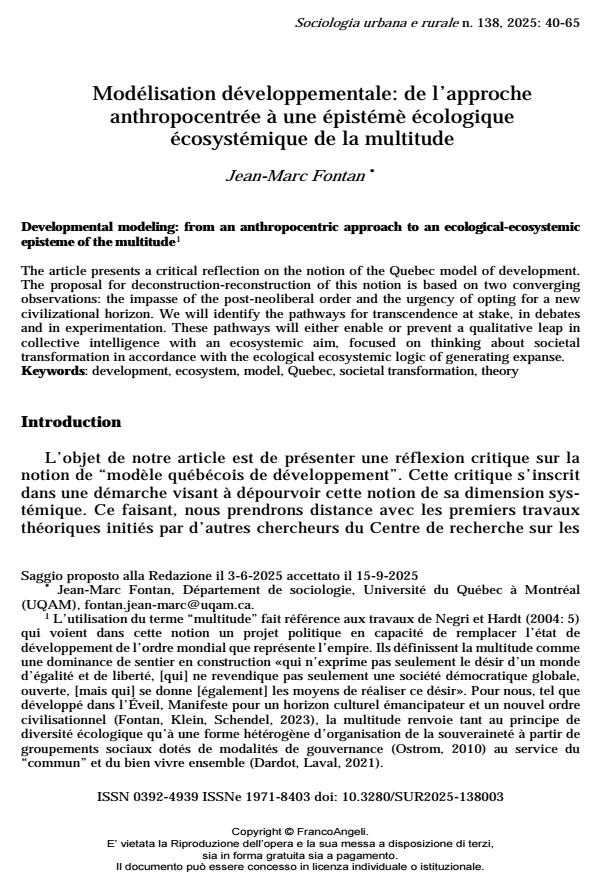
The article presents a critical reflection on the notion of the Quebec model of development. The proposal for deconstructionreconstruction of this notion is based on two converging observations: the impasse of the postneoliberal order and the urgency of opting for a new civilizational horizon. We will identify the pathways for transcendence at stake, in debates and in experimentation. These pathways will either enable or prevent a qualitative leap in collective intelligence with an ecosystemic aim, focused on thinking about societal transformation in accordance with the ecological ecosystemic logic of generating expanse.

Parole chiave:development, ecosystem, model, Quebec, societal transformation, theory

  1. Acemoglu D., Robinson J.A. (2006). Economic Origins of Dictatorship and Democracy. Cambridge: Cambridge University Press.
  2. Acemoglu D., Robinson J.A. (2012). Why Nations Fail: The Origins of Power, Prosperity, and Poverty. New York: Crown Business.
  3. Archambault J.P. (1932). La restauration de l’ordre social d’après les encycliques Rerum novarum et Quadragesimo anno. Montréal: Éditions de l’École sociale populaire.
  4. Aron S., Passera L. (2009). Les sociétés animales. Évolution de la coopération et organisation sociale, LouvainlaNeuve: De Boeck Supérieur.
  5. Azéma M. (2006). La représentation du mouvement au Paléolithique supérieur. Apport du comparatisme éthographique à l’interprétation de l’art pariétal. Bulletin de la Société préhistorique française, 103(3): 479505.
  6. Badiou A. (1969). Le concept de modèle. Introduction à une épistémologie matérialiste des mathématiques. Paris: Maspéro.
  7. Badiou A. (1988). L’Être et l’événement. Paris: Seuil. Beck U. (2001). La société du risque. Paris, Aubier.
  8. Bookchin M. (1986). The Greening of Politics: Toward a New Kind of Political Practice. Green Perspectives: Newsletter of the Green Program, Project 1, no. January. https://pzacad.pitzer.edu/anarchist_archives/bookchin/gp/perspectives1.html
  9. Bouchard M.J. (2021). L’innovation et l’économie sociale au cœur du modèle québécois. Entretiens avec Benoît Lévesque, Québec: Presses de l’Université du Québec, collection Politeia. Bourque G.L. (2000). Le modèle québécois de développement. De l’émergence au renouvel lement, SainteFoy: Presses de l’Université du Québec.
  10. Braudel, F. (1949). La Méditerranée et le monde méditerranéen à l’époque de Philippe II. Paris: Armand Colin.
  11. Braudel F. (1958). Histoire et sciences sociales: la longue durée. Annales, 13(4): 725753. Campbell D.T. (1965). Variation and selective retention in sociocultural evolution. Dans
  12. Barringer H.R., Blanksten G.I., Mack R.W. (eds.). Social Change in Developing Areas. Cambridge: Schenkman.
  13. Castells, M. (1996). The Rise of the Network Society. The Information Age. Oxford: Blackwell. CavalliSforza L.L., Feldman M.W. (1981). Cultural Transmission and Evolution: A Quanti tative Approach. Princeton: Princeton University Press. Claude Sonnet 4 Anthropic (2025). [Large language model]. https://claude.ai
  14. Dardot P., Laval C. (2021). Instituer les mondes. Cosmopolitisme des communs. Paris: La Découverte.
  15. Darwin C. ([1859] 2021). L’origine des espèces. Paris: La Découverte. Dawkins, R. (1976). The Selfish Gene. Oxford: Oxford University Press. Descola P. (2005). Pardelà nature et culture. Paris: Gallimard.
  16. Descola P., Pignocchi A. (2022). Ethnographies des mondes à venir. Paris: Seuil.
  17. Dupuy J.P. (2002). Pour un catastrophisme éclairé: Quand l’impossible est certain. Paris: Seuil. Durkheim É. ([1893] 1967). De la division du travail social. Paris: Presses universitaires de France.
  18. Eldredge N., Gould S.J. (1972). Punctuated equilibria: an alternative to phyletic gradualism.
  19. Dans Schopf T.J.M. (ed.). Models in Paleobiology. San Francisco: Freeman Cooper.
  20. Engels F. ([18731886] 2006). Dialectique de la nature. Paris: Éditions La Dispute.
  21. Escobar A. (1995). Encountering Development: The Making and Unmaking of the Third World. Princeton: Princeton University Press.
  22. Fontan J.M. (2025). Théorie Générale du Changement. Montréal: PhiLab, séminaire sur le changement, présentation PowerPoint, mai, non publié.
  23. Fontan J.M., Asselin H., Bergeron J., Boudreau G., Bussières D., Klein J.L., Tremblay P.A. (2025). La ruralité dans la transition sociale et écologique: bases théoriques et conceptuelles. Dans Klein J.L., Bussières D., Champagne C., Léonard, M, Tremblay P.A. (dir.). Vers une nouvelle ruralité L’expérience des Ateliers des savoirs partagés (ASP). Québec: Presses de l’Université du Québec.
  24. Fontan J.M., Klein J.L., van Schendel V. (2023). La transition économique à l’aune du Manifeste de l’Éveil. Revue Œconomia Humana, 1: 1317.
  25. Frank A.G. (1967). Capitalism and Underdevelopment in Latin America. Historical stories of Chile and Brazil. New York: Monthly Review Press.
  26. Frontier S. (1977). Réflexions pour une théorie des écosystèmes. Bulletin Écologie, 8(4): 445464.
  27. Gould S.J. (1989). Wonderful Life: The Burgess Shale and the Nature of History. New York: W.W. Norton.
  28. Gould S.J. (1996). Full House: The Spread of Excellence from Plato to Darwin. New York: Harmony Books.
  29. Gramsci A. ([19261934] 1971). Lettres de prison. Paris: Gallimard.
  30. Haraway D. (1985). A Cyborg Manifesto: Science, Technology, and SocialistFeminism in the Late Twentieth Century. Socialist Review, 80: 65108.
  31. Hardt M., Negri A. (2004). Multitude. Guerre et démocratie à l’âge de l’Empire. Paris: La Découverte.
  32. Héraclite d’Éphèse (vers 535475 av. J.C.). Fragments (Panta rhei «Tout coule»). Hirschman A.O. (1958). The Strategy of Economic Development. New Haven: Yale Univer sity Press.
  33. Klein J.L., Harrisson D. (dir.) (2006). L’innovation sociale. Émergence et effets sur la transformation des sociétés. Québec: Presses de l’Université du Québec, collection innovation sociale.
  34. Kuhn T. (1983). La structure des révolutions scientifiques. Paris: Flammarion.
  35. Kuznets S. (1966). Modern Economic Growth: Rate, Structure, and Spread. New Haven: Yale University Press.
  36. Latour B. (2017). Où atterrir? Comment s’orienter en politique. Paris: La Découverte.
  37. Lévesque B. (2002). Le modèle québécois: Un horizon théorique pour la recherche, une porte d’entrée pour un projet de société? Revue Interventions économiques, 29.
  38. Lévesque B. (2020). Le rapport au territoire selon trois générations du “modèle québécois” (19602020) vers un nouveau modèle de société?. Présentation PPT, UQAR campus Lévis, Rencontres ItalieQuébec, juin.
  39. Lévesque B., Bourque G.L., Vaillancourt Y. (1999). Trois positions dans le débat sur le modèle québécois. Nouvelles pratiques sociales, 12(2): 110.
  40. Lévesque B., Fontan J.M., Klein J.L. (dir.) (2014). L’innovation sociale: Les marches d’une construction théorique et pratique. SainteFoy: Presses de l’Université du Québec.
  41. LéviStrauss C. (1958). Anthropologie structurale. Paris: Plon.
  42. Lewis W.A. (1955). The Theory of Economic Growth. London: George Allen & Unwin. Lovelock J. E. (1979). Gaia: A New Look at Life on Earth. Oxford: Oxford University Press. Marx K. ([18571858] 2011). Manuscrits de 18571858 («Grundrisse»). Paris: Éditions so ciales.
  43. Marx K. ([1867] 1976). Le Capital. Paris: Éditions sociales.
  44. Marx K., Engels F. ([18451846] 1975). L’idéologie allemande. Paris: Éditions sociales. Mayr E. (1963). Animal Species and Evolution. Cambridge: Harvard University Press.
  45. Méral P., Pesche D. (dir.) (2016). Les services écosystémiques. Repenser les relations nature et société. Versailles: Éditions Quæ.
  46. Myrdal G. (1968). Asian Drama: An Inquiry into the Poverty of Nations. New York: Pantheon Books.
  47. Nisbet R.A. (1969). Social Change and History: Aspects of the Western Theory of Development. New York: Oxford University Press.
  48. North D. (1990). Institutions, Institutional Change and Economic Performance. Cambridge: Cambridge University Press.
  49. Ostrom E. (2010). La gouvernance des biens communs: pour une nouvelle approche des ressources naturelles. Paris: De Boeck.
  50. Parsons T. (1937). The Structure of Social Action. New York: McGrawHill. Parsons T. (1951). The Social System. New York: Free Press.
  51. Parsons T. (1966). Societies: Evolutionary and Comparative Perspectives. Englewood Cliffs: PrenticeHall.
  52. Perroux F. (1966). Les blocages de la croissance et du développement. La croissance, le développement, les progrès, le progrès (définitions). TiersMonde, 6: 239250. https://www.persee.fr/doc/tiers_00407356_1966_num_7_26_2200.
  53. PNUD (Programme des Nations Unies pour le développement) (1990). Rapport mondial sur le développement humain (1990). New York: Oxford University Press.
  54. Polanyi K. (1944). The Great Transformation: The Political and Economic Origins of Our Time. New York: Farrar & Rinehart.
  55. Prebisch R. (1950). The Economic Development of Latin America and its Principal Problems.
  56. New York: United Nations, Economic Commission for Latin America.
  57. Prigogine I., Stengers I. (1979). La Nouvelle Alliance: métamorphose de la science. Paris: Gallimard.
  58. Prigogine I., Stengers, I. (1984). Order Out of Chaos: Man’s New Dialogue with Nature. New York: Bantam Books.
  59. Rist G. (2013). Le développement: histoire d’une croyance occidentale. Paris: Presses de Sciences Po.
  60. Rodrik D. (2007). One Economics, Many Recipes: Globalization, Institutions, and Economic Growth. Princeton: Princeton University Press.
  61. Rostow W.W. (1960). The Stages of Economic Growth: A NonCommunist Manifesto. Cambridge: Cambridge University Press.
  62. Sachs W. (2010). The Development Dictionary: A Guide to Knowledge as Power. New York: Zed Books.
  63. Sen A. (1985). Commodities and Capabilities. Amsterdam: North Holland. Sen A. (1999). Development as Freedom. New York: Knopf.
  64. Spencer H. (1851). Social Statics: or, The Conditions essential to Happiness specified, and the First of them Developed. London: John Chapman.
  65. Teilhard de Chardin P. (1955). Le Phénomène humain. Paris: Seuil.
  66. Thom R. (1972). Stabilité structurelle et morphogenèse. Reading: Benjamin.
  67. Thompson D’Arcy Wentworth (1917). On Growth and Form. Cambridge: Cambridge University Press.
  68. Tilly C. (1984). Big Structures, Large Processes, Huge Comparisons, New York, Russell Sage Foundation.
  69. Truman H. (1949). Inaugural Address, Washington, Public Papers of the Presidents. https://www.trumanlibrary.gov/library/publicpapers/19/inauguraladdress.
  70. Weber M. ([19041917] 1965). Essais sur la théorie de la science. Paris: Plon. https://classiques.uqam.ca/classiques/Weber/essais_theorie_science/essais_theorie_science.html.

Jean-Marc Fontan, Modélisation développementale: de l’approche anthropocentrée à une épistémè écologique écosystémique de la multitude in "SOCIOLOGIA URBANA E RURALE" 138/2025, pp 40-65, DOI: 10.3280/SUR2025-138003