Territorial development in Quebec: between aspirations and structural limits

Titolo Rivista SOCIOLOGIA URBANA E RURALE
Autori/Curatori Marco Alberio, Mélanie Doyon, Juan-Luis Klein
Anno di pubblicazione 2026 Fascicolo 2025/138
Lingua Inglese Numero pagine 9 P. 7-15 Dimensione file 151 KB
DOI 10.3280/SUR2025-138001
Il DOI è il codice a barre della proprietà intellettuale: per saperne di più clicca qui

Qui sotto puoi vedere in anteprima la prima pagina di questo articolo.

Se questo articolo ti interessa, lo puoi acquistare (e scaricare in formato pdf) seguendo le facili indicazioni per acquistare il download credit. Acquista Download Credits per scaricare questo Articolo in formato PDF
Anteprima articolo

FrancoAngeli è membro della Publishers International Linking Association, Inc (PILA), associazione indipendente e non profit per facilitare (attraverso i servizi tecnologici implementati da CrossRef.org) l’accesso degli studiosi ai contenuti digitali nelle pubblicazioni professionali e scientifiche.

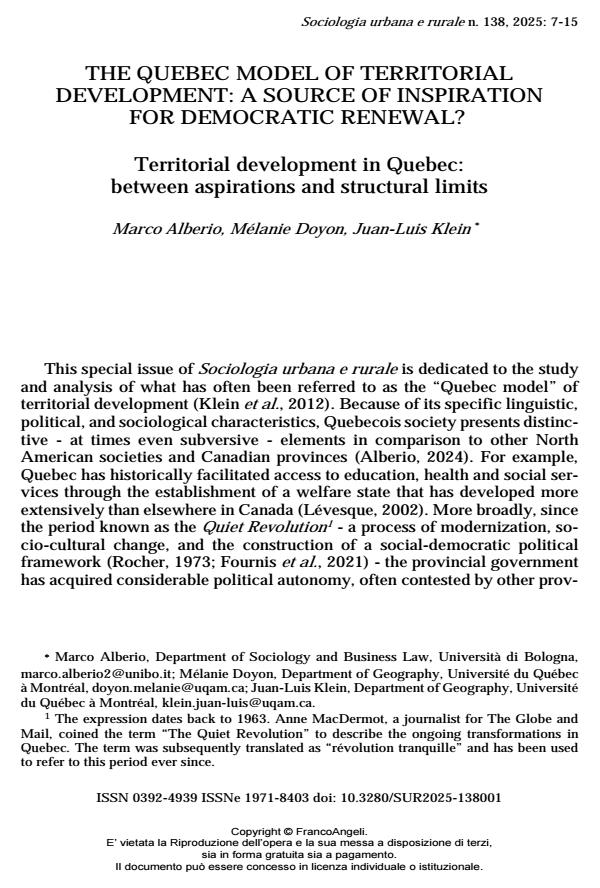
This special issue of Sociologia urbana e rurale is dedicated to the study and analysis of what has often been referred to as the “Quebec model” of territorial development (Klein et al., 2012). Because of its specific linguistic, political, and sociological characteristics, Quebecois society presents distinctive at times even subversive elements in comparison to other North American societies and Canadian provinces (Alberio, 2024). For example, Quebec has historically facilitated access to education, health and social services through the establishment of a welfare state that has developed more extensively than elsewhere in Canada (Lévesque, 2002). More broadly, since the period known as the Quiet Revolution1 a process of modernization, sociocultural change, and the construction of a socialdemocratic political framework (Rocher, 1973; Fournis et al., 2021) the provincial government has acquired considerable political autonomy, often contested by other prov

  1. Acosta A. (2013). Extractivism and Neoextractivism: Two Sides of the Same Curse. In Lang M., Mokrani D. (eds.). Beyond Development: Alternative Visions from Latin America. Amsterdam: RosaLuxemburg Foundation, Quito and Transnational Institute.
  2. Alberio M. (2015). Les initiatives locales et les défis des acteurs du milieu face aux coupes et aux changements actuels. Revue Organisations & Territoires, 24(3): 5360.
  3. Alberio M. (2022). La profession de pêcheur au Québec: structure, genèse et développement d’un secteur d’emploi «typiquement masculin». In Beaudry C., Gagnon M. (eds.). Diversité en milieu de travail. De l’exclusion à l'inclusion. Montréal: JFD Édition.
  4. Alberio M. (2024). Tentativi di riappropriazione comunitaria delle infrastrutture in un contesto di cambiamenti climatici: il caso della pesca nelle comunità autoctone del Québec, Canada. In Borghi V., Leonardi E. (a cura di). Il sociale messo in forma: le infrastrutture come cose, processi e logiche della vita collettiva. Napoli: Orthotes.
  5. Alberio M. (in press). (2026). Vers des modèles subversifs de développement socio territorial? Adaptation aux changements climatiques et pêcheries communautaires chez les Premières Nations du Québec. In Klein J.L., Pecqueur B., Sadik Y. (eds.) Le territoire pour une approche subversive du développement. Rennes: Presses universitaires de Rennes.
  6. Alberio M., Klein J.L. (2022). Multiactor and Participative Socioterritorial Development: Toward a New Model of Intervention? Journal of rural and community development, 17: 123. Alberio M., Soubirou M. (2022). How can a cooperativebased organization of indigenous fisheries foster the resilience to global changes? Lessons learned by coastal communities in east ern Québec. Environmental policy and governance, 32: 546559.
  7. Appadurai A. (2004). The capacity to aspire; Culture and the terms of recognition. In Walton M., Rao V. (eds.). Culture and Public Action: A CrossDisciplinary Dialogue on Development Policy. World Bank Publications.
  8. Blad C., Couton P. (2009). The Rise of an Intercultural Nation: Immigration, Diversity and Nationhood in Quebec. Journal of Ethnic and Migration Studies, 35(4): 645667. DOI: 10.1080/13691830902765277
  9. Bourque G.L. (2000). Le modèle québécois de développement: de l’émergence au développement. Québec: Presses de l’Université du Québec.
  10. Callorda Forssati E., Degavre F., Lévesque B. (2018). L’innovation sociale: retour sur les marches d’une construction théorique et pratique. Revue de la régulation, 23, 1er semestre, s.p.
  11. Chagnon C.W., Durante F., Gills B.K., HagolaniAlbov S.E., Hokkanen S., Kangasluoma S.M.J., Konttinen H., Kröger M., LaFleur W., Ollinaho O., Vuola M.P.S. (2022). From extractivism to global extractivism: the evolution of an organizing concept. The Journal of Peasant Studies, 49(4): 760792. DOI: 10.1080/03066150.2022.2069015
  12. Côté S., Klein J.L., Proulx M.U. (1995). Et les régions qui perdent…? RimouskiChicoutimiMontréal: GRIDEQGRIRDépartement de géographie de l’UQAM.
  13. Dardot P., Laval C. (2025). Instituer les mondes. Pour une cosmopolitique des communs. Paris: La Découverte.
  14. Doyon M., Klein J.L. (2021) NonConventional Agricultural Spaces and Climate Change: The Cases of Le Grenier boréal and Lufa Farms in Quebec, Canada. Climate, 9(10):148.
  15. Doyon M., Klein J.L., Handfield M., Laroche S., Morin L., Tremblay, P.A., Tremblay S. (2025). La question rurale au Québec au 21e siècle: pour une approche émancipatrice. In Klein J.L., Bussières D., Champagne C., Dufresne C., Léonard M., Tremblay P.A. (dirs). Vers une nouvelle ruralité. L’expérience des Ateliers des savoirs partagés. Québec: Presses de l’Université du Québec.
  16. Fortin G. (1971). La fin d’un règne. Montréal: Éditions Hurtubise HMH.
  17. Fournis Y., Alberio M., Lewis N., Devaux N., Handfield M. (2021). Note de recherche. Les études régionales québécoises à l'heure des inégalités: Quelques pistes conclusives. Revue canadienne des sciences régionales, 44(3): 159166.
  18. Fournis Y., Fortin M.J. (2015). Une définition territoriale de l’acceptabilité sociale: pièges et défis conceptuels. VertigO, 15(3).
  19. Fraser, N. (2021). Climates of Capital. For a TransEnvironnemental EcoSocialism, New Left Review, 127: 94127.
  20. Frère B., Laville J.L. (2022). La fabrique de l’émancipation. Repenser la critique du capitalisme à partir des expériences démocratiques, écologiques et solidaires. Paris: Éditions Seuil.
  21. Gudynas E. (2017). Los ambientalismos frente a los Extractivismos. Nueva Sociedad, 268, marzoabril: 110121.
  22. Jean B. (dir.) (2016). Le BAEQ revisité: un nouveau regard sur la première expérience de développement régional au Québec. Québec: Presses de l’Université Laval.
  23. Klein J.L., Bussières D., Champagne C., Dufresne C., Léonard M., Tremblay P.A. (eds.). (2025). Vers une nuovelle ruralité. L'expérience des Atelier des savoirs partagés. Québec: Presses de l’Université du Québec.
  24. Klein J.L., Fontan J.M. Harrison D., Lévesque B. (2012). The Quebec System of Social Innovation: a Focused Analysis on the Local Development Field. FINISTERRA Revista Portuguesa de Geografia, XLVII, 94: 928.
  25. Klein J.L., Pecqueur B., Sadik Y. (eds.) (in press) (2026). Le territoire: pour une approche subversive du développement. Rennes: Presses universitaires de Rennes.
  26. Lévesque B. (2002). Le modèle québécois: un horizon theorique pour la recherche, une porte d’entrée pour un projet de société?. Revue Interventions économiques, 29.
  27. Lévesque B. (2011). Un monde qui se défait, un monde à reconstruire. L’Action Nationale, 101(910): 157184.
  28. Lévy C., Alberio M. (eds.). (in press) (2025). Reimagining the Urban Commons in Italy: Reform, Social Innovation and Transformation. Leeds (UK): Emerald.
  29. Polèse M. (2012). À propos de l’extraordinaire diversité (et ouverture) des sciences régionales québécoises: Origines et prospective. Revue d’Économie Régionale & Urbaine, 4: 513-531.
  30. Rocher G. (1973). Le Québec en mutation. Montréal, Les Éditions Hurtubise HMH. Sassen S. (2007). A sociology of Globalization. New York: W.W. Norton & Company.

Marco Alberio, Mélanie Doyon, Juan-Luis Klein, Territorial development in Quebec: between aspirations and structural limits in "SOCIOLOGIA URBANA E RURALE" 138/2025, pp 7-15, DOI: 10.3280/SUR2025-138001