Scroll the world: When our fingers become the horsemen of the apocalypse
Titolo Rivista STUDI ORGANIZZATIVI
Autori/Curatori François-Xavier de Vaujany
Anno di pubblicazione 2025 Fascicolo 2025/2
Lingua Inglese Numero pagine 9 P. 171-179 Dimensione file 167 KB
DOI 10.3280/SO2025-002007
Il DOI è il codice a barre della proprietà intellettuale: per saperne di più
clicca qui
Qui sotto puoi vedere in anteprima la prima pagina di questo articolo.
Se questo articolo ti interessa, lo puoi acquistare (e scaricare in formato pdf) seguendo le facili indicazioni per acquistare il download credit. Acquista Download Credits per scaricare questo Articolo in formato PDF
FrancoAngeli è membro della Publishers International Linking Association, Inc (PILA), associazione indipendente e non profit per facilitare (attraverso i servizi tecnologici implementati da CrossRef.org) l’accesso degli studiosi ai contenuti digitali nelle pubblicazioni professionali e scientifiche.
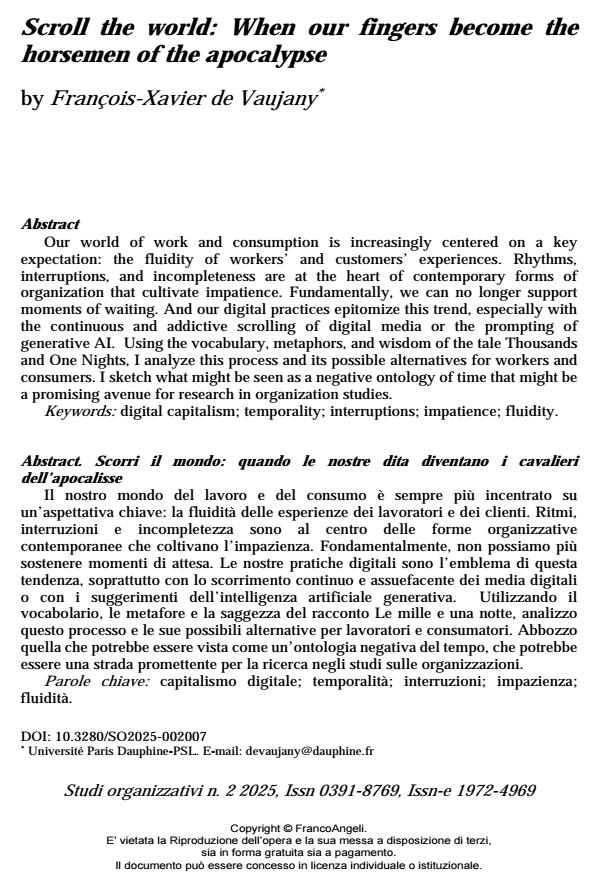
Our world of work and consumption is increasingly centered on a key expectation: the fluidity of workers’ and customers’ experiences. Rhythms, interruptions, and incompleteness are at the heart of contemporary forms of organization that cultivate impatience. Fundamentally, we can no longer support moments of waiting. And our digital practices epitomize this trend, especially with the continuous and addictive scrolling of digital media or the prompting of generative AI. Using the vocabulary, metaphors, and wisdom of the tale Thousands and One Nights, I analyze this process and its possible alternatives for workers and consumers. I sketch what might be seen as a negative ontology of time that might be a promising avenue for research in organization studies.
Il nostro mondo del lavoro e del consumo è sempre più incentrato su un’aspettativa chiave: la fluidità delle esperienze dei lavoratori e dei clienti. Ritmi, interruzioni e incompletezza sono al centro delle forme organizzative contemporanee che coltivano l’impazienza. Fondamentalmente, non possiamo più sostenere momenti di attesa. Le nostre pratiche digitali sono l’emblema di questa tendenza, soprattutto con lo scorrimento continuo e assuefacente dei media digitali o con i suggerimenti dell’intelligenza artificiale generativa. Utilizzando il vocabolario, le metafore e la saggezza del racconto Le mille e una notte, analizzo questo processo e le sue possibili alternative per lavoratori e consumatori. Abbozzo quella che potrebbe essere vista come un’ontologia negativa del tempo, che potrebbe essere una strada promettente per la ricerca negli studi sulle organizzazioni.
Parole chiave:capitalismo digitale; temporalità; interruzioni; impazienza; fluidità.
François-Xavier de Vaujany, Scroll the world: When our fingers become the horsemen of the apocalypse in "STUDI ORGANIZZATIVI " 2/2025, pp 171-179, DOI: 10.3280/SO2025-002007