Musica e movimento: teorie e applicazioni
Titolo Rivista RICERCHE DI PSICOLOGIA
Autori/Curatori Nicolò Francesco Bernardi
Anno di pubblicazione 2016 Fascicolo 2016/2
Lingua Italiano Numero pagine 12 P. 187-198 Dimensione file 178 KB
DOI 10.3280/RIP2016-002004
Il DOI è il codice a barre della proprietà intellettuale: per saperne di più
clicca qui
Qui sotto puoi vedere in anteprima la prima pagina di questo articolo.
Se questo articolo ti interessa, lo puoi acquistare (e scaricare in formato pdf) seguendo le facili indicazioni per acquistare il download credit. Acquista Download Credits per scaricare questo Articolo in formato PDF
FrancoAngeli è membro della Publishers International Linking Association, Inc (PILA), associazione indipendente e non profit per facilitare (attraverso i servizi tecnologici implementati da CrossRef.org) l’accesso degli studiosi ai contenuti digitali nelle pubblicazioni professionali e scientifiche.
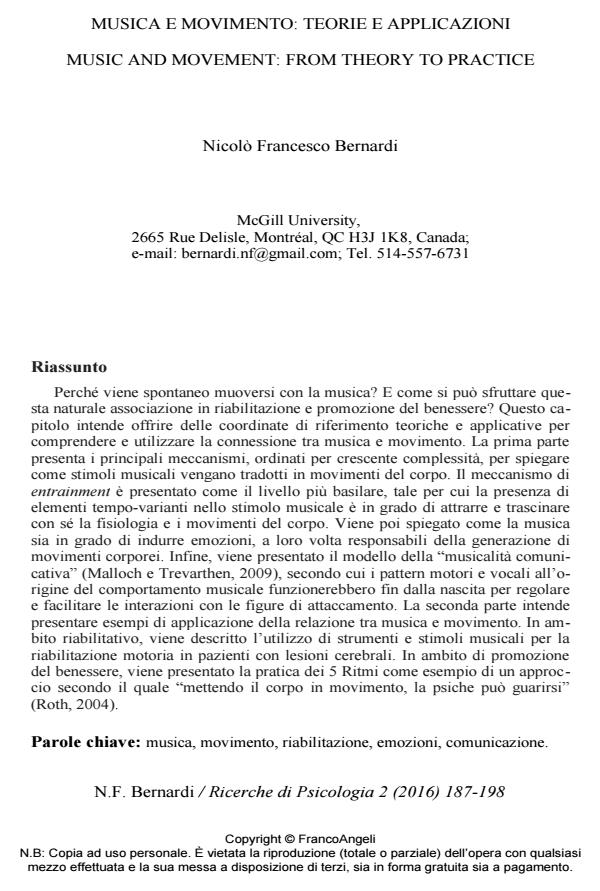
Perché viene spontaneo muoversi con la musica? E come si può sfruttare questa naturale associazione in riabilitazione e promozione del benessere? Questo capitolo intende offrire delle coordinate di riferimento teoriche e applicative per comprendere e utilizzare la connessione tra musica e movimento. La prima parte presenta i principali meccanismi, ordinati per crescente complessità, per spiegare come stimoli musicali vengano tradotti in movimenti del corpo. Il meccanismo di entrainment è presentato come il livello più basilare, tale per cui la presenza di elementi tempo-varianti nello stimolo musicale è in grado di attrarre e trascinare con sé la fisiologia e i movimenti del corpo. Viene poi spiegato come la musica sia in grado di indurre emozioni, a loro volta responsabili della generazione di movimenti corporei. Infine, viene presentato il modello della "musicalità comunicativa" (Malloch e Trevarthen, 2009), secondo cui i pattern motori e vocali all’origine del comportamento musicale funzionerebbero fin dalla nascita per regolare e facilitare le interazioni con le figure di attaccamento. La seconda parte intende presentare esempi di applicazione della relazione tra musica e movimento. In ambito riabilitativo, viene descritto l’utilizzo di strumenti e stimoli musicali per la riabilitazione motoria in pazienti con lesioni cerebrali. In ambito di promozione del benessere, viene presentato la pratica dei 5 Ritmi come esempio di un approccio secondo il quale "mettendo il corpo in movimento, la psiche può guarirsi" (Roth, 2004).
Parole chiave:Musica, movimento, riabilitazione, emozioni, comunicazione.
- Bernardi, L., Porta, C., Casucci, G., Balsamo, R., Bernardi, N. F., Fogari, R., & Sleight, P. (2009). Dynamic interactions between musical, cardiovascular, and cerebral rhythms in humans. Circulation, 119(25), 3171-3180. DOI: 10.1161/CIRCULATIONAHA.109.192192
- Bernardi, L., Porta, C., & Sleight, P. (2006). Cardiovascular, cerebrovascular, and respiratory changes induced by different types of music in musicians and non-musicians: the importance of silence. Heart, 92(4), 445-452. DOI: 10.1136/hrt.2005.064600
- Bernardi, N. F., Cioffi, M. C., Ronchi, R., Maravita, A., Bricolo, E., Zigiotto, L., ... & Vallar, G. (2015). Improving left spatial neglect through music scale playing. Journal of neuropsychology. DOI: 10.1111/jnp.12078
- Berntson, G.G., Sarter, M., & Cacioppo, J.T. (2003). Ascending visceral regulation of cortical affective information processing. European Journal of Neuroscience, 18(8), 2103-2109. DOI: 10.1046/j.1460-9568.2003.02967.x
- Bodak, R., Malhotra, P., Bernardi, N.F., Cocchini, G., & Stewart, L. (2014). Reducing chronic visuo-spatial neglect following right hemisphere stroke through instrument playing. Frontiers in human neuroscience, 8(413). DOI: 10.3389/fnhum.2014.00413
- Cant, N.B., & Benson, C.G. (2003). Parallel auditory pathways: projection patterns of the different neuronal populations in the dorsal and ventral cochlear nuclei. Brain research bulletin, 60(5), 457-474. DOI: 10.1016/S0361-9230(03)00050-9
- Davies, S. (2013). Music-to-listener emotional contagion. The Emotional Power of Music: Multidisciplinary perspectives on musical arousal, expression, and social control, 169. DOI: 10.1093/acprof:oso/9780199654888.001.0001
- DeNora, T. (2000). Music in everyday life. Cambridge University Press. DOI: 10.1017/CBO9780511489433
- Frijda, N.H., & Scherer, K.R. (2009). Emotion definitions (psychological perspectives). In D. Sander and K. R. Scherer (eds), Oxford Companion to Emotion and the Affective Sciences, pp. 142-143. Oxford: Oxford University Press. DOI: 10.1108/09504121011077110
- Griffiths, T. D., & Warren, J. D. (2002). The planum temporale as a computational hub. Trends in neurosciences, 25(7), 348-353. DOI: 10.1016/S0166-2236(02)02191-4
- Grahn, J.A., & Brett, M. (2007). Rhythm and beat perception in motor areas of the brain. Cognitive Neuroscience, Journal of, 19(5), 893-906. DOI: 10.1162/jocn.2007.19.5.893
- Janata, P., Tomic, S.T., & Haberman, J.M. (2012). Sensorimotor coupling in music and the psychology of the groove. Journal of Experimental Psychology: General, 141(1), 54. DOI: 10.1037/a0024208
- Jäncke, L. (2008). Music, memory and emotion. Journal of biology, 7(6), 1. DOI: 10.1186/jbiol82
- Lahav, A., Saltzman, E., & Schlaug, G. (2007). Action representation of sound: audiomotor recognition network while listening to newly acquired actions. The journal of neuroscience, 27(2), 308-314. DOI: 10.1523/JNEUROSCI.4822-06.2007
- Lim, I., van Wegen, E., De Goede, C., Deutekom, M., Nieuwboer, A., Willems, A., ... & Kwakkel, G. (2005). Effects of external rhythmical cueing on gait in patients with Parkinson's disease: a systematic review. Clinical rehabilitation, 19(7), 695-713. DOI: 10.1191/0269215505cr906oa
- Maclean, N., Pound, P., Wolfe, C., & Rudd, A. (2000). Qualitative analysis of stroke patients' motivation for rehabilitation. Bmj, 321(7268), 1051-1054. DOI: 10.1136/bmj.321.7268.1051
- Malloch, S., & Trevarthen, C. (2009). Communicative musicality. Exploring the basis of human companionship. DOI: 10.1111/j.1752-0118.2009.01158_1.x
- Nieuwboer, A., Kwakkel, G., Rochester, L., Jones, D., van Wegen, E., Willems, A. M., ... & Lim, I. (2007). Cueing training in the home improves gait-related mobility in Parkinson’s disease: the RESCUE trial. Journal of Neurology, Neurosurgery & Psychiatry, 78(2), 134-140. DOI: 10.1136/jnnp.200X.097923
- Roth, G. (1997). Sweat your prayers: Movement as spiritual practice. JP Tarcher/Putnam.
- Roth, G. (2004). Connections: The Five Threads of Intuitive Wisdom. JP. Tarcher/Penguin.
- Salimpoor, V.N., Zald, D.H., Zatorre, R.J., Dagher, A., & McIntosh, A.R. (2015). Predictions and the brain: how musical sounds become rewarding.Trends in cognitive sciences, 19(2), 86-91. DOI: 10.1016/j.tics.2014.12.001
- Scherer, K.R. (2005). What are emotions? And how can they be measured?.Social science information, 44(4), 695-729. DOI: 10.1177/0539018405058216
- Scherer, K.R., & Coutinho, E. (2013). How music creates emotion: a multifactorial process approach. The emotional power of music, 121-45. DOI: 10.1093/acprof:oso/9780199654888.001.0001
- Schneider, S., Schönle, P.W., Altenmüller, E., & Münte, T.F. (2007). Using musical instruments to improve motor skill recovery following a stroke. Journal of neurology, 254(10), 1339-1346. DOI: 10.1007/s00415-006-0523-2
- Thaut, M.H., Kenyon, G.P., Hurt, C.P., McIntosh, G.C., & Hoemberg, V. (2002). Kinematic optimization of spatiotemporal patterns in paretic arm training with stroke patients. Neuropsychologia, 40(7), 1073-1081. DOI : 10.1016/S0028-3932(01)00141-5.
- Trainor, L.J., Austin, C.M., & Desjardins, R.N. (2000). Is infant-directed speech prosody a result of the vocal expression of emotion?. Psychological science, 11(3), 188-195. DOI: 10.1111/1467-9280.00240
- Zatorre, R.J., Chen, J.L., & Penhune, V.B. (2007). When the brain plays music: auditory–motor interactions in music perception and production. Nature reviews neuroscience, 8(7), 547-558. DOI :10.1038/nrn2152.
Nicolò Francesco Bernardi, Musica e movimento: teorie e applicazioni in "RICERCHE DI PSICOLOGIA " 2/2016, pp 187-198, DOI: 10.3280/RIP2016-002004