La teoria della mente nell'invecchiamento: la "conquista della saggezza"?
Titolo Rivista RICERCHE DI PSICOLOGIA
Autori/Curatori Antonella Marcheti, Ilaria Castelli, Annalisa Valle, Davide Massaro
Anno di pubblicazione 2016 Fascicolo 2016/1
Lingua Italiano Numero pagine 16 P. 63-78 Dimensione file 78 KB
DOI 10.3280/RIP2016-001005
Il DOI è il codice a barre della proprietà intellettuale: per saperne di più
clicca qui
Qui sotto puoi vedere in anteprima la prima pagina di questo articolo.
Se questo articolo ti interessa, lo puoi acquistare (e scaricare in formato pdf) seguendo le facili indicazioni per acquistare il download credit. Acquista Download Credits per scaricare questo Articolo in formato PDF
FrancoAngeli è membro della Publishers International Linking Association, Inc (PILA), associazione indipendente e non profit per facilitare (attraverso i servizi tecnologici implementati da CrossRef.org) l’accesso degli studiosi ai contenuti digitali nelle pubblicazioni professionali e scientifiche.
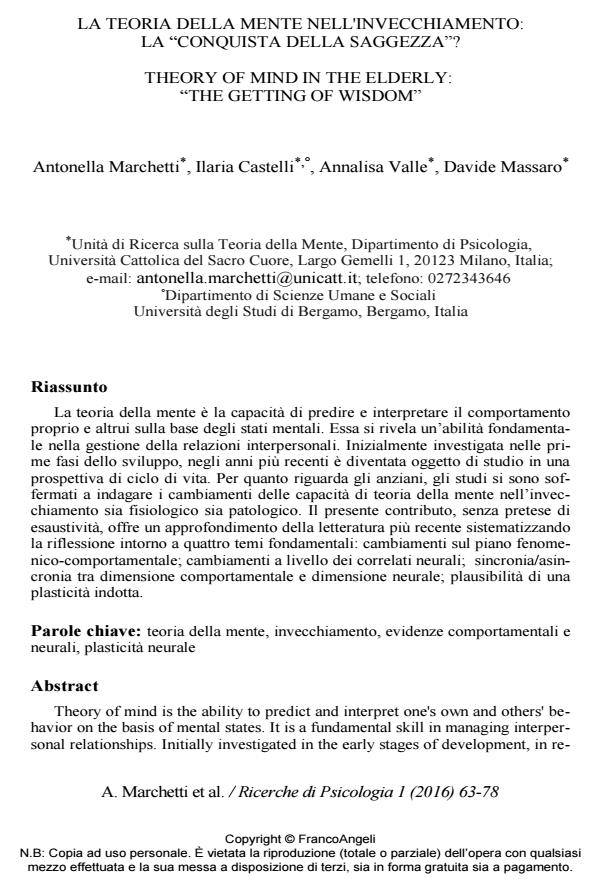
La teoria della mente è la capacità di predire e interpretare il comportamento proprio e altrui sulla base degli stati mentali. Essa si rivela un’abilità fondamentale nella gestione della relazioni interpersonali. Inizialmente investigata nelle prime fasi dello sviluppo, negli anni più recenti è diventata oggetto di studio in una prospettiva di ciclo di vita. Per quanto riguarda gli anziani, gli studi si sono soffermati a indagare i cambiamenti delle capacità di teoria della mente nell’invecchiamento sia fisiologico sia patologico. Il presente contributo, senza pretese di esaustività, offre un approfondimento della letteratura più recente sistematizzando la riflessione intorno a quattro temi fondamentali: cambiamenti sul piano fenomenico- comportamentale; cambiamenti a livello dei correlati neurali; sincronia/asincronia tra dimensione comportamentale e dimensione neurale; plausibilità di una plasticità indotta.
Parole chiave:Teoria della mente, invecchiamento, evidenze comportamentali e neurali, plasticità neurale
- Cavallini, E., Bianco, F., Bottiroli, S., Rosi, A., Vecchi, T., & Lecce, S. (2015). Training for generalization in Theory of Mind: a study with older adults. Front Psychol, 6, 1123. DOI: 10.3389/fpsyg.2015.01123
- Chaby, L., & Narme, P. (2009). [Processing facial identity and emotional expression in normal aging and neurodegenerative diseases]. Psychol Neuropsychiatr Vieil, 7(1), 31-42. DOI: 10.1684/pnv.2008.0154
- Charlton, R.A., Barrick, T.R., Markus, H.S., & Morris, R.G. (2009). Theory of mind associations with other cognitive functions and brain imaging in normal aging. Psychol Aging, 24(2), 338-348. DOI: 10.1037/a0015225
- Corbetta, M., Patel, G., & Shulman, G.L. (2008). The reorienting system of the human brain: from environment to theory of mind. Neuron, 58(3), 306-324. DOI: 10.1016/j.neuron.2008.04.017
- Craig, J.S., Hatton, C., Craig, F.B., & Bentall, R.P. (2004). Persecutory beliefs, attributions and theory of mind: Comparison of patients with paranoid delu sions, Asperger's syndrome and healthy controls. Schizophrenia Research, 69(1), 29-33. DOI: 10.1016/S0920-9964(03)00154-3
- Cuerva, A.G., Sabe, L., Kuzis, G., Tiberti, C., Dorrego, F., & Starkstein, S.E.M. (2001). Theory of Mind and Pragmatic Abilities in Dementia. Neuropsychiatry, Neuropsychology, & Behavioral Neurology, 14, 3, 153-158.
- Decety, J., & Lamm, C. (2007). The role of the right temporoparietal junction in social interaction: how low-level computational processes contribute to metacognition. Neuroscientist, 13(6), 580-593. DOI: 10.1177/1073858407304654
- Duval, C., Piolino, P., Bejanin, A., Eustache, F., & Desgranges, B. (2011). Age effects on different components of theory of mind. Consciousness and Cognition, 20(3), 627-642. DOI: 10.1016/j.concog.2010.10.025
- Eddy, C.M., Sira Mahalingappa, S., & Rickards, H. E. (2012). Is Huntington's disease associated with deficits in theory of mind? Acta Neurol Scand, 126(6), 376-383. DOI: 10.1111/j.1600-0404.2012.01659.x
- Euteneuer, F., Schaefer, F., Stuermer, R., Boucsein, W., Timmermann, L., Barbe, M. T., Kalbe, E. (2009). Dissociation of decision-making under ambiguity and decision-making under risk in patients with Parkinson's disease: a neuropsychological and psychophysiological study. Neuropsychologia, 47(13), 2882-2890. DOI: 10.1016/j.neuropsychologia.2009.06.014
- Frith, C.D., & Frith, U. (2006). The neural basis of mentalizing. Neuron, 50(4), 531-534. DOI: 10.1016/j.neuron.2006.05.001
- Gallagher, H.L., & Frith, C.D. (2003). Functional imaging of 'theory of mind'. Trends in Cognitive Sciences, 7(2), 77-83. DOI: 10.1016/S1364-6613(02)00025-6
- Gallese, V. (2003). The roots of empathy: the shared manifold hypothesis and the neural basis of intersubjectivity. Psychopathology, 36(4), 171-180. DOI: 10.1159/000072786
- Gilleen, J., & David, A.S. (2005). The cognitive neuropsychiatry of delusions: From psychopathology to neuropsychology and back again. Psychological Medicine, 35(1), 5-12. DOI: 10.1017/S0033291704003976
- Gobbini, M.I., Koralek, A.C., Bryan, R.E., Montgomery, K.J., & Haxby, J.V. (2007). Two takes on the social brain: A comparison of theory of mind tasks. Journal of Cognitive Neuroscience, 19(11), 1803-1814. DOI: 10.1162/jocn.2007.19.11.1803
- Gregory, C., Lough, S., Stone, V., Erzinclioglu, S., Martin, L., Baron-Cohen, S., & Hodges, J.R. (2002). Theory of mind in patients with frontal variant frontotemporal dementia and Alzheimer's disease: theoretical and practical implications. Brain, 125(4), 752-764. DOI: 10.1093/brain/awf079
- Happe, F.G., Winner, E., & Brownell, H. (1998). The getting of wisdom: theory of mind in old age. Dev Psychol, 34(2), 358-362.
- Abu-Akel, A. (2003). A neurobiological mapping of theory of mind. Brain Research Reviews, 43(1), 29-40. DOI: 10.1016/S0165-0173(03)00190-5
- Amodio, D.M., & Frith, C.D. (2006). Meeting of minds: the medial frontal cortex and social cognition. Nat Rev Neurosci, 7(4), 268-277. DOI: 10.1038/nrn1884
- Baglio, F., Castelli, I., Alberoni, M., Blasi, V., Griffanti, L., Falini, A., Marchetti, A. (2012). Theory of mind in amnestic mild cognitive impairment: an FMRI study. J Alzheimers Dis, 29(1), 25-37. DOI: 10.3233/JAD-2011-111256
- Baron-Cohen, S. (1995). Mindblindness: An Essay on Autism and Theory of Mind. The MIT Press.
- Baron-Cohen, S. (1989). The autistic child's theory of mind: A case of specific developmental delay. Journal of Child Psychology & Psychiatry & Allied Disciplines, 30(2), 285-297. DOI: 10.1111/j.1469-7610.1989.tb00241.x.tientswithparkinson'sdisease.ParkinsonismRelatDisord,16(7),466-470.DOI:10.1016/j.parkreldis.2010.04.014
- Bodden, M.E., Mollenhauer, B., Trenkwalder, C., Cabanel, N., Eggert, K.M., Unger, M.M., Bar. (2009). Dissociation of decision-making under ambiguity and decision-making under risk in patients with Parkinson's disease: a neuropsychological and psychophysiological study. Neuropsychologia, 47(13), 2882-2890. DOI: 10.1016/j.parkreldis.2010.04.014
- Bottiroli, S., Cavallini, E., Ceccato, I., Vecchi, T., & Lecce, S. (2016). Theory of Mind in aging: Comparing cognitive and affective components in the faux pas test. Arch Gerontol Geriatr, 62, 152-162. DOI: 10.1016/j.archger.2015.09.009
- Brosgole, L., & Weisman, J. (1995). Mood Recognition Across the Ages. Int J Neurosci, 82(3-4), 169-189. DOI: 10.3109/00207459508999800
- Cabinio, M., Rossetto, F., Blasi, V., Savazzi, F., Castelli, I., Massaro, D., Baglio, F. (2015). Mind-Reading Ability and Structural Connectivity Changes in Aging. Front. Psychol., 6, 286. DOI: 10.3389/fpsyg.2015.01808
- Calder, A.J., Keane, J., Manly, T., Sprengelmeyer, R., Scott, S., Nimmo-Smith, I., & Young, A.W. (2003). Facial expression recognition across the adult life span. Neuropsychologia, 41(2), 195-202. DOI: 10.1016/S0028-3932(02)00149-5
- Caoile, J.D. (2002). Theory of mind, empathy, and insight in alzheimer's disease. Ph.D.
- Castelli, I., Baglio, F., Blasi, V., Alberoni, M., Falini, A., Liverta-Sempio, O., Marchetti, A. (2010). Effects of aging on mindreading ability through the eyes: an fMRI study. Neuropsychologia, 48(9), 2586-2594. DOI: 10.1016/j.-neuropsychologia.2010.05.005
- Castelli, I., Pini, A., Alberoni, M., Liverta-Sempio, O., Baglio, F., Massaro, D., Nemni, R. (2011). Mapping levels of theory of mind in Alzheimer's disease: a preliminary study. Aging Ment Health, 15(2), 157-168. DOI: 10.1080/13607863.2010.513038
- Henry, J.D., Phillips, L.H., Ruffman, T., & Bailey, P.E. (2013). A meta-analytic review of age differences in theory of mind. Psychol Aging, 28(3), 826-839.
- Kipps, C.M., & Hodges, J.R. (2006). Theory of mind in frontotemporal dementia. Social Neuroscience, 1(3-4), 235-244. DOI: 10.1080/17470910600989847.Lecce,S.,Bottiroli,S.,Bianco,F.,Rosi,A.,&Cavallini,E.(2015).TrainingolderadultsonTheoryofMind(ToM):transferonmetamemory.ArchGerontolGeriatr,60(1),217-226.DOI:10.1016/j.archger.2014.10.001
- Leslie, A., & Roth, D. (1994). What autism teaches us about metarepresentation. In S. T.-F. Baron-Cohen, Helen ; et al. (Ed.), Understanding other minds: Perspectives from autism. London, Oxford University Press:.
- Leslie, A.M. (1987). Pretense and representation: The origins of "theory of mind.". Psychological Review, 94(4), 412-426. DOI: 10.1037/0033-295X.94.4.412
- Leslie, A.M., & Thaiss, L. (1992). Domain specificity in conceptual development: Neuropsychological evidence from autism. Cognition, 43(3), 225-251. DOI: 10.1016/0010-0277(92)90013-8
- Lough, S., Kipps, C.M., Treise, C., Watson, P., Blair, J.R., & Hodges, J.R. (2006). Social reasoning, emotion and empathy in frontotemporal dementia. Neuropsychologia, 44(6), 950-958. DOI: 10.1016/j.neuropsychologia.2005.08.009
- Maylor, E.A., Moulson, J M., Muncer, A.M., & Taylor, L.A. (2002). Does performance on theory of mind tasks decline in old age? British Journal of Psychology, 93(4), 465-485. DOI: 10.1348/000712602761381358
- McDowella, C.L., Harrisona, D.W., & Demareea, H.A. (1994). Is right hemisphere decline in the perception of emotion a function of aging? International Journal of Neuroscience, 79, 1-2, 1-11. DOI: 10.3109/00207459408986063
- McKinnon, M.C., & Moscovitch, M. (2007). Domain-general contributions to social reasoning: Theory of mind and deontic reasoning re-explored. Cognition, 102(2), 179-218. DOI: 10.1016/j.cognition.2005.12.011
- Mengelberg, A., & Siegert, R.J. (2003). Is theory-of-mind impaired in Parkinson's disease? Cognitive Neuropsychiatry, 8(3), 191-209. DOI: 10.1080/13546800244000292
- Mimura, M., Oeda, R., & Kawamura, M. (2006). Impaired decision-making in Parkinson's disease. Parkinsonism Relat Disord, 12(3), 169-175. DOI: 10.1016/j.parkreldis.2005.12.003
- Monetta, L., Grindrod, C.M., & Pell, M.D. (2009). Irony comprehension and theory of mind deficits in patients with Parkinson's disease. Cortex, 45(8), 972-981. DOI: 10.1016/j.cortex.2009.02.021
- Neary, D., Snowden, J.S., Gustafson, L., Passant, U., Stuss, D., Black, S., Benson, D. F. (1998). Frontotemporal lobar degeneration: A consensus on clinical diagnostic criteria. Neurology, 51(6), 1546-1554. DOI: 10.1212/WNL.51.6.1546
- Pardini, M., & Nichelli, P.F. (2009). Age-related decline in mentalizing skills across adult life span. Exp Aging Res, 35(1), 98-106. DOI: 10.1080/03610730802545259
- Perner, J., & Wimmer, H. (1985). "John thinks that Mary thinks that.": Attribution of second-order beliefs by 5- to 10-year-old children. Journal of Experimental Child Psychology, 39(3), 437-471. DOI: 10.1016/0022-0965(85)90051-7
- Perner, J., & Leekam, S. (2008). The curious incident of the photo that was accused of being false: Issues of domain specificity in development, autism, and brain imaging. The Quarterly Journal of Experimental Psychology, 61(1), 76-89. DOI: 10.1080/17470210701508756
- Peron, J., Le Jeune, F., Haegelen, C., Dondaine, T., Drapier, D., Sauleau, P., Verin, M. (2010). Subthalamic nucleus stimulation affects theory of mind network: a PET study in Parkinson's disease. PLoS One, 5(3), e9919. DOI: 10.1371/journal.pone.0009919
- Peron, J., Vicente, S., Leray, E., Drapier, S., Drapier, D., Cohen, R., Verin, M. (2009). Are dopaminergic pathways involved in theory of mind? A study in Parkinson's disease. Neuropsychologia, 47(2), 406-414. DOI: 10.1016/j.neuropsychologia.2008.09.008
- Phillips, L.H., MacLean, R.D.J., & Allen, R. (2002). Age and the understanding of emotions: Neuropsychological and sociocognitive perspectives. Journals of Gerontology: Series B: Psychological Sciences & Social Sciences, 57B(6), 526-P530. DOI: 10.1093/geronb/57.6.P526
- Poletti, M., Enrici, I., & Adenzato, M. (2012). Cognitive and affective Theory of Mind in neurodegenerative diseases: neuropsychological, neuroanatomical and neurochemical levels. Neurosci Biobehav Rev, 36(9), 2147-2164. DOI: 10.1016/j.neubiorev.2012.07.004
- Poletti, M., Enrici, I., Bonuccelli, U., & Adenzato, M. (2011). Theory of Mind in Parkinson's disease. Behav Brain Res, 219(2), 342-350. DOI: 10.1016/j.bbr.2011.01.010
- Rankin, K.P., Baldwin, E., Pace-Savitsky, C., Kramer, J.H., & Miller, B.L. (2005). Self awareness and personality change in dementia. J Neurol Neurosurg Psychiatry, 76(5), 632-639. DOI: 10.1136/jnnp.2004.042879
- Roca, M., Torralva, T., Gleichgerrcht, E., Chade, A., Arevalo, G.G., Gershanik, O., & Manes, F. (2010). Impairments in social cognition in early medicated and unmedicated Parkinson disease. Cogn Behav Neurol, 23(3 ), 152-158. DOI: 10.1097/WNN.0b013e3181e078de
- Rosi, A., Cavallini, E., Bottiroli, S., Bianco, F., & Lecce, S. (2015). Promoting theory of mind in older adults: does age play a role? Aging Ment Health, 1-7. DOI: 10.1080/13607863.2015.1049118
- Ruffman, T., Henry, J.D., Livingstone, V., & Phillips, L.H. (2008). A meta-analytic review of emotion recognition and aging: implications for neuropsychological models of aging. Neurosci Biobehav Rev, 32(4), 863-881. DOI: 10.1016/j.neubiorev.2008.01.001
- Saltzman, J., Strauss, E., Hunter, M., & Archibald, S. (2000). Theory of mind and executive functions in normal human aging and Parkinson's disease. Journal of the International Neuropsychological Society, 6(7), 781-788. DOI: 10.1017/S1355617700677056
- Santangelo, G., Trojano, L., Barone, P., Errico, D., Grossi, D., & Vitale, C. (2013). Apathy in Parkinson's disease: diagnosis, neuropsychological correlates, pathophysiology and treatment. Behav Neurol, 27(4), 501-513. DOI: 10.3233/BEN-129025
- Saxe, R., Carey, S., & Kanwisher, N. (2004). Understanding other minds: Linking developmental psychology and functional neuroimaging. Annual Review of Psychology, 55, 87-124. DOI: 10.1146/annurev.psych.55.090902.142044
- Saxe, R., & Kanwisher, N. (2003). People thinking about thinking peopleThe role of the temporo-parietal junction in “theory of mind”. NeuroImage, 19(4), 1835-1842. DOI: 10.1016/S1053-8119(03)00230-1
- Saxe, R., & Powell, L.J. (2006). It's the Thought That Counts: Specific Brain Regions for One Component of Theory of Mind. Psychological Science, 17(8), 692-699. DOI: 10.1111/j.1467-9280.2006.01768.x
- Schurz, M., & Perner, J. (2015). An evaluation of neurocognitive models of theory of mind. Front Psychol, 6, 1610. DOI: 10.3389/fpsyg.2015.01610
- Schurz, M., Radua, J., Aichhorn, M., Richlan, F., & Perner, J. (2014). Fractionating theory of mind: a meta-analysis of functional brain imaging studies. Neurosci Biobehav Rev, 42, 9-34. DOI: 10.1016/j.neubiorev.2014.01.009
- Siegal, M., & Varley, R. (2002). Neural systems involved in "theory of mind". Nat Rev Neurosci, 3(6), 463-471. DOI: 10.1038/nrn844
- Slessor, G., Phillips, L.H., & Bull, R. (2007). Exploring the specificity of age-related differences in theory of mind tasks. Psychol Aging, 22(3), 639-643. DOI: 10.1037/0882-7974.22.3.639
- Snowden, J.S., Gibbons, Z.C., Blackshaw, A., Doubleday, E., Thompson, J., Craufurd, D., Neary, D. (2003). Social cognition in frontotemporal dementia and Huntington's disease. Neuropsychologia, 41(6), 688-701. DOI: 10.1016/S0028-3932(02)00221-X
- Sullivan, K., Zaitchik, D., & Tager-Flusberg, H. (1994). Preschoolers can attribute second-order beliefs. Developmental Psychology, 30(3), 395-402. DOI: 10.1037/0012-1649.30.3.395
- Sullivan, S., & Ruffman, T. (2004). Social understanding: How does it fare with advancing years? British Journal of Psychology, 95(1), 1-18. DOI: 10.1348/000712604322779424
- Tokuchi, R., Hishikawa, N., Kurata, T., Sato, K., Kono, S., Yamashita, T., Abe, K. (2014). Clinical and demographic predictors of mild cognitive impairment for converting to Alzheimer's disease and reverting to normal cognition. J Neurol Sci, 346(1-2), 288-292. DOI: 10.1016/j.jns.2014.09.012
- Van Overwalle, F. (2009a). Interacting Minds--A Biological Basis. Science, 286(5445), 1692-1695. DOI: 10.1126/science.286.5445.1692
- Van Overwalle, F. (2009b). Social cognition and the brain: a meta-analysis. Hum Brain Mapp, 30(3), 829-858. DOI: 10.1002/hbm.20547
- van Veluw, S.J., & Chance, S.A. (2014). Differentiating between self and others: an ALE meta-analysis of fMRI studies of self-recognition and theory of mind. Brain Imaging Behav, 8(1), 24-38. DOI: 10.1007/s11682-013-9266-8
- Assessing metarepresentational abilities in adolescence: an exploratory study on relationships between definitional competence and theory of mind Alessia Cornaggia, Federica Bianco, Ilaria Castelli, Carmen Belacchi, in Frontiers in Psychology 1456432/2024
DOI: 10.3389/fpsyg.2024.1456432 - Humanity in Psychology Antonella Marchetti, Edoardo Alfredo Bracaglia, pp.179 (ISBN:978-3-031-30639-6)
Antonella Marcheti, Ilaria Castelli, Annalisa Valle, Davide Massaro, La teoria della mente nell'invecchiamento: la "conquista della saggezza"? in "RICERCHE DI PSICOLOGIA " 1/2016, pp 63-78, DOI: 10.3280/RIP2016-001005