One Health between social sciences and veterinary medicine
Titolo Rivista SALUTE E SOCIETÀ
Autori/Curatori Francesca Zaltron, Giuseppe Favaro, Giuseppe Ru, Laura Tomassone
Anno di pubblicazione 2026 Fascicolo 2026/2
Lingua Inglese Numero pagine 11 P. 67-77 Dimensione file 274 KB
DOI 10.3280/SES2026-002007
Il DOI è il codice a barre della proprietà intellettuale: per saperne di più
clicca qui
Qui sotto puoi vedere in anteprima la prima pagina di questo articolo.
Se questo articolo ti interessa, lo puoi acquistare (e scaricare in formato pdf) seguendo le facili indicazioni per acquistare il download credit. Acquista Download Credits per scaricare questo Articolo in formato PDF
FrancoAngeli è membro della Publishers International Linking Association, Inc (PILA), associazione indipendente e non profit per facilitare (attraverso i servizi tecnologici implementati da CrossRef.org) l’accesso degli studiosi ai contenuti digitali nelle pubblicazioni professionali e scientifiche.
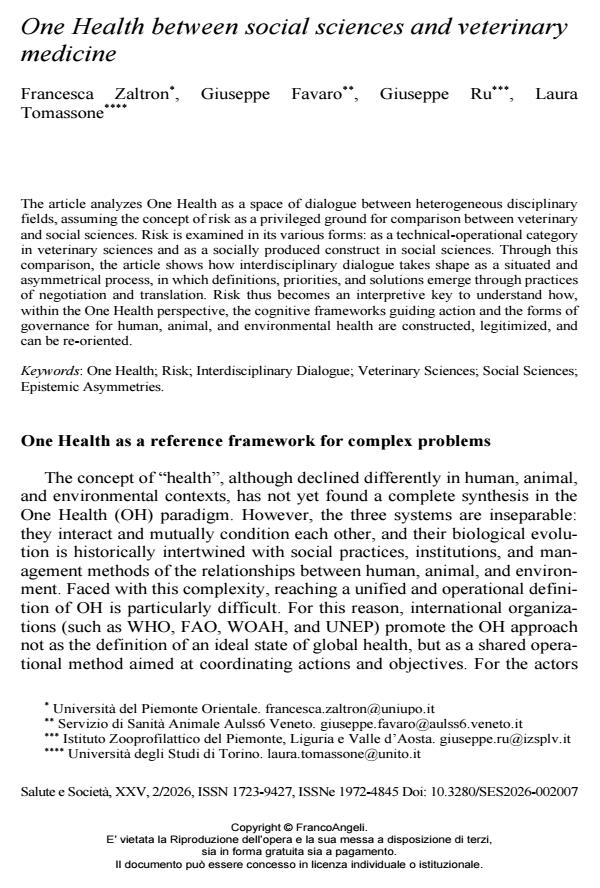
The article analyzes One Health as a space of dialogue between heterogeneous disciplinary fields, assuming the concept of risk as a privileged ground for comparison between veterinary and social sciences. Risk is examined in its various forms: as a technical-operational category in veterinary sciences and as a socially produced construct in social sciences. Through this comparison, the article shows how interdisciplinary dialogue takes shape as a situated and asymmetrical process, in which definitions, priorities, and solutions emerge through practices of negotiation and translation. Risk thus becomes an interpretive key to understand how, within the One Health perspective, the cognitive frameworks guiding action and the forms of governance for human, animal, and environmental health are constructed, legitimized, and can be re-oriented.
L’articolo analizza la One Health come spazio di dialogo tra saperi disciplinari eterogenei, assumendo il concetto di rischio come terreno privilegiato di confronto tra scienze veterinarie e scienze sociali. Il rischio viene esaminato nelle sue diverse declinazioni: come categoria tecnico-operativa nelle scienze veterinarie e come costrutto socialmente prodotto nelle scienze sociali. Attraverso questo confronto, l’articolo mostra come il dialogo interdisciplinare si configuri come un processo situato e asimmetrico, in cui definizioni, priorità e soluzioni emergono attraverso pratiche di negoziazione e traduzione. Il rischio diventa così una chiave interpretativa per comprendere come, nella prospettiva One Health, si costruiscono, si legittimano e possono essere riorientati i quadri conoscitivi che guidano l’azione e le forme di governance della salute umana, animale e ambientale.
Parole chiave:One Health; Rischio; Dialogo interdisciplinare; Scienze veterinarie; Scienze sociali; Asimmetrie epistemiche
- Balduzzi G., Favretto A.R. (2024). Social science and the relationship between human and nonhuman within the One Health framework. Salute e Società, 3: 5-24. DOI: 10.3280/SES2024-00300
- Barnett J., Pfeiffer D.U., Hoque A., Giassudin M., Flora M.S., Biswas P.K., Debnath N., Fournie G. (2020). Practicing co-production and interdisciplinary: Challenges and implications for One Health research. Preventive Veterinary Medicine, 177: 104949.
- Beck U. (1992). Risk and society. Toward a New Modernity. London: Sage.
- Beck U., Grande E. (2010). Varieties of second modernity: Extra-European experiences and perspectives. The British Journal of Sociology, 61(3): 409-443.
- Bourdieu P. (1998). Le régles de l’art. Genése et structure du champ littéraire. Paris: Seuil.
- Cassidy A. (2016). One Medicine? Advocating (Inter)disciplinarity at the Interfaces of Animal Health, Human Health, and the Environment. In: Frickel S., Albert M., Prainsack B., eds., Investigating Interdisciplinary Collaboration: Theory and Practiceacross Disciplines. New Brunswick, NJ: Rutgers University Press.
- Chien Y. (2013). How did international agencies perceive the avian influenza problem? The adoption & manufacture of the ‘one world, one health’ framework. Sociology of Health & Illness, 35(2): 213-226.
- FAO, UNEP, WHO, and WOAH (2022). One Health Joint Plan of Action (2022-2026). Working together for the health of humans, animals, plants and the environment. Rome.
- Favretto A.R. (2018). Crisi della fiducia, diritto e disuguaglianze nella protezione della salute pubblica. In: D’Alessandro L., Montanari A., a cura di, Diseguaglianze e crisi della fiducia. Milano: FrancoAngeli.
- Giddens A. (1990). The Consequences of Modernity. Cambridge: Polity Press.
- Hinchliffe S. (2015), More than one world, more than one health: Re-configuring interspecies health. Social Science & Medicine, 129: 28-35.
- Klinke A., Renn O. (2006). Systemic Risks as Challenge for Policy Making in Risk Governance. Forum Qualitative Sozialforschung/ Forum: Qualitative Social Research, 7(1): Art. 33.
- Lapinski M.K., Funk J.A., Moccia L.T. (2015). Recommendations for the role of social science research in One Health. Social Science & Medicine, 129: 51-60.
- Leboeuf A. (2011). Making Sense of One Health Cooperating at the Human- Animal-Ecosystem Health Interface, IFRI Health and Environment Reports 7. Paris: Institut français des Relations Internationales (IfRI).
- Lupton D. (1999). Risk. London: Routledge.
- Michalon J. (2020). Accounting for One Health: Insights from the social sciences. Parasite, 27(56): 1-10.
- One Health High-Level Expert Panel – OHHLEP (2022). One Health: A new definition for a sustainable and healthy future. PLoS Pathogens, 18(6): e1010537.
Francesca Zaltron, Giuseppe Favaro, Giuseppe Ru, Laura Tomassone, One Health between social sciences and veterinary medicine in "SALUTE E SOCIETÀ" 2/2026, pp 67-77, DOI: 10.3280/SES2026-002007