Beyond the Green Classroom. Climate Migration in European Schools: Student Perceptions and Educational Challenges
Journal title PRISMA Economia - Società - Lavoro
Author/s Gabriele Sospiro, Bianca Lombardi
Publishing Year 2026 Issue 2025/2
Language Italian Pages 29 P. 67-95 File size 383 KB
DOI 10.3280/PRI2025-002006
DOI is like a bar code for intellectual property: to have more infomation
click here
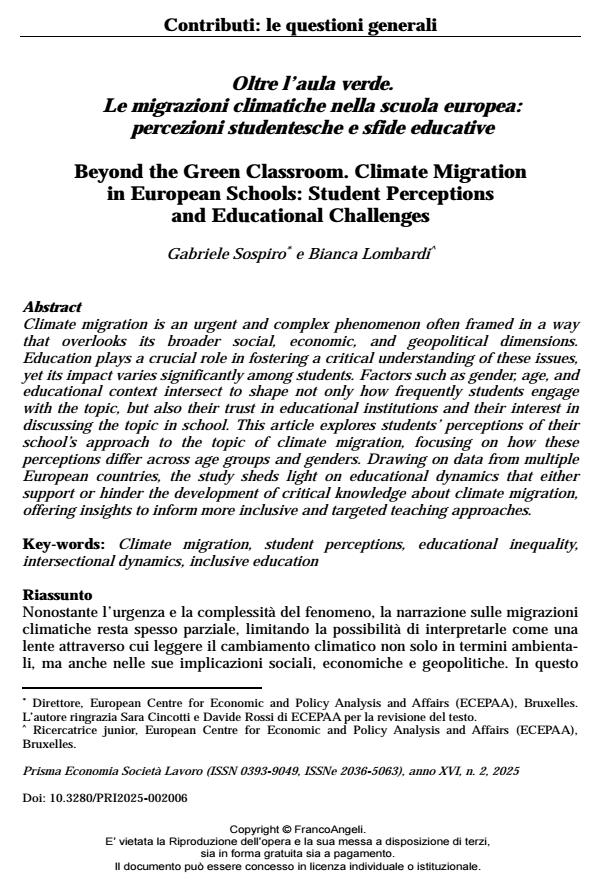
Below, you can see the article first page
If you want to buy this article in PDF format, you can do it, following the instructions to buy download credits
FrancoAngeli is member of Publishers International Linking Association, Inc (PILA), a not-for-profit association which run the CrossRef service enabling links to and from online scholarly content.
Climate migration is an urgent and complex phenomenon often framed in a way that overlooks its broader social, economic, and geopolitical dimensions. Education plays a crucial role in fostering a critical understanding of these issues, yet its impact varies significantly among students. Factors such as gender, age, and educational context intersect to shape not only how frequently students engage with the topic, but also their trust in educational institutions and their interest in discussing the topic in school. This article explores students’ perceptions of their school’s approach to the topic of climate migration, focusing on how these perceptions differ across age groups and genders. Drawing on data from multiple European countries, the study sheds light on educational dynamics that either support or hinder the development of critical knowledge about climate migration, offering insights to inform more inclusive and targeted teaching approaches.
Keywords: Climate migration, student perceptions, educational inequality, intersectional dynamics, inclusive education
Gabriele Sospiro, Bianca Lombardi, Oltre l’aula verde. Le migrazioni climatiche nella scuola europea: percezioni studentesche e sfide educative in "PRISMA Economia - Società - Lavoro" 2/2025, pp 67-95, DOI: 10.3280/PRI2025-002006