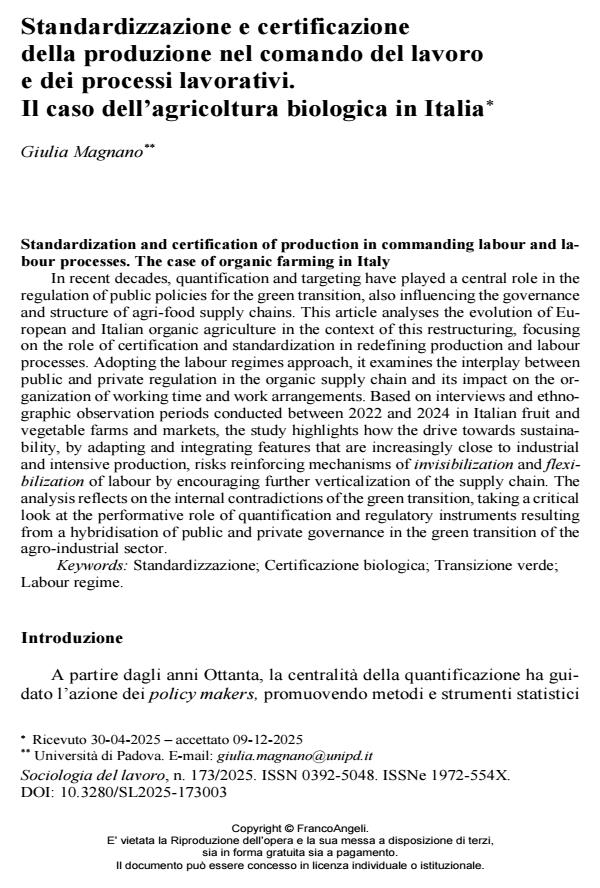
Standardizzazione e certificazione della produzione nel comando del lavoro e dei processi lavorativi. Il caso dell’agricoltura biologica in Italia
Titolo Rivista SOCIOLOGIA DEL LAVORO
Autori/Curatori Giulia Magnano
Anno di pubblicazione 2026 Fascicolo 2025/173
Lingua Italiano Numero pagine 28 P. 31-58 Dimensione file 376 KB
DOI 10.3280/SL2025-173003
Il DOI è il codice a barre della proprietà intellettuale: per saperne di più
clicca qui
Qui sotto puoi vedere in anteprima la prima pagina di questo articolo.
Se questo articolo ti interessa, lo puoi acquistare (e scaricare in formato pdf) seguendo le facili indicazioni per acquistare il download credit. Acquista Download Credits per scaricare questo Articolo in formato PDF
FrancoAngeli è membro della Publishers International Linking Association, Inc (PILA), associazione indipendente e non profit per facilitare (attraverso i servizi tecnologici implementati da CrossRef.org) l’accesso degli studiosi ai contenuti digitali nelle pubblicazioni professionali e scientifiche.
In recent decades, quantification and targeting have played a central role in the regulation of public policies for the green transition, also influencing the governance and structure of agri-food supply chains. This article analyses the evolution of Eu-ropean and Italian organic agriculture in the context of this restructuring, focusing on the role of certification and standardization in redefining production and labour processes. Adopting the labour regimes approach, it examines the interplay between public and private regulation in the organic supply chain and its impact on the or-ganization of working time and work arrangements. Based on interviews and ethno-graphic observation periods conducted between 2022 and 2024 in Italian fruit and vegetable farms and markets, the study highlights how the drive towards sustaina-bility, by adapting and integrating features that are increasingly close to industrial and intensive production, risks reinforcing mechanisms of invisibilization and flexi-bilization of labour by encouraging further verticalization of the supply chain. The analysis reflects on the internal contradictions of the green transition, taking a critical look at the performative role of quantification and regulatory instruments resulting from a hybridisation of public and private governance in the green transition of the agro-industrial sector.
Parole chiave:Standardizzazione; Certificazione biologica; Transizione verde; Labour regime.
- Abbott, K.W., D. Levi-Faur, D. Snidal. (2017). Theorizing Regulatory Intermediaries: The RIT Model. Annals of the American Academy of Political and Social Science 670 (1): 14– 35. DOI: 10.1177/0002716216688272
- Anderson, B. (2010). Migration, Immigration Controls and the Fashioning of Precarious Workers. Work, Employment & Society 24, 6: 300–317. DOI: 10.1177/095001701036214
- Augère-Granier, M-L. (2021). Migrant seasonal workers in the European agricultural sector. European Parliamentary Research Service. PE 689.347.
- Gereffi G. (1999). International trade and industrial upgrading in the apparel commodity chain. In Journal of International Economics. 48 (1): 37-70.
- Baglioni, E., Campling L., Coe N.M., Smith A. (2022). Introduction: Labour Regimes and Global Production. In: Baglioni, E., Campling L., Coe N.M., Smith A. (a cura di), Labour Regimes and Global Production, pp. 1–26. Newcastle: Agenda Publishing.
- Benegiamo, M., Guillibert P., Villa M. (2023). Work and welfare transformations in the cli-mate crisis: A research pathway towards an ecological, just transition. Sociologia del la-voro: 165 (1), 9-29.
- Benvegnu´, C., Haidinger, B., Sacchetto, D. (2018). Restructuring Labour Relations and Em-ployment in the European Logistics Sector: Unions’ Responses to a Segmented Work-force, in (a cura di) Doellgast, V., Lillie, N., and Pulignano, V., Reconstructing Solidarity: Labour Unions, Precarious Work, and the Politics of Institutional Change in Europe, Ox-ford, Oxford Academic: 83–103.
- Berbec, A.K., Feledyn-Szewczyk, B., Thalmann, C., Wyss, R., Grenz, J., Kopinski, J., Sta-lenga, J., Radzikowski, P. (2018). Assessing the Sustainability Performance of Organic and Low-Input Conventional Farms from Eastern Poland with the RISE Indicator Sys-tem’. Sustainability (Switzerland). 10 (6).
- Bidarbakhtnia, A. (2019). Measuring Sustainable Development Goals (SDGs): An Inclusive Approach. Global Policy 11 (1): 56–67. DOI: 10.1111/1758-5899.12774
- Bonanno, A., Cavalcanti, J. (2014). Introduction. in Id. (a cura di). Labor Relations in Glob-alized Food. Bingley, Emerald.
- Borras, S.M. Jr., Backes, S., Herre, R., Michele, L., Mills, E. (2016). Land Grabbing and Human Rights: The Involvement of European Corporate and Financial Entities in Land Grabbing Outside the European Union. Research Paper accessibile al sito: https://www.europarl.europa.eu/thinktank/en/document/EXPO_STU(2016)578007 (Consultato a marzo 2024).
- Borghi, V., Giullari, B. (2015). Trasformazioni delle basi informative e immaginazione socio-logica. Rassegna Italiana di Sociologia. 56 (3-4): 379-404. DOI: 10.1423/81797.
- Botticello, J., Gregson N., Crang M., Calestani M., Krzywoszynska A. (2014). Doing the “dirty work of the Work” of the Green Economy: Resource Recovery and Migrant Labour in the EU. European Urban and Regional Studies. 23(4): 541-555. DOI: 10.1177/0969776414554489
- Bubbico, D., Di Nunzio, D., Dorigatti, L., Pedaci, M. (2023). Filiere Produttive, Condizioni Di Lavoro e Azione Sindacale. Quaderni di Rassegna Sindacale. Lavori 2: 5–14.
- Brown, W. (2015). Undoing the Demos: Neoliberalism’s Stealth Revolution, MIT Press, Cam-bridge, MA.
- Brunsson N., Jacobsson B. (2000). A World of Standards. Oxford, Oxford University Press.
- Buck, D., Getz C., Guthman J. (1997). From Farm to Table: The Organic Vegetable Com-modity Chain of Northern California. Sociologia Ruralis. 37: 3–20. DOI: 10.1111/1467-9523.00033
- Caruso, F. S. (2018). Certificazioni e lavoro nelle filiere agroalimentari. Il caso di GlobalGap Italia. Meridiana: Agricolture e Cibo, 93: 155–78. Roma, Viella. https://www.jstor.org/stable/26778679
- Commissione Europea (2020). Farm to Fork Strategy for a Fair, Healthy and Environmen-tally Friendly Food System. Testo disponibile al sito: https://food.ec.europa.eu/horizon-tal-topics/farm-fork-strategy_en?prefLang=it (Consultato il 12/02/2025).
- Commissione Europea (2025). The 28 CAP Strategic Plans Underway. Summary of imple-mentation 2003-2024. Testo disponibile al sito: https://agriculture.ec.europa.eu/cap-my-country/cap-strategic-plans_it (Consultato a settembre, 2025).
- Corrado, A. (2018). Agricoltura Biologica, Convenzionalizzazione e Catene Del Valore. Me-ridiana: Agricolture e Cibo, 93, 155–78. Roma, Viella. https://www.jstor.org/sta-ble/26778675
- Corrado, A., Perrotta D., de Castro C. (2017). Introduction. Cheap Food, Cheap Labour, High Profits. Agriculture and Mobility in the Mediterranean. In: Corrado A., de Castro C., Per-rotta D., (a cura di), Migration and Agriculture. Mobility and Change in the Mediterra-nean Area. Londra, Routledge.
- de Castro Pericacho, C., Gadea Montesinos E., Sánchez García M.A. (2021). Estandarizadores. La Nueva Burocracia Privada Que Controla La Calidad y La Seguridad Alimentaria En Las Cadenas Globales Agrícolas. Revista Española de Sociología 30 (1): a16.
- Décosse, F., Desalvo A. (2017). Les détachés de l’agriculture intensive. Plein Droit. 113 (2): 7-10.
- Desrosières, A. (2011). The Economics of Convention and Statistics: The Paradox of Origins. Historical Social Research/Historische Sozialforschung, 36 (4(138)), 64-81.
- De Wit, J., Verhoog H. (2007). Organic Values and the Conventionalization of Organic Ag-riculture. NJAS: Wageningen Journal of Life Sciences 54 (4): 449–62. DOI: 10.1016/S1573-5214(07)80015-7
- Dumont, A. M., Baret P.V. (2017). Why Working Conditions Are a Key Issue of Sustainabil-ity in Agriculture? A Comparison between Agroecological, Organic and Conventional Vegetable Systems. Journal of Rural Studies 56:53–64.
- Eriksen, T. H. (2017). Overheating: An Anthropology of Accelerated Change. Londra, Pluto Press.
- Esping Andersen, G., Gallie, D., Hemerijck, A. e J. Myles. (2002). Why We Need a New Wel-fare State, Oxford, Oxford University Press.
- Finger, R., Fabry, A., Kammer, M., Candel, J., Dalhaus, T., e Meemken, E. M. (2024). Farmer Protests in Europe 2023–2024. EuroChoices 23, 3: 59–63. DOI: 10.1111/1746-692X.1245
- Fondazione Metes. (2024). Bollettino Statistico della Fondazione Metes n. 18. Marzo 2024. FLAI CGIL. Accessibile al sito: https://www.fondazionemetes.it/wp-con-tent/uploads/2024/04/Bollettino-Statistico-N.-18-PER-SITO.pdf (Consultato ad aprile 2025).
- Friedland, W. (1984). Commodity systems analysis. Pp. 221-235 in (a cura di) H. Schwarz-weller Research in Rural Sociology and Development, Volume 1 (London: JAI Press).
- Friedmann, H. (1982). The Political Economy of Food: The Rise and Fall of the Postwar International Food Order’. American Journal of Sociology 88: 248–86. DOI: 10.1086/64925
- Friedmann, H. (2005). From Colonialism to Green Capitalism: Social Movements and Emer-gence of Food Regimes’. In: (a cura di) Buttel F.H., McMichael P. New Directions in the Sociology of Global Development, 11:227–64. Leeds. Emerald Group Publishing Limited. DOI: 10.1016/S1057-1922(05)11009-9
- Fünfgeld, H. (2017). Institutional Tipping Points in Organizational Climate Change Adapta-tion Processes. Journal of Extreme Events 04 (01): 1750002. DOI: 10.1142/S2345737617500026
- Gadea, E., Corrado, A., Perrotta, D., de Castro, C. (2017). Female Agriculture Workers in Southern Spain: An Ethnographic View of Migration and Labour in Huelva. in (a cura di) Corrado A., Perrotta D., and de Castro C. Migration and Agriculture: Mobility and Change in the Mediterranean Area, London, Routledge: 125–40.
- Garrapa, A. M. (2016). The Citrus Fruit Crisis Value Chains and 'Just in Time' Migrants in Rosarno (Italy) and Valencia (Spain), in Corrado A., Perrotta D., and de Castro C. (a cura di), Migration and Agriculture: Mobility and Change in the Mediterranean Area, London, Routledge: 111–28.
- Gereffi, G. (2018). The Organization of Buyer-Driven Global Commodity Chains: How US Retailers Shape Overseas Production Networks. In (a cura di)., Global Value Chains and Development: Redefining the Contours of 21st Century Capitalism, Cambridge, Cam-bridge University Press: 43–71.
- Gertel, J., Sippel, S. (2014). Seasonality and Temporality in Intensive Agriculture. In: (a cura di) J. Gertel, S. R. Sippel, Seasonal Workers in Mediterranean Agriculture. The Social Costs of Eating Fresh, London, Routledge.
- Getz, C., Brown S., e Shreck A. (2008). Class Politics and Agricultural Exceptionalism in California’s Organic Agriculture Movement. Politics & Society 36 (4): 478–507. DOI: 10.1177/0032329208324709
- Gielens, K., Ma Y., Namin A., Sethuraman R., Smith R.J., Bachtel R.C., Jervis S. (2021). The Future of Private Labels: Towards a Smart Private Label Strategy. Journal of Retailing 97 (1): 99–115.
- Giovannini, M., Forno, F., Magnani, N. (2024), Practicing Sustainable Eating: Zooming in a Civic Food Network. Agriculture and Human Values 41 (3): 921–33.
- Goodman, D., Redclift M. (1991). Refashoning nature. Londra, Routledge.
- Goodman, D., Sorj B., Wilkinson J. (1987). From farming to biotechnology. Oxford, Basil Blackwell.
- Guthman, J. (2002). Commodified Meanings, Meaningful Commodities: Re–thinking Pro-duction–Consumption Links through the Organic System of Provision. Sociologia Ru-ralis, 42: 295-311. DOI: 10.1111/1467-9523.0021
- Guthman, J. (2004). The Trouble With “Organic Lite” in California: A Rejoinder to the “Con-ventionalisation” Debate. Sociologia Ruralis 44 (June):301–16.
- Guillibert, P., Barca, S., and Leonardi, E. (2022), A Just Transition to the Circular Economy (JUST2CE). Rapporto tecnico Horizon 2020 Framework Programme. Testo disponibile al sito: https://just2ce.eu/e-library/ (Consultato il 12/01/2025).
- Haslam, C., Tsitsianis N., Lehman G., Andersson T, Malamatenios J. (2018). Accounting for Decarbonisation and Reducing Capital at Risk in the S&P500. Accounting Forum 42 (1): 119–29.
- Hayren S., Farinella D., Mononen T. (2022). The local culturalisation of pro-environmental policy: cultural responses to organic farming in Sardinia and Finnish Kainuu. Interna-tional Journal of Sociology of Agriculture and Food, 28 (1): 23-29.
- Havinga, T., Verbruggen, P. (2017). Understanding Complex Governance Relationships in Food Safety Regulation: The RIT Model as a Theoretical Lens. The ANNALS of the American Academy of Political and Social Science, 670(1), 58-77. DOI: 10.1177/000271621668887
- Hibou, B. (2013). La Bureaucratisation Néolibérale, Ou La Domination et Le Redéploient de l’Etat Dans Le Monde Contemporain. In: (a cura di) Hibou B. La Bureaucratisation Néo-libérale. Recherches. La Découverte.
- Hilal, M., Leedon G., Duboys de Labarre M., Antonioli F., Boehm M., Csillag P., Donati M. (2021). Organic and Geographical Indication Certifications’ Contributions to Employ-ment and Education, Journal of Agricultural & Food Industrial Organization. 19 (2): 161–76.
- Holmes, S. M. (2023). Fresh Fruit, Broken Bodies: Migrant Farmworkers in the United States, Oakland, University of California Press.
- IFOAM. (2020). The Four Principles of Organic Agriculture. Disponibile a: https://ifoam.bio/why-organic/shaping-agriculture/four-principles-organic (Consultato a giugno 2025).
- Klassen, S. (2024). Racialized Migrant Labour in Organic Agriculture in Canada: Blind Spots and Barriers to Justice. In C. Hammelman, C. Z. Levkoe, K. Reynolds (a cura di) Radical Food Geographies: Power, Knowledge and Resistance. Bristol, Bristol University Press: 86-102. DOI: 10.56687/9781529233445-01
- Konstantinidis, C. (2018). Capitalism in Green Disguise: The Political Economy of Organic Farming in the European Union. Review of Radical Political Economics 50 (4): 830–52. DOI: 10.1177/0486613417717482
- Kröger, M., Schäfer M. (2014). Between Ideals and Reality: Development and Implementa-tion of Fairness Standards in the Organic Food Sector. Journal of Agricultural and Envi-ronmental Ethics 27 (1): 43–63.
- Levidow, L. (2015). European Transitions towards a Corporate-Environmental Food Regime: Agroecological Incorporation or Contestation?, Journal of Rural Studies 40: 76–89.
- Lo Cascio, M., Perrotta D. (2022). Subcontracted Migrant Labour and Just-in-Time Retail Chain Requirements: A Qualitative Research on the Bagged Salad Commodity System in Northern Italy. Revue Européenne Des Migrations Internationales 38 (3–4): 115–37.
- Loconto, A., Busch, L. (2010). Standards, Techno-Economic Networks, and Playing Fields: Performing the Global Market Economy, Review of International Political Economy 17, 3: 507–36. DOI: 10.1080/0969229090331987
- Loconto, A. (2017). Models of Assurance: Diversity and Standardization of Modes of Inter-mediation. ANNALS of the American Academy of Political and Social Science, SAGE Publications, 670 (1): 112-132. DOI: 10.1177/0002716217692517
- Lorizo, M. a cura di (2024). Il paradigma della sostenibilità. Milano: FrancoAngeli.
- Magnano, G., Falasconi, L., and Giordano, C. (2024). Exploring the Nexus between Social and Environmental Sustainability within EU Organic Agriculture: A Systematic Litera-ture Review. Frontiers in Sustainable Food Systems 8: 1502085.
- Mattila, T.E.A., Perkiö-Mäkelä M., Hirvonen M., Kinnunen B., Väre M., Rautiainen R. (2021). Work Exposures and Mental and Musculoskeletal Symptoms in Organic Farm-ing. Ergonomics 65:1–11. DOI: 10.1080/00140139.2021.1974102
- Maurice, J. (2016). Measuring Progress towards the SDGs—a New Vital Science. The Lancet 388 (10053): 1455–58. DOI: 10.1016/S0140-6736(16)31791-3
- McMichael, P. (1994). Introduction. In McMichael P. (a cura di), The Global Restructuring of Agri-Food Systems. Ithaca, Cornell University Press: 1-18.
- McMichael, P. (2018). L’analisi dei food regimes. Meridiana: Agricolture e Cibo, (93) 3: 27–50. Roma, Viella.
- Medland, L. (2016). Working for Social Sustainability: Insights from a Spanish Organic Pro-duction Enclave. Agroecology and Sustainable Food Systems 40:1133–56. DOI: 10.1080/21683565.2016.1224213
- Mezzadra, S., Neilson B. (2014). Fabrica mundi. In: Mezzadra S., Neilson B., Confini e fron-tiere La moltiplicazione del lavoro nel mondo globale. Bologna. Il Mulino.
- Moraes, N., Gadea Montesinos M.E., Pedreño A., de Castro C. (2012). Enclaves Globales Agrícolas y Migraciones de Trabajo: Convergencias Globales y Regulaciones Transnacionales’. Política y Sociedad 49 (1), 13-34.
- Obach, B.K. (2015). Organic Struggle: The Movement for Sustainable Agriculture in the United States, Cambridge, MIT Press.
- Omar, A., Thorsøe, M. H. (2023). Rebalance Power and Strengthen Farmers’ Position in the EU Food System? A CDA of the Farm to Fork Strategy, Agriculture and Human Values 41, 2: 1-16.
- Palumbo, L., Corrado, A., Triandafyllidou, A. (2022). Migrant Labour in the Agri-Food Sys-tem in Europe: Unpacking the Social and Legal Factors of Exploitation. European Journal of Migration and Law, 24(2), 179-192. DOI: 10.1163/15718166-1234012
- Palidda, R. (2020). Poco benessere e molto sfruttamento: I costi dell’oro verde per le migranti tunisine e rumene nell’agricoltura ragusana. in A. Cortese, R. Palidda (a cura di). L’onda Invisibile. Rumeni e tunisini nell’agricoltura siciliana, Milano, FrancoAngeli: 123–56.
- Perrotta D. (2017). Processing tomatoes in the era of the retailing revolution: mechanization and migrant labour in northern and southern Italy. In: Corrado A., de Castro C., Perrotta D., a cura di, Migration and Agriculture. Mobility and Change in the Mediterranean Area. Londra, Routledge.
- Piro, V. (2022). Migrant Farmworkers in Plastic Factories. Investigating Work-Life Strug-gles. Cham, Palgrave
- Piro, V., Sanò G. (2017), "Entering the ‘Plastic Factories’. Conflicts and Competition in Si-cilian Greenhouses and Packaginghouses," in Corrado A., Perrotta D., de Castro C. (a cura di), Migration and Agriculture: Mobility and Change in the Mediterranean Area, Londra, Routledge: 293–307.
- Ponte, S., Gibbon P. (2005). Quality Standards, Conventions and the Governance of Global Value Chains. Economy and Society 34 (1): 1–31. DOI: 10.1080/0308514042000329315
- Räthzel, N., Uzzell, D. (2012), Trade Unions in the Green Economy: Working for the Envi-ronment. London, Routledge.
- Sanò, G. (2018), Fabbriche Di Plastica. Il Lavoro Nell’agricoltura Industriale. Verona, Om-brecorte.
- Sansavini, S. (2006). The Role of Research and Technology in Shaping a Sustainable Fruit Industry: European Advances and Prospects. Revista Brasileira De Fruticultura. 28 (3). DOI: 10.1590/S0100-2945200600030004
- Siddique, S., Hamid, M., Tariq, A., Kazi, A. (2014). Organic Farming: The Return to Nature. In: (a cura di) Ahmad, P., Wani, M., Azooz, M., Phan Tran, LS. Improvement of Crops in the Era of Climatic Changes. Springer, New York, NY. DOI: 10.1007/978-1-4614-8824-8_1
- SINAB. (2023). Bio in cifre. Rapporto ISMEA e SINAB disponibile al sito: https://www.si-nab.it/sites/default/files/2023-07/BIO%20IN%20CIFRE%202023.pdf (Consultato a maggio 2025)
- Sippel, S.R., Dolinga, M. (2023). Constructing Agri-Food for Finance: Startups, Venture Cap-ital and Food Future Imaginaries. Agriculture and Human Values. 40, 2: 475–88.
- Smith, A. (2024). AgTech and the Restructuring of Agrifood Labour Regimes: Digital Tech-nologies, Migrant Labour and the Intensification of Production in the UK Glasshouse Sec-tor. New Technology, Work and Employment 39 (3): 309–34.
- Strauss, S. (2015). Cultural Knowledge and Local Risks. Nature Climate Change 5 (7): 624–25.
- Tettamanzi, P., Tedeschi R., Murgolo M. (2023). The European Union (EU) Green Taxon-omy: Codifying Sustainability to Provide Certainty to the Markets. Environment, Devel-opment and Sustainability 26 (August):27111–36.
- Timmermans, S., Epstein S. (2010). A World of Standards but Not a Standard World: Toward a Sociology of Standards and Standardization’. Annual Review of Sociology. 36: 69-89.
- Vandeplas, A., Vanyolos, I., Vigani, M., Vogel, L. (2022), The Possible Implications of the Green Transition for the EU Labour Market. Discussion Paper 176, December, 2022. EU Commission. Testo disponibile al sito: https://economy-finance.ec.europa.eu/publi-cations/possible-implications-green-transition-eu-labour-market_en (Consultato il 12/12/2024)
Giulia Magnano, Standardizzazione e certificazione della produzione nel comando del lavoro e dei processi lavorativi. Il caso dell’agricoltura biologica in Italia in "SOCIOLOGIA DEL LAVORO " 173/2025, pp 31-58, DOI: 10.3280/SL2025-173003