L’ipnosi in ambito giuridico-forense: applicazioni, potenzialità e prospettive

Titolo Rivista IPNOSI
Autori/Curatori Barbara Fiorani
Anno di pubblicazione 2026 Fascicolo 2025/2
Lingua Italiano Numero pagine 15 P. 18-32 Dimensione file 92 KB
DOI 10.3280/IPN2025-002002
Il DOI è il codice a barre della proprietà intellettuale: per saperne di più clicca qui

Qui sotto puoi vedere in anteprima la prima pagina di questo articolo.

Se questo articolo ti interessa, lo puoi acquistare (e scaricare in formato pdf) seguendo le facili indicazioni per acquistare il download credit. Acquista Download Credits per scaricare questo Articolo in formato PDF
Anteprima articolo

FrancoAngeli è membro della Publishers International Linking Association, Inc (PILA), associazione indipendente e non profit per facilitare (attraverso i servizi tecnologici implementati da CrossRef.org) l’accesso degli studiosi ai contenuti digitali nelle pubblicazioni professionali e scientifiche.

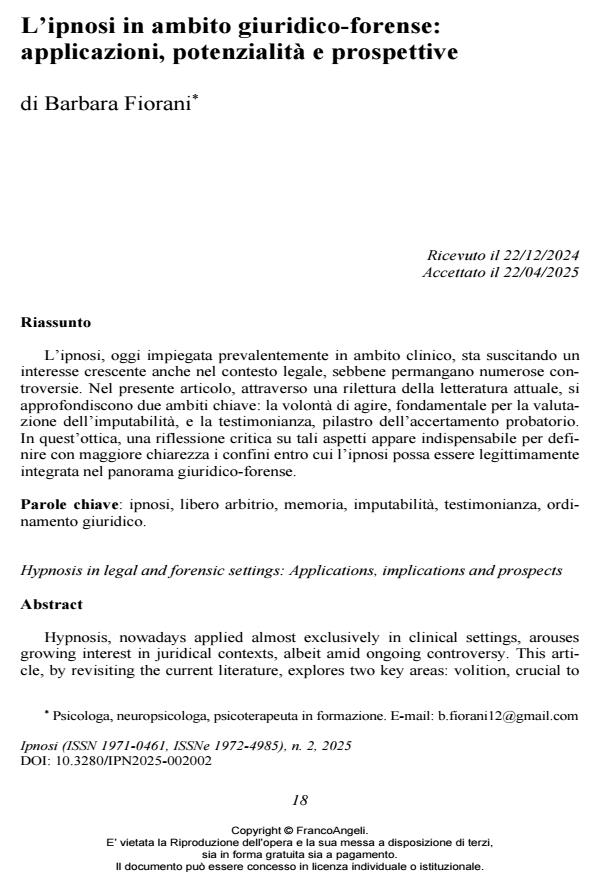
L’ipnosi, oggi impiegata prevalentemente in ambito clinico, sta suscitando un interesse crescente anche nel contesto legale, sebbene permangano numerose controversie. Nel presente articolo, attraverso una rilettura della letteratura attuale, si approfondiscono due ambiti chiave: la volontà di agire, fondamentale per la valutazione dell’imputabilità, e la testimonianza, pilastro dell’accertamento probatorio. In quest’ottica, una riflessione critica su tali aspetti appare indispensabile per definire con maggiore chiarezza i confini entro cui l’ipnosi possa essere legittimamente integrata nel panorama giuridico-forense.

Parole chiave:ipnosi, libero arbitrio, memoria, imputabilità, testimonianza, ordinamento giuridico.

  1. Baltman J., Lynn S. (2016). Hypnosis, memory and expectations. In Trusz S., Babel P., eds, Interpersonal and intrapersonal expectancies, 47-51. United Kingdom: Routledge/Taylor & Francis Group.
  2. Basso J., McHale A., Ende V., Oberlin D., Suzuki W. (2019). Brief, daily meditation enhances attention, memory, mood, and emotional regulation in non-experienced meditators. Behavioural brain research, 356: 208-220.
  3. Brady T., Schacter D., Alvare, G. (2018). The adaptive nature of false memories is revealed by gist-based distortion of true memories. Open Science Framework. 1-35.
  4. Carol R., Kieckhaefer J., Johnson J., Peek J., Schreiber Compo N. (2021). Being a good witness: The roles of benevolence and working memory capacity in rapport’s effect on eyewitness memory. Journal of Applied Social Psychology, 51(7): 730-745.
  5. Caso A., Gabbert F., Dando C. (2024). Eyewitness confidence in the interviewing context: Understanding the impact of question type and order. Applied Cognitive Psychology, 38(3): 1-11.
  6. Dando C., Taylor, D., Caso A., Nahouli Z., Adam C. (2023). Interviewing in virtual environments: Towards understanding the impact of rapport-building behaviours and retrieval context on eyewitness memory. Memory & Cognition, 51(2): 404-421.
  7. Dasse M., Elkins G., Weaver C. (2015). Hypnotizability, not suggestion, influences false memory development. International Journal of Clinical and Experimental Hypnosis, 63(1): 110-128. DOI: 10.1080/00207144.2014.961880
  8. Mammini C. (2018). Ipnosi in ambito giuridico. In: De Benedittis G., Mammini C., Rago M., a cura di, Blue Book. La guida all’ipnosi evidence based. Milano: Franco Angeli.
  9. Mammini C. (2021). Ipnosi in ambito giuridico. In: De Benedittis G., Loriedo C., Mammini C., Rago N., a cura di, Trattato di ipnosi. Milano: Franco Angeli.
  10. Dodier O., Ginet M., Teissedre F., Verkampt F., Fisher R. (2021). Using the cognitive interview to recall real-world emotionally stressful experiences: Road accidents. Applied cognitive psychology, 35(4): 1099-1105.
  11. Edmond G., Martire K., Kemp R., Hamer D., Hibbert B., Ligertwood A., White D. (2014). How to cross-examine forensic scientists: a guide for lawyers. Australian Bar Review, 39(174).
  12. Elkins G., Barabasz A., Council J., Spiegel D. (2015). Promoviendo la investigacion y la practica: La definición actualizada de hipnosis de la División 30 de la APA. International Journal of Clinical and Experimental Hypnosis, 63(1): 1-9. DOI: 10.1080/00207144.2014.961870
  13. Fernandez A., Urwicz L., Vuilleumier P., Berna, C. (2021). Impact of hypnosis on psychophysiological measures: A scoping literature review. American Journal of Clinical Hypnosis, 64(1): 36-52. DOI: 10.1080/00029157.2021.1873099
  14. Ferrua P. (2017). La prova nel processo penale: Volume I. Struttura e procedimento (Vol. 1). Torino: G. Giappichelli Editore.
  15. Fifel K. (2018). Readiness potential and neuronal determinism: New insights on Libet experiment. Journal of Neuroscience, 38(4): 784-786. DOI: 10.1523/JNEUROSCI.3136-17.2017
  16. Fornari U. (2015). Trattato di psichiatria forense. Torino: UTET Giuridica.
  17. Giorello G. (2018). Libertà di pensiero: Giordano Bruno, John Stuart Mill e Paul K. Feyerabend. Milano: Mimesis.
  18. Kaplan R., Van Damme I., Levine L., Loftus E. (2016). Emotion and false memory. Emotion Review, 8(1): 8-13. DOI: 10.1177/1754073915601228
  19. Kekecs Z., Szekely A., Varga K. (2016). Alterations in electrodermal activity and cardiac parasympathetic tone during hypnosis. Psychophysiology, 53(2): 268-277.
  20. Kieckhaefer J., Vallano J., Schreiber Compo N. (2014). Examining the positive effects of rapport building: When and why does rapport building benefit adult eyewitness memory? Memory, 22(8): 1010-1023. DOI: 10.1080/09658211.2013.864313
  21. Kukucka J., Dror I. (2023). Human factors in forensic science: Psychological causes of bias and error. In DeMatteo K., Scherr C., Eds., The Oxford handbook of psychology and law. New York: Oxford University Press.
  22. Lane S., Houston K. (2019). Eyewitness memory. In Brewer N., Douglass A.B., eds, Psychological science and the law. New York: Guilford Press.
  23. Lane S., Houston K. (2021). Understanding eyewitness memory: Theory and applications. New York: University Press.
  24. Lankton S. (2020). What Milton Erickson said about being ericksonian. American Journal of Clinical Hypnosis, 63(1): 4-13. DOI: 10.1080/00029157.2020.1754068
  25. Leo D., Bruno D., Proietti R. (2025). Remembering what did not happen: the role of hypnosis in memory recall and false memories formation. Frontiers in Psychology, 16: 1433762.
  26. Li L. (2022). How to tackle variations in elite interviews: Access, strategies, and power dynamics. Qualitative Research, 22(6): 846-861. DOI: 10.1177/1468794121994475
  27. Libet B., Gleason, C., Wrigh, E., Pearl D. (1983). Time of conscious intention to act in relation to onset of cerebral activity (readiness-potential). Brain, 106(3): 623-642.
  28. Lindegaard M., Jacques S. (2014). Agency as a cause of crime. Deviant behavior, 35(2): 85-100. DOI: 10.1080/01639625.2013.822205
  29. Lindeløv J., Overgaard R., Overgaard M. (2017). Improving working memory performance in brain-injured patients using hypnotic suggestions. Brain, 140(4): 1100-1106.
  30. Loftus E., Doyle J., Dysart J. (2013). Eyewitness testimony: Civil & criminal (5th ed.). New York: Lexis Law.
  31. Lush P., Dienes Z. (2019). Time perception and the experience of agency in meditation and hypnosis. Psych journal, 8(1): 36-50.
  32. Lynn S., Laurence J., Kirsch I. (2015). Hypnosis, suggestion, and suggestibility: An integrative model. American Journal of Clinical Hypnosis, 57(3): 314-329. DOI: 10.1080/00029157.2014.976783
  33. Lynn S., Green J., Polizzi C., Ellenberg S., Gautam A., Aksen D. (2019). Hypnosis, hypnotic phenomena, and hypnotic responsiveness: Clinical and Research Foundations-A 40-Year Perspective. International Journal of Clinical and Experimental Hypnosis, 67(4): 475-511. DOI: 10.1080/00207144.2019.1649541
  34. Lynn S., Polizzi C., Miskovic V., Aksen D. (2020). Creating the “stuff of experience”: spontaneous thoughts, memory, and hypnosis in clinical and forensic contexts. In Press D., Cosmelli D., Kaufman J., eds, Creativity and the wandering mind: Spontaneous and controlled cognition. New York: Accademic Press.
  35. Marr C., Sauerland M., Otgaar H., Quaedflieg C., Hope L. (2021). The effects of acute stress on eyewitness memory: An integrative review for eyewitness researchers. Memory, 29(8): 1091-1100. DOI: 10.1080/09658211.2021.1955935
  36. Martin J., Pacherie E. (2019). Alterations of agency in hypnosis: A new predictive coding model. Psychological review, 126(1): 133-152.
  37. Mason J. (2021). The Willed Trance: Volition, Voluntariness and Hypnotised Defendants. The Journal of Criminal Law, 85(1): 26-43. DOI: 10.1177/0022018320963551
  38. McKinnon M., Palombo D., Nazarov A., Kumar N., Khuu W., Levine, B. (2015). Threat of death and autobiographical memory: A study of passengers from Flight AT236. Clinical psychological science, 3(4): 487-502. DOI: 10.1177/2167702614542280
  39. Melton G., Petrila J., Poythress N., Slobogin C., Otto R., Mossman D., Con-die, L. (2017). Psychological evaluations for the courts: A handbook for mental health professionals and lawyers. New York: Guilford Publications.
  40. Nahouli Z., Dando C., Mackenzie J., Aresti A. (2021). Rapport building and witness memory: Actions may ‘speak’ louder than words. PloS ONE, 16(8): 1-20.
  41. Nestor P. (2019). In defense of free will: Neuroscience and criminal responsibility. International journal of law and psychiatry, 65: 101344.
  42. Palfi B., Parris B., McLatchie N., Kekecs Z., Dienes, Z. (2021). Can unconscious intentions be more effective than conscious intentions? Test of the role of metacognition in hypnotic response. Cortex, 135: 219-239.
  43. Palsson O., Twist S., Walker, M. (2019). A national survey of clinical hypnosis views and experiences of the adult population in the United States. International Journal of Clinical and Experimental Hypnosis, 67(4): 428-448. DOI: 10.1080/00207144.2019.1649538
  44. Paterline B. (2016). Forensic hypnosis and the courts. Journal Law Criminal Justice, 4(2): 1-7.
  45. Pereboom,D. (2014). Free will, agency, and meaning in life. United Kingdom: Oxford University Press
  46. Peter B. (2024). Hypnosis in psychotherapy, psychosomatics and medicine. A brief overview. Frontiers in Psychology, 15: 1-18.
  47. Polito V., Barnier A., Woody E. (2013). Developing the Sense of Agency Rating Scale (SOARS): An empirical measure of agency disruption in hypno-sis. Consciousness and cognition, 22(3): 684-696.
  48. Polito V., Barnier A., Woody E., Connors M. (2014). Measuring agency change across the domain of hypnosis. Psychology of Consciousness: Theory, Research, and Practice, 1(1): 3-19.
  49. Reyna V. (2013). Fuzzy-trace theory and false memory. In Bjorklund D., ed., Memory distortions and their prevention. New Jersey: Lawrence Erlbaum Associates Publishers.
  50. Rosner R., Scott C. (2017). Principles and practice of forensic psychiatry (3rd ed.). New York: CRC Press Taylor & Francis group.
  51. Salvaggio M. (2018). The justification of reconstructive and reproductive memory beliefs. Philosophical Studies, 175: 649-663.
  52. Sauerland M., Raymaekers L., Otgaar H., Memon A., Waltjen T., Nivo M., Smeets T. (2016). Stress, stress-induced cortisol responses, and eyewitness identification performance. Behavioral sciences & the law, 34(4): 580-594.
  53. Schmidt B., Böhmer J., Schnuerch M., Koch T., Michelmann S. (2024). Post-hypnotic suggestion improves confidence and speed of memory access with long-lasting effects. Acta Psychologica, 245: 104240.
  54. Scoboria A., Wade K., Lindsay D., Azad T., Strange D., Ost J., Hyman I. (2017). A mega-analysis of memory reports from eight peer-reviewed false memory implantation studies. Memory, 25(2): 146-163. DOI: 10.1080/09658211.2016.1260747
  55. Shaw J., Porter S. (2015). Constructing rich false memories of committing crime. Psychological science, 26(3): 291-301. DOI: 10.1177/0956797614562862
  56. Shaw J. (2020). Do false memories look real? Evidence that people struggle to identify rich false memories of committing crime and other emotional events. Frontiers in psychology, 11: 1-7.
  57. Shields G., Sazma M., McCullough A., Yonelinas A. (2017). The effects of acute stress on episodic memory: A meta-analysis and integrative review. Psychological bulletin, 143(6): 636-675.
  58. Snow M., Eastwood J. (2023). Examining the effects of negative emotion and interviewing procedure on eyewitness recall. Applied Cognitive Psychology, 37(5): 1139-1152.
  59. Strange D., Takarangi M. (2015). Memory distortion for traumatic events: the role of mental imagery. Frontiers in psychiatry, 6.
  60. Taylor D., Dando C. (2024). Eyewitness memory for person, object and action information is mediated by interview environment and the presence or absence of rapport. Journal of Criminal Psychology. DOI: 10.1108/JCP-07-2024-0057
  61. Terhune D., Cleeremans A., Raz A., Lynn S. (2017). Hypnosis and top-down regulation of consciousness. Neuroscience & Biobehavioral Reviews, 81: 59-74.
  62. Tyng C., Amin H., Saad M., Malik A. (2017). The influences of emotion on learning and memory. Frontiers in psychology, 8: 1-22.
  63. Van Rosmalen E., Vredeveldt A. (2024). Collaborative interviewing of eyewitnesses: a field study. Journal of Criminal Psychology, 15(2): 210-226. DOI: 10.1108/JCP-04-2024-0028
  64. Weitzenhoffer A. (1974). When is an “instruction” an “instruction”? Inter-national Journal of Clinical and Experimental Hypnosis, 22(3): 258-269. DOI: 10.1080/00207147408413005
  65. Wilson H. (2024). Judicial perspectives on forensic hypnosis: a review of case law and best practices. The American Journal of Political Science Law and Criminology, 6(11): 1-6.
  66. Wolfs A., Sneyd D., Vallano J., Schreiber Compo N., Reinoso L. (2022). The effects of building and maintaining rapport on cooperative mock eyewitness recall. Journal of Investigative Psychology and Offender Profiling, 19(3): 151-166.
  67. Wolpe N., Rowe J. (2014). Beyond the “urge to move”: objective measures for the study of agency in the post-Libet era. Frontiers in human neuroscience, 8: 1-13.
  68. Xu J., Vik A., Groote I., Lagopoulos J., Holen A., Ellingsen Ø., Davanger S. (2014). Nondirective meditation activates default mode network and areas associated with memory retrieval and emotional processing. Frontiers in human neuroscience, 8: 86.
  69. Yonelinas A., Ritchey M. (2015). The slow forgetting of emotional episodic memories: An emotional binding account. Trends in cognitive sciences, 19(5): 259-267.
  70. Zahedi A., Stuermer B., Hatami J., Rostami R., Sommer W. (2017). Eliminating stroop effects with post-hypnotic instructions: Brain mechanisms inferred from EEG. Neuropsychologia, 96: 70-77.
  71. Zahedi A., Stürmer B., Sommer W. (2020). Can posthypnotic suggestions boost updating in working memory? Behavioral and ERP evidence. Neuropsychologia, 148: 107632.
  72. Zahedi A., Lynn S., Sommer W. (2024). How hypnotic suggestions work–A systematic review of prominent theories of hypnosis. Consciousness and cognition, 123: 103730.

Barbara Fiorani, L’ipnosi in ambito giuridico-forense: applicazioni, potenzialità e prospettive in "IPNOSI" 2/2025, pp 18-32, DOI: 10.3280/IPN2025-002002