Toward a therapeutic relational complexity: cotherapy
Journal title RIVISTA DI PSICOTERAPIA RELAZIONALE
Author/s Maurizio Gallinari, Anna Maria Paulis
Publishing Year 2026 Issue 2025/62
Language Italian Pages 7 P. 69-75 File size 85 KB
DOI 10.3280/PR2025-062009
DOI is like a bar code for intellectual property: to have more infomation
click here
Below, you can see the article first page
If you want to buy this article in PDF format, you can do it, following the instructions to buy download credits
FrancoAngeli is member of Publishers International Linking Association, Inc (PILA), a not-for-profit association which run the CrossRef service enabling links to and from online scholarly content.
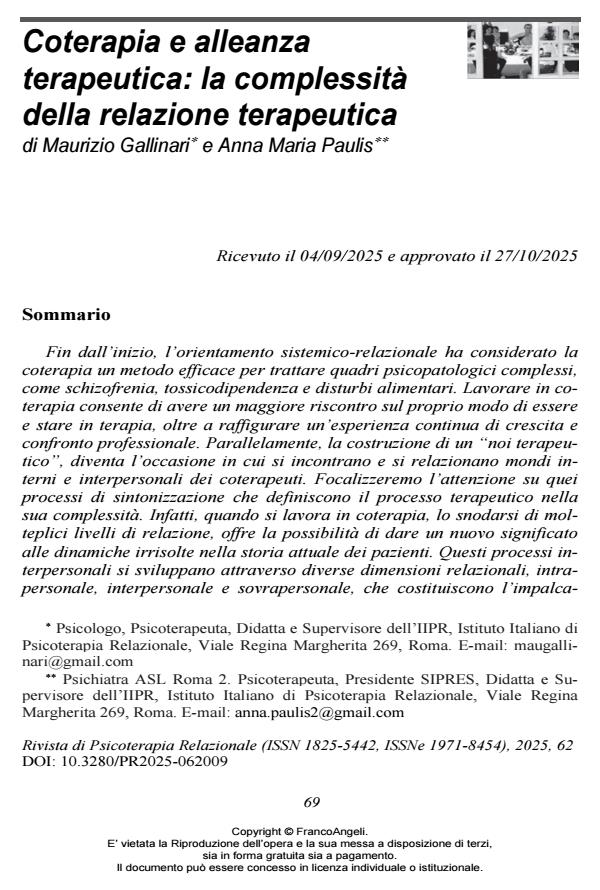
Since its inception, the systemic-relational approach has regarded cotherapy as an effective method for working with complex psychopathological conditions such as schizophrenia, drugs addicted, and eating disorders. Working in cotherapy offers greater feedback on one’s way of being and engaging in therapy, while also representing a continuous opportunity for professional growth and mutual reflection. At the same time, the construction of a “therapeutic we” becomes a space in which the internal and interpersonal worlds of the cotherapists meet and relate. Our focus will be on those attunement processes that define the therapeutic process in all its complexity. Indeed, when working in cotherapy, the unfolding of multiple levels of relationship allows for unresolved dynamics in the patient’s current life history to be re-signified. These interpersonal processes develop across various relational dimensions ‒ intrapersonal, interpersonal, and suprapersonal ‒ which form the scaffolding of therapeutic relational complexity. The development of such therapeutic relational complexity managing critical moments in the complete therapeutic process.
Keywords: complexity, relationship, co-therapy, attunement, therapeutic process.
- Abbonda P., Bitonte F., Falcucci M., Ferraguzzi F., Porcedda L. (2018). Noi terapeutico e noi di coppia: processi in divenire. Terapia Familiare, 116: 9-30. DOI: 10.3280/TF2018-11600
- Boszormenyi-Nagy I., Framo J. (1969). Psicoterapia intensiva della famiglia. Torino: Bollati Boringhieri.
- Boszormenyi-Nagy I., Spark G.M. (1988). Lealtà invisibili. Roma: Astrolabio.
- Ceccarelli M., Morganti G. (2005). Solo se mi oppongo esisto. La terapia familiare come strumento per la conduzione di un setting individuale. In Liotti G., Farina B., Rainone A. (a cura di), Due terapeuti per un paziente. Dalla teoria dell’at-tac¬camento alle psicoterapie a setting multipli. Roma: Laterza.
- Ceccarelli M. (2024). Sulla natura della mente. Funzioni, disfunzioni, psicoterapia. Milano: FrancoAngeli.
- Elkaim M. (1996). Dall’autoreferenzialità alle aggregazioni. In Andolfi M., Angelo C., de Nichilo M. (1996) (a cura di), Sentimenti e Sistemi. Milano: Raffaello Cortina.
- Gray W.J. Duhl F.J., D. Rizzo N.D. (1978). Teoria Generale dei Sistemi e Psichiatria. Milano: Feltrinelli.
- Hornova L. (2020). Dialogical Co-therapy. Australian and New Zealand Journal of Family Therapy, 41: 325-341.
- Loriedo C. (1978). Terapia relazionale: le tecniche e i terapeuti. Roma: Astrolabio.
- Loriedo C., Picardi A. (2000). Dalla Teoria Generale dei Sistemi alla Teoria dell’Attaccamento. Percorsi e modelli della psicoterapia sistemico-relazionale. Milano: FrancoAngeli.
- Reeve G.H. (1939). Trends in Therapy. A method of coordinate treatment. American Journal of Orthopsychiatry, 14: 550-565.
- Rizzolatti G., Sinigaglia C. (2006). So quel che fai. Il cervello che agisce e i neuroni specchio. Milano: Raffaello Cortina.
- Rizzolatti G., Sinigaglia C. (2019). Specchi nel cervello. Milano: Raffaello Cortina.
- Rubinstain D., Wiener D.R. (1967). Cotherapy teamwork relationships in family therapy. In Zuk G., Boszormnenyi-Nagy I., Family Therapy and Disturbed Families. Palo Alto: Science and Behavior Books.
- Stern D. (1992). Il mondo interpersonale del bambino. Torino: Bollati Boringhieri.
- Whitaker C.A. (1978). Co-therapy of Chronic Schizophrenia in Berger Milton M. (ed.), Beyond the Double Bind: Communication and Family Systems, Theories and Techniques with Schizophrenics (pp. 155-175). New York: Brunner-Mazel
Maurizio Gallinari, Anna Maria Paulis, Coterapia e alleanza terapeutica: la complessità della relazione terapeutica in "RIVISTA DI PSICOTERAPIA RELAZIONALE " 62/2025, pp 69-75, DOI: 10.3280/PR2025-062009