Macrosistema e sistemi familiari
Titolo Rivista RIVISTA DI PSICOTERAPIA RELAZIONALE
Autori/Curatori Danilo Solfaroli Camillocci
Anno di pubblicazione 2026 Fascicolo 2025/62
Lingua Italiano Numero pagine 15 P. 13-27 Dimensione file 132 KB
DOI 10.3280/PR2025-062003
Il DOI è il codice a barre della proprietà intellettuale: per saperne di più
clicca qui
Qui sotto puoi vedere in anteprima la prima pagina di questo articolo.
Se questo articolo ti interessa, lo puoi acquistare (e scaricare in formato pdf) seguendo le facili indicazioni per acquistare il download credit. Acquista Download Credits per scaricare questo Articolo in formato PDF
FrancoAngeli è membro della Publishers International Linking Association, Inc (PILA), associazione indipendente e non profit per facilitare (attraverso i servizi tecnologici implementati da CrossRef.org) l’accesso degli studiosi ai contenuti digitali nelle pubblicazioni professionali e scientifiche.
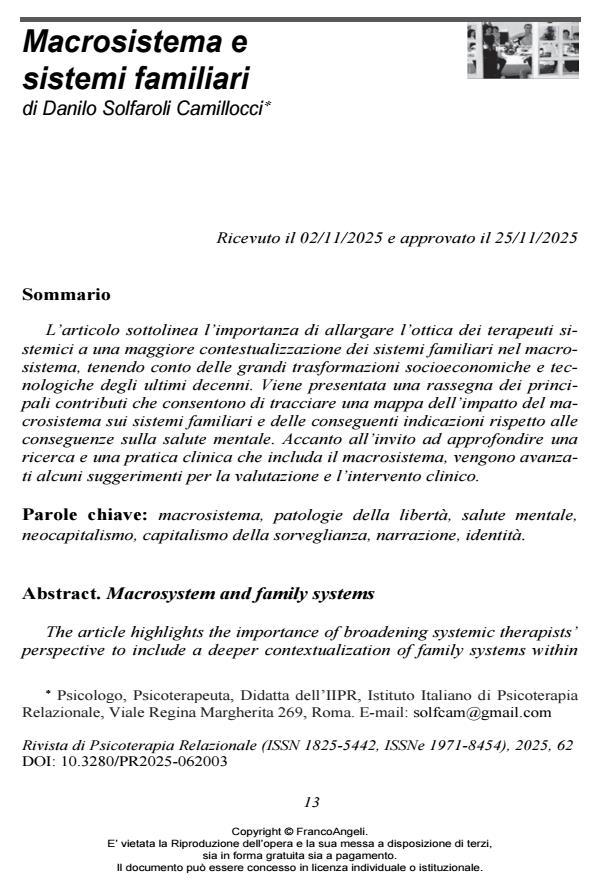
L’articolo sottolinea l’importanza di allargare l’ottica dei terapeuti sistemici a una maggiore contestualizzazione dei sistemi familiari nel macrosistema, tenendo conto delle grandi trasformazioni socioeconomiche e tecnologiche degli ultimi decenni. Viene presentata una rassegna dei principali contributi che consentono di tracciare una mappa dell’impatto del macrosistema sui sistemi familiari e delle conseguenti indicazioni rispetto alle conseguenze sulla salute mentale. Accanto all’invito ad approfondire una ricerca e una pratica clinica che includa il macrosistema, vengono avanzati alcuni suggerimenti per la valutazione e l’intervento clinico.
Parole chiave:macrosistema, patologie della libertà, salute mentale, neocapitalismo, capitalismo della sorveglianza, narrazione, identità.
- McDaniel B.T., Radesky J.S. (2018). Technoference: Parent distraction with technology and associations with child behavior problems. Child Devel., 89, 1: 100-109.
- McGoldrick M., Giordano J., Garcia-Preto N. (eds.) (2005). Ethnicity and family therapy (3rd ed.). New York, NY: Guilford Press.
- Alter A. (2017). Irresistible: The rise of addictive technology and the business of keeping us hooked. New York: Penguin Press. Trad. it.: Irresistibile. Come dire no alla schiavitù della tecnologia. Firenze: Giunti Editore, 2017.
- Ba’ S. (2019). The Struggle to Reconcile Precarious Work and Parenthood: The Case of Italian ‘Precarious Parents’. Work, Employment and Society, 33, 5: 812-828.
- Bauman Z. (1999). In Search of Politics. Cambridge, UK: Polity Press. Trad. it.: La società dell’incertezza. Nuova edizione. Bologna: il Mulino, 2014.
- Bauman Z. (2003). Liquid love: On the frailty of human bonds. Cambridge: Polity Press. Trad. it.: Amore liquido: sulla fragilità dei legami affettivi. Roma; Bari: Laterza, 2004.
- Bauman Z. (2007). Liquid times: Living in an age of uncertainty. Cambridge, UK: Malden, MA: Polity Press. Trad. it.: Tempi liquidi: vivere in un’epoca di incertezza. Bari: Laterza, 2008.
- Beck U. (1992). Risk society: Towards a new modernity. London: Sage. Trad. it.: La società del rischio: Verso una seconda modernità. Carocci, 1994.
- Beck U., Beck-Gernsheim E. (2002). Individualization: Institutionalized individualism and its social and political consequences. London: Sage.
- Bronfenbrenner U., Morris P.A. (2006). The bioecological model of human development. In Damon W., Lerner R.M. (eds.), Handbook of child psychology (Vol. 1, pp. 793–828). Hoboken, N.J.: Wiley.
- Ehrenberg, A. (1998). La fatigue d’être soi: Dépression et société. Paris: Jacob. Trad. it.: La fatica di essere se stessi. Depressione e società. Torino: Einaudi, 1999.
- Ehrenberg A. (2010). La société du malaise. Paris: Odile Jacob. Trad. it.: La società del disagio. Torino: Einaudi, 2011.
- Fisher, M. (2009). Capitalist realism: Is there no alternative? Zero Books. Trad. it.: Realismo capitalistico: Ma non c’è alternativa? Milano: Ubulibri, 2015.
- Galimberti U. (2025). È l’età della tecnica che ha cancellato storia e memoria. La Repubblica, 14 ottobre.
- Hales M., Rigali S., Paller A., Liszewsky W., Lagu T. (2025). Pediatric Skin Care Regiments on TikTok. Pediatrics, 156, 1.
- Han B.C. (2012). La società della stanchezza. Roma: Nottetempo.
- Han B.C. (2014). La società della trasparenza. Roma: Nottetempo.
- Han B.C. (2016). Psicopolitica. Il neoliberismo e le nuove tecniche del potere. Roma: Nottetempo.
- Han B.C. (2017). Nello sciame. Visioni del digitale. Roma: Nottetempo.
- Han B.C. (2020). La scomparsa dei riti. Una topologia del presente. Roma: Nottetempo.
- Han B.C. (2024). La crisi della narrazione. Informazione, politica e vita quotidiana. Torino: Einaudi.
- Hochschild A.R. (1983). The Managed Heart: Commercialization of Human Feeling. University of California Press. Trad. it.: Il cuore gestito: La commercializzazione del sentimento umano. Milano: Bruno Mondadori, 2004.
- Illouz E. (2007). Cold intimacies: The making of emotional capitalism. Cambridge, UK: Polity Press.
- Illouz E. (2012). Why love hurts: A sociological explanation. Cambridge, UK: Polity Press. Trad. it.: Perché l’amore fa male: Una spiegazione sociologica. Bologna: il Mulino.
- Lebow J.L. (2021). Attending to the larger system in systemic therapy and family research. Family Process, 60, 4: 1079-1082.
- Lipovetsky G. (2006). Le bonheur paradoxal. Essai sur la société d’hyperconsom-mation. Paris: Gallimard. Trad. it.: Una felicità paradossale. Sulla società dell’iperconsumo. Milano: Cortina, 2007.
- McGoldrick M., Hardy K.V., Williams C. (eds.) (2005). Re-visioning family therapy: Race, culture, and gender in clinical practice (2nd ed.). New York, NY: Guilford Press.
- Meggiolaro S., Ongaro F. (2024). Leaving home across the recent cohorts in Italy: does economic vulnerability due to labour market status matter?. Genus, 80, 3.
- Pietropaoli M. (2025). Conflitto e insufficienza a partire da Ehrenberg. L’etica dinanzi alle odierne “patologie della libertà”. Rivista Internazionale di Filosofia e Psicologia, 16, 1: 66-75.
- Rosa H. (2010). Alienation and acceleration: Towards a critical theory of late-modern temporality. Natchitoches, LA: NSU Press. Trad. it.: Accelerazione e alienazione. Per una teoria critica del tempo nella tarda modernità, Torino: Einaudi, 2015.
- Rosa H. (2019). Resonance. A sociology of our relationship to the world, Cambridge: Polity Press.
- Sefton-Green J., Mannell K., Erstad O. (2025). The Platformization of the Family: Towards a Research Agenda. London: Plagrave Mcmillan.
- Stanghellini G. (2020). Selfie. Sentirsi nello sguardo dell’altro. Milano: Feltrinelli.
- Steinberg S.B. (2017). Sharenting: Children’s Privacy in the Age of Social Media. Emory Law Journal, 66, 4.
- Turkle S. (2011). Alone together: Why we expect more from technology and less from each other. New York: Basic Books. Trad. it.: Insieme ma soli. Perché ci aspettiamo sempre più dalla tecnologia e sempre meno dagli altri. Torino: Einaudi, 2019.
- Turkle S. (2015). Reclaiming conversation: The power of talk in a digital age. new York, N.Y.: Penguin Press. Trad. it.: La conversazione necessaria. La forza del dialogo nell’era digitale. Torino: Einaudi, 2016.
- Walsh F. (2006). Strengthening family resilience (2nd ed.). New York, NY: Guilford Press. Trad. it.: (2016). La resilienza familiare. Milano: Raffaello Cortina.
- Zuboff S. (2019). The Age of Surveillance Capitalism: The Fight for a Human Future at the New Frontier of Power. New York: PublicAffairs. Trad. it.: Il capitalismo della sorveglianza. Il futuro dell’umanità nell’era dei nuovi poteri. Roma: Luiss University Press.
Danilo Solfaroli Camillocci, Macrosistema e sistemi familiari in "RIVISTA DI PSICOTERAPIA RELAZIONALE " 62/2025, pp 13-27, DOI: 10.3280/PR2025-062003