Il dolore, “il più autoritario di tutti i processi”
Titolo Rivista PSICOTERAPIA PSICOANALITICA
Autori/Curatori Maria Luisa Algini
Anno di pubblicazione 2025 Fascicolo 2025/2
Lingua Italiano Numero pagine 18 P. 35-52 Dimensione file 114 KB
DOI 10.3280/PSP2025-002003
Il DOI è il codice a barre della proprietà intellettuale: per saperne di più
clicca qui
Qui sotto puoi vedere in anteprima la prima pagina di questo articolo.
Se questo articolo ti interessa, lo puoi acquistare (e scaricare in formato pdf) seguendo le facili indicazioni per acquistare il download credit. Acquista Download Credits per scaricare questo Articolo in formato PDF
FrancoAngeli è membro della Publishers International Linking Association, Inc (PILA), associazione indipendente e non profit per facilitare (attraverso i servizi tecnologici implementati da CrossRef.org) l’accesso degli studiosi ai contenuti digitali nelle pubblicazioni professionali e scientifiche.
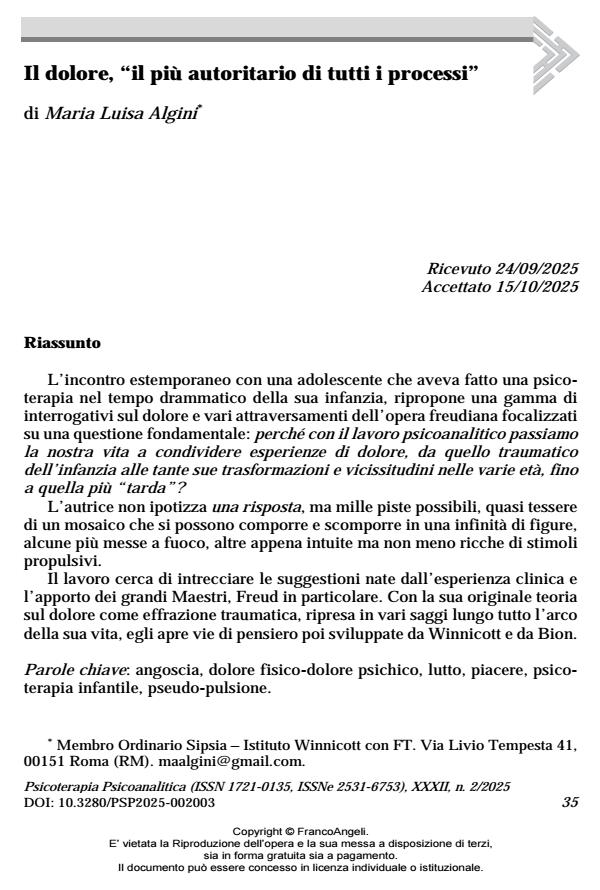
L’incontro estemporaneo con una adolescente che aveva fatto una psicoterapia nel tempo drammatico della sua infanzia, ripropone una gamma di interrogativi sul dolore e vari attraversamenti dell’opera freudiana focalizzati su una questione fondamentale: perché con il lavoro psicoanalitico passiamo la nostra vita a condividere esperienze di dolore, da quello traumatico dell’infanzia alle tante sue trasformazioni e vicissitudini nelle varie età, fino a quella più “tarda”? L’autrice non ipotizza una risposta, ma mille piste possibili, quasi tessere di un mosaico che si possono comporre e scomporre in una infinità di figure, alcune più messe a fuoco, altre appena intuite ma non meno ricche di stimoli propulsivi. Il lavoro cerca di intrecciare le suggestioni nate dall’esperienza clinica e l’apporto dei grandi Maestri, Freud in particolare. Con la sua originale teoria sul dolore come effrazione traumatica, ripresa in vari saggi lungo tutto l’arco della sua vita, egli apre vie di pensiero poi sviluppate da Winnicott e da Bion.
Parole chiave:angoscia, dolore fisico-dolore psichico, lutto, piacere, psicoterapia infantile, pseudo-pulsione.
- Algini M.L., (2016a 2° ed). Il tempo dell’orizzonte corto. Sull’amore e il lutto. Roma: Robin.
- Algini M.L., (2016b). Le ferite invisibili. Sui bambini e la morte dei genitori. Roma-Torino: Robin.
- Algini M.L. (2024). Viaggiare l’età tarda. Sul valore della caducità. Milano: Mimesis.
- Alighieri D. Commedia. (Inferno, V, v. 121-123).
- Aubert A. (1996). Il dolore. Originalità di una teoria freudiana. Roma: Borla, 1999.
- Bion W.R. (1970). Attenzione e interpretazione. Roma: Armando, 1973.
- Biondo D. (1915). Dolore e trauma al crocevia dell’adolescenza. In: Lupinacci A., Biondo D., Accetti L., Galeota M., Lucattini A. Il dolore dell’analista. Roma: Astrolabio.
- Freud S. (1884). Sulla cocaina. Roma: Newton Compton, 1979.
- Freud S. (1892-95). Studi sull’isteria. OSF, 1.
- Freud S. (1892). Minute teoriche per Fliess W. OSF, 2
- Freud S. (1895). Progetto per una psicologia scientifica. OSF, 2.
- Freud S. (1908). Analisi della fobia di un bambino di cinque anni (Caso clinico del piccolo Hans), OSF, 5.
- Freud S. (1914). Introduzione al narcisismo. OSF, 7.
- Freud S. (1915). La rimozione. OSF, 8.
- Freud S. (1915). Lutto e melanconia. OSF, 8.
- Freud S. (1920). Al di là del principio di piacere. OSF, 9.
- Freud S. (1922). L’Io e l’Es. OSF, 9.
- Freud S. (1924). Il problema economico del masochismo. OSF, 10
- Freud S. (1925). Inibizione, sintomo, angoscia. OSF, 10.
- Freud S. (1938). Risultati, idee, problemi. OSF, 11.
- Freud S. (1909-1939). Lettere tra Freud e il Pastore Pfister. Torino: Bollati Boringhieri, 1990.
- Gaddini E. (1982). Fantasie difensive precoci e processo psicoanalitico. Riv. Psicoan. XXVIII, 1.
- Gori E.C. (1987). Dolore (mentale) e sofferenza (psichica) secondo Freud. Riv. Psicoan. XXXIII, 3.
- Green A. (1982). Il doppio limite. Psicoanalisi degli stati limite. Milano: Raffaello Cortina, 1990.
- Grossmann D. (2011). Caduto fuori dal tempo. Milano: Mondadori, 2012.
- Lai M. (2019). Tenendo per mano il sole. Roma: Catalogo Mostra al Maxxi di Roma.
- Pirandello L. (1921). Sei personaggi in cerca di autore. Milano: Mondadori, 1948.
- Pontalis J-B. (1977). Tra il sogno e il dolore. Roma: Borla, 1988.
- Semi A.A. (2003). Metapsicologia del dolore? Riv. Psicoan. XVIX, 1.
- Winnicott D.W. (1953). Discussione su “Grief and Mourning in Infancy”. Esplorazioni psicoanalitiche. Milano: Raffaello Cortina, 1995.
- Winnicott D.W. (1963). La paura del crollo. Esplorazioni psicoanalitiche. Milano: Raffaello Cortina, 1995.
- Winnicott D.W. (1967). Confronto tra il concetto di regressione clinica e il concetto di organizzazione difensiva. Esplorazioni psicoanalitiche. Milano: Raffaello Cortina, 1995.
- Winnicott D.W. (2016). Il sentimento del reale. Scritti inediti. (a cura di Ferruta A. e Boffito S.). Milano: Raffaello Cortina, 2025.
Maria Luisa Algini, Il dolore, “il più autoritario di tutti i processi” in "PSICOTERAPIA PSICOANALITICA" 2/2025, pp 35-52, DOI: 10.3280/PSP2025-002003