Intelligenza Artificiale e Tecnologie Assistive: accessibilità, sfide e opportunità
Titolo Rivista SALUTE E SOCIETÀ
Autori/Curatori Alessandro Pepino, Ersilia Vallefuoco, Michele Mele
Anno di pubblicazione 2025 Fascicolo 2025/3
Lingua Italiano Numero pagine 15 P. 67-81 Dimensione file 440 KB
DOI 10.3280/SES2025-003005
Il DOI è il codice a barre della proprietà intellettuale: per saperne di più
clicca qui
Qui sotto puoi vedere in anteprima la prima pagina di questo articolo.
Se questo articolo ti interessa, lo puoi acquistare (e scaricare in formato pdf) seguendo le facili indicazioni per acquistare il download credit. Acquista Download Credits per scaricare questo Articolo in formato PDF
FrancoAngeli è membro della Publishers International Linking Association, Inc (PILA), associazione indipendente e non profit per facilitare (attraverso i servizi tecnologici implementati da CrossRef.org) l’accesso degli studiosi ai contenuti digitali nelle pubblicazioni professionali e scientifiche.
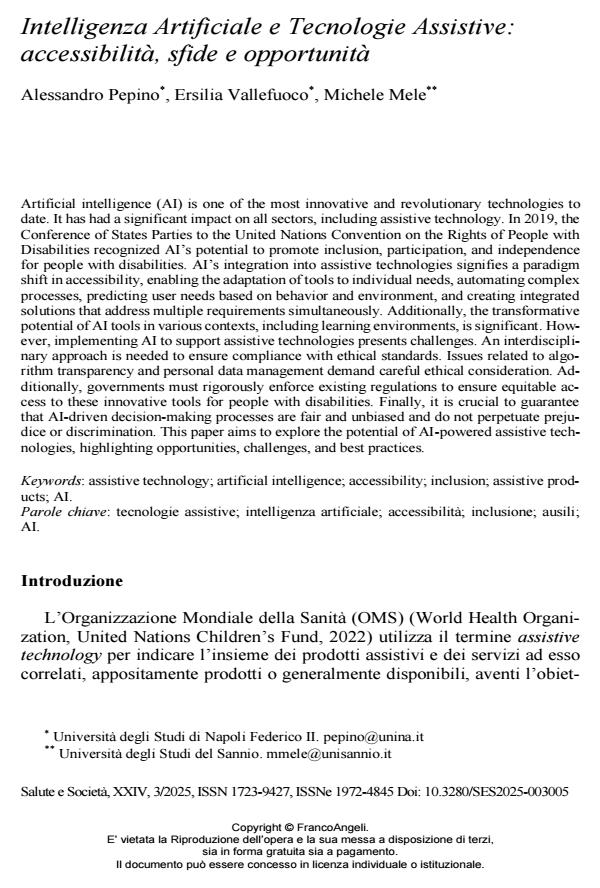
Artificial intelligence (AI) is one of the most innovative and revolutionary technologies to date. It has had a significant impact on all sectors, including assistive technology. In 2019, the Conference of States Parties to the United Nations Convention on the Rights of People with Disabilities recognized AI’s potential to promote inclusion, participation, and independence for people with disabilities. AI’s integration into assistive technologies signifies a paradigm shift in accessibility, enabling the adaptation of tools to individual needs, automating complex processes, predicting user needs based on behavior and environment, and creating integrated solutions that address multiple requirements simultaneously. Additionally, the transformative potential of AI tools in various contexts, including learning environments, is significant. However, implementing AI to support assistive technologies presents challenges. An interdisciplinary approach is needed to ensure compliance with ethical standards. Issues related to algorithm transparency and personal data management demand careful ethical consideration. Additionally, governments must rigorously enforce existing regulations to ensure equitable access to these innovative tools for people with disabilities. Finally, it is crucial to guarantee that AI-driven decision-making processes are fair and unbiased and do not perpetuate prejudice or discrimination. This paper aims to explore the potential of AI-powered assistive technologies, highlighting opportunities, challenges, and best practices.
Parole chiave:tecnologie assistive; intelligenza artificiale; accessibilità; inclusione; ausili; AI.
Alessandro Pepino, Ersilia Vallefuoco, Michele Mele, Intelligenza Artificiale e Tecnologie Assistive: accessibilità, sfide e opportunità in "SALUTE E SOCIETÀ" 3/2025, pp 67-81, DOI: 10.3280/SES2025-003005