Disabilità e autonomia: i limiti dell’approccio relazionale

Titolo Rivista SALUTE E SOCIETÀ
Autori/Curatori Domenico Melidoro
Anno di pubblicazione 2025 Fascicolo 2025/3
Lingua Italiano Numero pagine 14 P. 35-48 Dimensione file 310 KB
DOI 10.3280/SES2025-003003
Il DOI è il codice a barre della proprietà intellettuale: per saperne di più clicca qui

Qui sotto puoi vedere in anteprima la prima pagina di questo articolo.

Se questo articolo ti interessa, lo puoi acquistare (e scaricare in formato pdf) seguendo le facili indicazioni per acquistare il download credit. Acquista Download Credits per scaricare questo Articolo in formato PDF
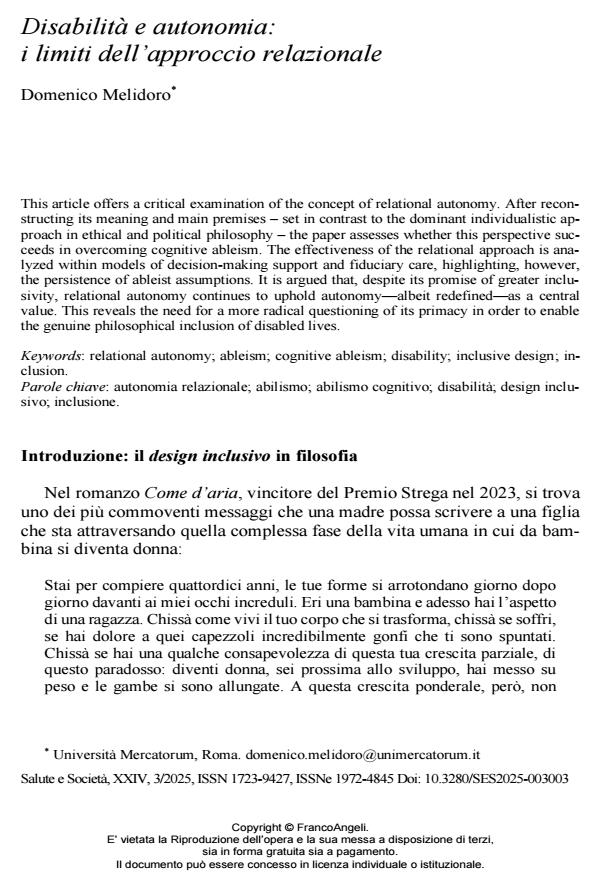
Anteprima articolo

FrancoAngeli è membro della Publishers International Linking Association, Inc (PILA)associazione indipendente e non profit per facilitare (attraverso i servizi tecnologici implementati da CrossRef.org) l’accesso degli studiosi ai contenuti digitali nelle pubblicazioni professionali e scientifiche

This article offers a critical examination of the concept of relational autonomy. After reconstructing its meaning and main premises – set in contrast to the dominant individualistic approach in ethical and political philosophy – the paper assesses whether this perspective succeeds in overcoming cognitive ableism. The effectiveness of the relational approach is analyzed within models of decision-making support and fiduciary care, highlighting, however, the persistence of ableist assumptions. It is argued that, despite its promise of greater inclusivity, relational autonomy continues to uphold autonomy—albeit redefined—as a central value. This reveals the need for a more radical questioning of its primacy in order to enable the genuine philosophical inclusion of disabled lives.

Parole chiave:autonomia relazionale; abilismo; abilismo cognitivo; disabilità; design inclusivo; inclusione.

  1. American Psychiatric Association (2022). Diagnostic and statistical manual of mental disorders (V edizione, testo revisionato). Washington, DC: American Psychiatric Publishing.
  2. Campbell F.K. (2009). Contours of Ableism. The Production of Disability and Abledness. New York: Palgave Macmillan.
  3. Carlson L. (2001). Cognitive Ableism and Disability Studies: Feminist Reflections on the History of Mental Retardation. Hypatia. A Journal of Feminist Philosophy, 4: 124-146.
  4. Christman J. (2010). The Politics of Persons. Individual Autonomy and Socio-historical Selves. Cambridge, UK: Cambridge University Press. d’Adamo A. (2023). Come d’aria. Roma: Elliot.
  5. Davy L. (2015). Philosophical Inclusive Design: Intellectual Disability and the Limits of Individual Autonomy in Moral and Political Theory. Hypatia. A Journal of Feminist Philosophy, 1: 132-148.
  6. Davy L. (2019). Between an Ethic of Care and an Ethic of Autonomy: Negotiating Relational Autonomy, Disability, and Dependency. Angelaki, 24: 101-114. DOI: 10.1080/0969725X.2019.162046
  7. Fineman M.A. (2004). The Autonomy Myth: A Theory of Dependency. New York: New Press.
  8. Francis L.P., Silvers A. (2007). Liberalism and Individually Scripted Ideas of the Good: Meeting the Challenge of Dependent Agency. Social Theory and Practice, 33: 311-334.
  9. Francis L.P. (2009). Understanding Autonomy in Light of Intellectual Disability. In Brownlee K., Cureton A., a cura di, Disability and Disadvantage. Oxford: Oxford University Press.
  10. Mackenzie C., Stoljar N. (2000). Autonomy Refigured. In Mackenzie C., Stoljar N, a cura di, Relational Autonomy: Feminist Perspectives on Autonomy, Agency, and the Social Self. Oxford: Oxford University Press.
  11. Mackenzie C. (2014). Three Dimensions of Autonomy: A Relational Analysis. In Veltman A., Piper M., a cura di, Autonomy, Oppression and Gender. New York: Oxford University Press.
  12. Nedelsky J. (1989). Reconceiving Autonomy: Sources, Thoughts and Possibilities. Yale Journal of Law and Feminism, 1: 7-36.
  13. Nedelsky J. (2011). Law’s Relations: A Relational Theory of Self, Autonomy, and Law. Oxford: Oxford University Press.
  14. Peterson A., Karlawish J., Largent E. (2020). Supported Decision Making with People at the Margins of Autonomy. The American Journal of Bioethics, 11: 4-18. DOI: 10.1080/15265161.2020.186350
  15. Reindall S.M. (1999). Independence, Dependence, Interdependence: Some reflections on the subject and personal autonomy. Disability & Society, 14: 353-367. DOI: 10.1080/0968759992619
  16. Silvers A., Francis L.P. (2009). Thinking About the Good: Reconfiguring Liberal Metaphysics (or Not) for People with Intellectual Disabilities. Metaphilosophy, 40: 475-498.
  17. Stoljar N., Voigt K. (2022). Introduction. In Stoljar N., Voigt K., a cura di, Autonomy and Equality: Relational Approaches. New York: Routledge.

Domenico Melidoro, Disabilità e autonomia: i limiti dell’approccio relazionale in "SALUTE E SOCIETÀ" 3/2025, pp 35-48, DOI: 10.3280/SES2025-003003