Mental imagery in elderly: how much it influences cognitive functioning?
Journal title RICERCHE DI PSICOLOGIA
Author/s Maria Guarnera, Sabrina Castellano, Santo Di Nuovo
Publishing Year 2014 Issue 2014/1
Language Italian Pages 12 P. 147-158 File size 181 KB
DOI 10.3280/RIP2014-001008
DOI is like a bar code for intellectual property: to have more infomation
click here
Below, you can see the article first page
If you want to buy this article in PDF format, you can do it, following the instructions to buy download credits
FrancoAngeli is member of Publishers International Linking Association, Inc (PILA), a not-for-profit association which run the CrossRef service enabling links to and from online scholarly content.
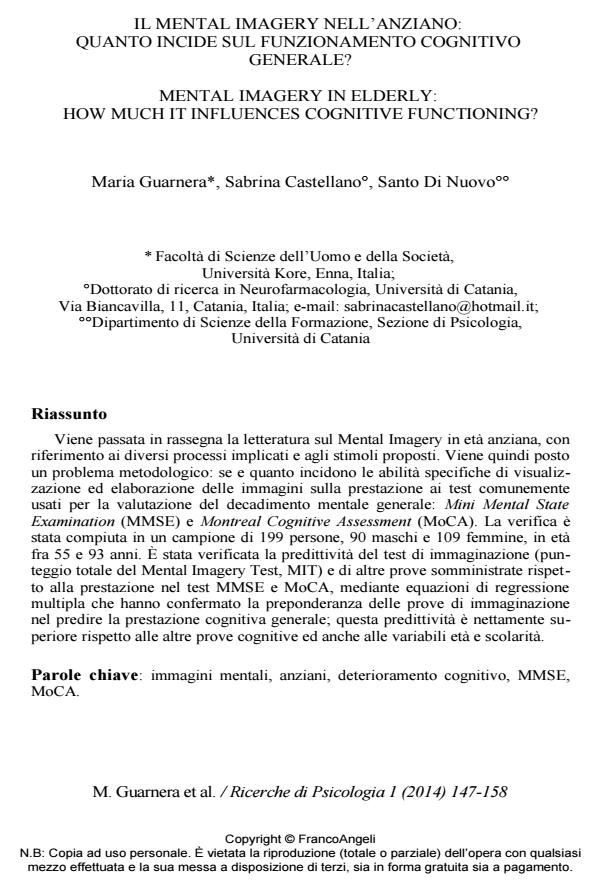
After having reviewed the literature on Mental Imagery in old age, with reference to the specific processes involved and to the pertinent stimuli, a methodological problem have been raised: if and how much the specific skills of visualization and image processing influence the performance in tests commonly used for the assessment of general mental decay: i.e., Mini Mental State Examination (MMSE) and Montreal Cognitive Assessment (MoCA). The study involved a sample of 199 people, 90 males and 109 females, aged between 55 and 93 years. The results confirmed the preponderance of the imagination (Mental Imagery Test, total score) in predicting general cognitive performance (MMSE and MoCA scores); this prediction is much higher than the other cognitive tests and also than the variables age and education.
Keywords: Mental imagery, elderly, cognitive impairment, MMSE, MoCA.
- Berg, C., Hertzog, C., & Hunt, E. (1982). Age differences in the speed of mental rotation. Developmental Psychology, 18, 95-107. DOI: 10.1037/0012-1649.18.1.95
- Bollinger, J., Rubens, M.T., Masangkay, E., Kalkstein, J., & Gazzaley, A. (2011). An expectation-based memory deficit in aging. Neuropsychologia, 49, 1466-1475. DOI: 10.1016/j.neuropsychologia.2010.12.021
- Borg, C., Thomas-Anterion, C., Bogey, S., Davier, K., & Laurent, B. (2010). Visual imagery processing and knowledge of famous names in Alzheimer’s disease and MCI. Aging, Neuropsychology, and Cognition, 17, 603-614. DOI: 10.1080/13825585.2010.481357
- Li, S.C., Lindenberger, U., & Sikstrom, S. (2001). Aging cognition: from neuromodulation to representation. Trends in Cognitive Sciences, 5, 479-486. DOI: 10.1016/S1364-6613(00)01769-1
- Malouin, F., Belleville, S., Richards, C.L., Desrosiers, J., & Doyon, J. (2004). Working memory and mental practice outcomes after stroke. Archives of Physical Medicine and Rehabilitation, 85, 177- 183. DOI: 10.1016/S0003-9993(03)00771-8
- Malouin, F., Richards, C.L., & Durand, A. (2010). Normal aging and motor imagery vividness: implications for mental practice training in rehabilitation. Archives of Physical Medicine and Rehabilitation, 91, 1122-1127. DOI: 10.1016/j.apmr.2010.03.007
- Mason, S.E., & Smith, A.D. (1977). Imagery in the aged. Experimental Aging Research, 3, 17-32. DOI: 10.1080/03610737708257085
- Measso, G., Cavarzeran, F., Zappala, C., Lebowitz, B.D., Crook, T.H., & Pirozzolo, F.J. (1993). The Mini-mental State Examination. Normative study of an Italian random sample. Developmental Neuropsychology, 9, 77-85. DOI: 10.1080/87565649109540545
- Nasreddine, Z.S., Chertkow, H., Phillips, N., Whitehead, V., Collin, I., & Cummings, J.L. (2004). The Montreal Cognitive Assessment (MOCA): A Brief Cognitive Screening Tool for Detection of Mild Cognitive Impairment, Neurology, 62, 132.
- Palladino, P., & De Beni, R. (2003). When mental images are very detailed: image generation and memory performance as a function of age. Acta Psychologica, 113(3), 297-314. DOI: 10.1016/S0001-6918(03)00045-3
- Sharps, M.J., & Gollin, E.S. (1987). Speed and accuracy of mental image rotation in young and elderly adults. Journal of Gerontology, 42, 342-343. DOI: 10.1093/geronj/42.3.342
- Schott, N. (2012). Age-related differences in motor imagery: Working memory as a mediator. Experimental Aging Research, 38(5), 559-583. DOI: 10.1080/0361073X.2012.726045
- Skoura, X., Papaxanthis, C., Vinter, A., & Pozzo, T. (2005). Mentally represented motor actions in normal aging I?. Age effects on the temporal features of overt and covert execution of actions. Behavioural Brain Research, 165, 229-239. DOI: 10.1016/j.bbr.2005.07.023
- Zapparoli, L., Invernizzi, P., Gandola, M., Verardi, M., Berlingeri, M., Sberna, M., De Santis, A., & Paulesu, E. (2013). Mental images across the adult lifespan: A behavioural and fMRI investigation of motor execution and motor imagery. Experimental Brain Research, 224, 519-540. DOI: 10.1007/s00221-012-3331-1
- Zehnder, F., Martin, M., Altgassen, M., & Clare, L. (2009). Memory training effects in old age as markers of plasticity: A meta-analysis. Restorative Neurology and Neuroscience, 27, 507-520. DOI: 10.3233/RNN-2009-0491
- Briggs, S.D., Raz, N., & Marks, W. (1999). Age-related deficits in generation and manipulation of mental images: I. The role of sensorimotor speed and working memory. Psychology and Aging, 14, 427-435. DOI: 10.1037/0882-7974.14.3.427
- Brown, H.D., Kosslyn, S.M., & Dror, I.E. (1998). Aging and scanning of imagined and perceived visual images. Experimental Aging Research 24, 181-194. DOI: 10.1080/036107398244319
- Bruyer, R., & Scailquin, J.C. (2000). Effects of aging on the generation of mental images. Experimental Aging Research, 26, 337-351. DOI: 10.1080/036107300750015732
- Clapp, W.C., Rubens, M.T., & Sabharwal, J. (2011). Neural basis for the negative impact of multitasking on working memory in older adults. Proceedings of the U.S. National Academy of Sciences., 108, 7212-7217. DOI: 10.1073/pnas.1015297108
- Cornoldi, C., Friso, G., Giordano, L., Molin, A., Poli, S., Rigoni, F., & Tressoldi, P.E. (1997). Abilità visuo-spaziali. Trento: Erickson.
- De Beni, R., Pazzaglia, F., & Gardini, S. (2007). The generation and maintenance of visual mental images: evidence from image type and aging. Brain Cognition, 63, 271-278. DOI: 10.1016/j.bandc.2006.09.004
- Devlin, A.L., & Wilson, P.H. (2010). Adult age differences in the ability to mentally transform object and body stimuli. Aging, Neuropsychology, and Cognition, 17, 709-729. DOI: 10.1080/13825585.2010.510554
- Di Nuovo, S., Castellano, S., & Guarnera, M. (2014). Mental Imagery Test. Firenze: Hogrefe.
- Dror, I.E., & Kosslyn, S.M. (1994). Mental imagery and aging. Psychology of Aging, 9, 90-102. DOI: 10.1037/0882-7974.9.1.90
- Folstein, M.F., Folstein, S.E., & McHugh, P.R. (1975). Mini-Mental State. A practical method for grading the cognitive state of patients for the clinician. Journal of Psychiatric Research, 12, 189-198. DOI: 10.1016/0022-3956(75)90026-6
- Gardini, S., Pagliara, S., Ghetti, C., Venneri, A., & Caffarra, P. (2011). Visuospatial imagery impairment in posterior cortical atrophy: A cognitive and SPECT study. Behavioural Neurology, 24, 123-132. DOI: 10.1155/2011/547451
- Goh, J.O., Suzuki, A., & Park, D.C. (2010). Reduced neural selectivity increases fMRI adaptation with age during face discrimination. Neuroimage, 51, 336-344. DOI: 10.1016/j.neuroimage.2010.01.107
- Grossi, D., Becker, J.T., & Trojano, L. (1994). Visuospatial imagery in Alzheimer disease. Perceptual and Motor Skills, 78, 867-874. DOI: 10.2466/pms.1994.78.3.867
- Hussey, E.P., Smolinsky, J.G., Piryatinsky, I., Budson, A.E., & Ally, B.A. (2012). Using mental imagery to improve memory in patients with Alzheimer disease: Trouble generating or remembering the mind's eye? Alzheimer Disease and Associated Disorders, 26, 124-134. DOI: 10.1097/WAD.0b013e31822e0f73
- Iachini, T., Poderico C., Ruggiero, G., & Iavarone, A. (2005). Age differences in mental scanning of locomotor maps. Disability and Rehabilitation, 27, 741-752. DOI: 10.1080/09638280400014782
- Kalkstein, J., Checksfield, K., Bollinger, J., & Gazzaley, A. (2011). Diminished top-down control underlies a visual imagery deficit in normal aging. The Journal of Neuroscience, 31, 15768-15774. DOI: 10.1523/JNEUROSCI.3209-11.2011
- Kemps, E., & Newson, R. (2005). Patterns and predictors of adult age differences in mental imagery. Aging, Neuropsychology, and Cognition, 12, 99-128. DOI: 10.1080/13825580590925152
- Kosslyn, S.M., Margolis, J.A., Goldknopf, E.J., Daly, R.F., & Barrett, A.M. (1990). Age differences in imagery abilities. Child Development, 61, 995-1010. DOI: 10.2307/1130871
- Immagine mentale e deficit visivi Giulia Santoro, in RICERCHE DI PSICOLOGIA 1/2014 pp.173
DOI: 10.3280/RIP2014-001010 - Le capacità immaginative nei musicisti Anita Angelica, in RICERCHE DI PSICOLOGIA 1/2014 pp.111
DOI: 10.3280/RIP2014-001006
Maria Guarnera, Sabrina Castellano, Santo Di Nuovo, Il mental imagery nell’anziano: quanto incide sul funzionamento cognitivo generale? in "RICERCHE DI PSICOLOGIA " 1/2014, pp 147-158, DOI: 10.3280/RIP2014-001008