CliCCHE. Higher education on climate change adaptation and urban health

Titolo Rivista TERRITORIO
Autori/Curatori Timothy D. Brownlee, Chiara Camaioni, Caterina Francesca Di Giovanni, Giacomo Ilardo, Ioanna Kyprianou, Graziano Enzo Marchesani, Jovanovic Predrag, Omar Shatarat
Anno di pubblicazione 2026 Fascicolo 2024/111
Lingua Inglese Numero pagine 11 P. 134-144 Dimensione file 486 KB
DOI 10.3280/TR2024-111012
Il DOI è il codice a barre della proprietà intellettuale: per saperne di più clicca qui

Qui sotto puoi vedere in anteprima la prima pagina di questo articolo.

Se questo articolo ti interessa, lo puoi acquistare (e scaricare in formato pdf) seguendo le facili indicazioni per acquistare il download credit. Acquista Download Credits per scaricare questo Articolo in formato PDF
Anteprima articolo

FrancoAngeli è membro della Publishers International Linking Association, Inc (PILA), associazione indipendente e non profit per facilitare (attraverso i servizi tecnologici implementati da CrossRef.org) l’accesso degli studiosi ai contenuti digitali nelle pubblicazioni professionali e scientifiche.

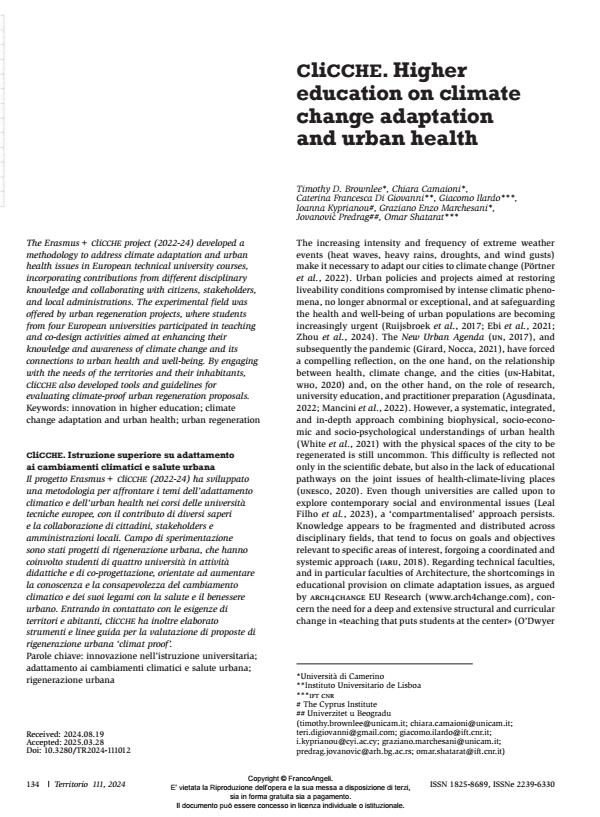
The Erasmus+ CliCCHE project (2022-24) developed a methodology to address climate adaptation and urban health issues in European technical university courses, incorporating contributions from different disciplinary knowledge and collaborating with citizens, stakeholders, and local administrations. The experimental ?eld was offered by urban regeneration projects, where students from four European universities participated in teaching and co-design activities aimed at enhancing their knowledge and awareness of climate change and its connections to urban health and well-being. By engaging with the needs of the territories and their inhabitants, CliCCHE also developed tools and guidelines for evaluating climate-proof urban regeneration proposals.

Il progetto Erasmus+ CliCCHE (2022-24) ha sviluppato una metodologia per affrontare i temi dell’adattamento climatico e dell’urban health nei corsi delle università tecniche europee, con il contributo di diversi saperi e la collaborazione di cittadini, stakeholders e amministrazioni locali. Campo di sperimentazione sono stati progetti di rigenerazione urbana, che hanno coinvolto studenti di quattro università in attività didattiche e di co-progettazione, orientate ad aumentare la conoscenza e la consapevolezza del cambiamento climatico e dei suoi legami con la salute e il benessere urbano. Entrando in contattato con le esigenze di territori e abitanti, CliCCHE ha inoltre elaborato strumenti e linee guida per la valutazione di proposte di rigenerazione urbana ‘climat proof’.

Parole chiave:innovazione nell’istruzione universitaria; adattamento ai cambiamenti climatici e salute urbana; rigenerazione urbana

  1. Aernouts N., Cognetti F., Maranghi E., 2023, eds., Urban Living Lab for Local Regeneration: Beyond Participation in Large-scale Social Housing Estates. Cham: Springer. https://link.springer.com/book/10.1007/978-3-031-19748-2 (access: 2024.11.29).
  2. Agusdinata D.B., 2022, «The role of universities in SDGs solution co-creation and implementation: a human-centered design and shared-action learning process». Sustain Sci., 17, 4: 1589-1604.
  3. Bodolica V., Spraggon M., Badi H., 2021, «Extracurricular activities and social entrepreneurial leadership of graduating youth in universities from the Middle East». The International Journal of Management Ed-ucation, 19, 2, 100489: 1-11.
  4. Brundiers K., Barth M., Cebrián G. et al., 2021, «Key competencies in sustainability in higher education toward an agreed-upon reference framework». Sustain Sci., 16: 13-29.
  5. Corburn J., 2003, «Bringing Local Knowledge into Environmental Deci-sion Making: Improving Urban Planning for Communities at Risk». Journal of Planning Education and Research, 22, 4: 420-433. DOI: 10.1177/0739456X03022004008
  6. Donovan E., Holder H., 2016, «How architecture students gain and apply knowledge of sustainable architecture». In: Hájek P., Tywoniak J., Lupíšek A., Sojková K., eds., CESB16: Central Europe towards Sustain-able Building 2016 Proceedings. Prague: Grada Publishing, 1574-1582. Duinker P., Greig L., 2007, «Scenario analysis in environmental impact assessment: improving explorations of the future Environ». Impact
  7. Ebi K.L., Vanos J., Baldwin J.W., Bell J.E., Hondula D.M., Errett N.A., Hayes K., Reid C.E., Saha S., Spector J., Berry P., 2021, «Extreme Weather and Climate Change: Population Health and Health System Implications». Annu Rev Public Health, 2021 Apr 1, 42: 293-315.
  8. El-Bahrawy A.M., 2024, «Investigating Ladybug as A Tool for Measuring Outdoor Thermal Comfort in Urban Neighborhoods». JES. Journal of Engineering Sciences, 52, 1, January and February: 33-57.
  9. Flood S., Cradock-Henry N.A., Blackett P., Edwards P., 2018, «Adaptive and interactive climate futures: Systematic review of serious games for engagement and decision-making». Environmental Research Letters, 13, 063005: 1-20.
  10. Gearin E., Hurt C.S., 2024, «Making Space: A New Way for Community Engagement in the Urban Planning Process». Sustainability, 16, 2039: 1-18.
  11. Girard L.F., Nocca F., 2021, «Climate change and health impacts in urban areas: Towards hybrid evaluation tools for new governance». Atmo-sphere, 11, 12, 1344: 1-29.
  12. Goldner L., Golan D., 2018, «What is meaningful civic engagement for students? Recollections of Jewish and Palestinian graduates in Israel», Studies in Higher Education, 44, 3: 1-15.
  13. Hasler K., Whitmore S., Wolstenholme R. Payne C., Hutton A., Fingland C., Tarvit G., 2022, «People, places and the climate emergency – the Scottish Place Standard Tool with a climate lens». The European Journal of Public Health, 32, 3.
  14. Helmer-Hirschberg O., 1966, The Use of the Delphi Technique in Problems of Educational Innovations. Santa Monica (CA): Rand. www.rand.org/ pubs/papers/P3499.html (access: 2024.11.29).
  15. Hemment D., Ajates Gonzalez R., Woods M., Long D., Giesen R., Cobley A., 2017, «GROW Citizens’ Observatory Framework. A reference and guidelines for community platforms to generate, share and utilise infor-mation to address community, science, policy and innovation challeng-es». European Commission. www.research.ed.ac.uk/files/450146457/ Hemment_1.1.pdf.
  16. Husar M., Ondrejicka V., Scacchi M., 2020, «Involving Citizens through Walking: Urban Walks as a Tool for Awareness Raising in Historic Built Areas». IOP Conference Series Materials Science and Engineering 960, 022087: 1-9. DOI: 10.1088/1757-899X/960/2/022087
  17. IARU, 2018, Global priorities, educated solutions: The role of academia in advancing the sustainable development goals international alliance of research universities. Stockholm: International Alliance of Research Uni-versities. www.iau-hesd.net/action/report-iaru-global-priorities-educa-ted-solutions-role-academia-advancing-sustainable (access: 2024.11.29). Khalo X., Damoah B., 2023, «Reinvigorating Climate Change Education in Universities a Social Transformative Agenda». Environmental Science & Sustainable Development, 8, 4: 19-26.
  18. Künzli R., 2019, «Disziplinarität und transdisziplinarität». ITDB, 1: 8-15.
  19. Lampropoulos G., Kinshuk, 2024, «Virtual reality and gamification in education: a systematic review». Education Tech Research Dev, 72: 1691-1785.
  20. Leal Filho W., Dibbern T., Viera Trevisan L., Coggo Cristofoletti E., Dinis M.A.P., Matandirotya N., Sierra J., Shulla K., Buttriss G., L’Espoir Decosta P., Mbah M.F., Sanni M., 2023, «Mapping universities-com-munities partnerships in the delivery of the Sustainable Development Goals». Front. Environ. Sci., 11, 1246875: 1-12.
  21. Lidskog R., Soneryd L., Uggla Y., 2009, Transboundary Risk Governance. London: Routledge. DOI: 10.4324/9781849774642
  22. Lin P.M., Kim Y., Qiu H., Ren L., 2017, «Experiential learning in hospitality education through a service-learning project». Journal of Hospitality & Tourism Education, 29, 2: 71-81.
  23. Mancini M.C., Arfini F., Guareschi M., 2022, «When higher education meets sustainable development of rural areas: Lessons learned from a community-university partnership». Soc. Sciences-Basel, 11, 8, 338: 1-15.
  24. Mitchell C., Cordell D., Fam D., 2015, «Beginning at the end: the outco-me spaces framework to guide purposive transdisciplinary research». Futures, 65: 86-96.
  25. Morales I., Segalàs J., Masseck T., 2023, «Urban Living Labs: A Higher Education Approach to Teaching and Learning about Sustainable Deve-lopment». Sustainability, 15, 14876: 1-20.
  26. Nicholson S., Nikolopoulou M., Watkins R., Löve M., Ratti C., 2024, «Data driven design for urban street shading: Validation and application of ladybug tools as a design tool for outdoor thermal comfort». Urban Climate, 56, 102041: 1-29.
  27. Nyseth T., Hamdouch A., 2019, «The Transformative Power of Social Innovation in Urban Planning and Local Develop». Urban Planning, 4, 1: 1-6.
  28. O’Dwyer S., Geoghegan E., Nisonen E., Castano-De La Rosa R., Pelsmakers S., Lykouras I., Donovan E., Bragadin M.A., Morganti C., Coraglia U.M., 2023, «Architectural education: methods for integrating climate change design (CCD) in the curriculum». AMPS: A Focus on Pedagogy: Teaching, Learning and Research in the Modern Academy, Virtual, 20-22 April 2022, AMPS Proceedings Series, 28, 2: 167-189.
  29. Oh J., Seo M., 2022, «Evaluation of Citizen-Student Cooperative Urban Planning and Design Experience in Higher Education». Sustainability, 14, 4, 2072: 1-18.
  30. Pörtner H.O., Roberts D.C., Tignor M. et al., 2022, eds., IPCC 2022. Climate Change 2022: Impacts, Adaptation and Vulnerability. Con-tribution of Working Group II to the Sixth Assessment Report of the Intergovernmental Panel on Climate Change. Cambridge (UK)-New York: Cambridge University Press.
  31. Prutsch A., Felderer A., Balas M., König M., Clar C., Steurer R., 2014, Methods and Tools for Adaptation to Climate Change. A Handbook for Provinces, Regions and Cities. Wien: Environment Agency Austria. https://climate-adapt.eea.europa.eu/en/metadata/guidances/methods-and-tools-for-adaptation-to-climate-change-a-handbo-ok-for-provinces-regions-and-cities/11292669 (access: 2024.11.29).
  32. Regione Emilia Romagna, 2023, Urban Health. Promuovere interventi in-tersettoriali per la vivibilità, la salute e il benessere urbano. Documento di lavoro. Bologna: Centro Stampa Giunta – Regione Emilia-Romagna, dicembre. https://salute.regione.emilia-romagna.it/prp/aree-temati-che/ambiente-clima-e-salute/urban-health (access: 2024.11.29).
  33. Reimers F.M., 2021, Education and Climate Change. The Role of Universities. Cham: Springer Nature Switzerland. achievements and opportunities». International Journal of Educational Development, 104, 102965: 1-4.
  34. Richlin L., 2023, Blueprint for learning: Constructing college courses to facilitate, assess, and document learning. New York: Taylor & Francis. Ruijsbroek A., Wong A., Kunst A.E., van den Brink C., van Oers H.A.M., Droomers M., Stronks K., 2017, «The impact of urban regeneration programmes on health and health-related behaviour: Evaluation of the Dutch District Approach 6.5 years from the start». PLoS One, May 9.
  35. Shiel C., Leal Filho W., Finisterra do Paço A.A., Luciana Brandli L., 2016, «Evaluating the engagement of universities in capacity building for sustainable development in local communities». Evaluation and Pro-gram Planning, 54: 123-134.
  36. Spano D., Mereu V., Bacciu V., Barbato G., Casartelli V., Ellena M., Lames-so E., Ledda A., Marras S., Mercogliano P., Monteleone L., Mysiak J., Padulano R., Raffa M., Ruiu M.G.G., Serra V., Villani V., 2021, Analisi del rischio. I cambiamenti climatici in sei città italiane.
  37. Tan X., Altrock U., Liang X., 2023, «Towards collaborative planning: deliberative knowledge utilisation and conflict resolution in urban regeneration in South China». disP - The Planning Review, 59, 4: 31-49. DOI: 10.1080/02513625.2023.2323820
  38. Tang K.H.D., 2019, «Climate change in Malaysia: Trends, contributors, impacts, mitigation and adaptations». Science of the Total Environment, 650: 1858-1871.
  39. Thomas I., 2009, «Critical thinking, transformative learning, sustainable education, and problem-based learning in universities». J. Transf. Educ., 7: 245-264. DOI: 10.1177/1541344610385753
  40. UN – United Nations, 2017, New Urban Agenda. https://habitat3.org/ the-new-urban-agenda (access: 2024.11.29).
  41. UN-Habitat, WHO-World Health Organization, 2020, Integrating health in urban and territorial planning: a sourcebook. Geneva: UN-HABI-TAT, and World Health Organization. unhabitat.org/sites/default/ files/2020/05/1-final_highres_20002_integrating_health_in_urban_ and_territorial_planning_a_sourcebook.pdf (access: 2024.11.29).
  42. UNESCO, 2020, Education for sustainable development: A road map. ESD42030. France: UNESCO. https://unesdoc.unesco.org/ark:/48223/ pf0000374802 (access: 2024.11.29).
  43. Velez A.L., Hall R.P., Lewis, S.N., 2022, «Designing transdisciplinarity: Exploring institutional drivers and barriers to collaborative transdisci-plinary teaching». Journal of Public Affairs Education, 28, 2: 138-155. DOI: 10.1080/15236803.2021.1992196
  44. White D., Delaney S., 2021, «Full STEAM Ahead, but Who Has the Map for Integration? A PRISMA Systematic Review on the Incorporation of Interdisci-plinary Learning into Schools». LUMAT: International Journal on Math, Sci-ence and Technology Education, 9, 2: 9-32.

Timothy D. Brownlee, Chiara Camaioni, Caterina Francesca Di Giovanni, Giacomo Ilardo, Ioanna Kyprianou, Graziano Enzo Marchesani, Jovanovic Predrag, Omar Shatarat, CliCCHE. Higher education on climate change adaptation and urban health in "TERRITORIO" 111/2024, pp 134-144, DOI: 10.3280/TR2024-111012