Come il ruolo di genere influenza la narrazione della malattia e la ricostruzione dell’identità del paziente

Titolo Rivista RIVISTA SPERIMENTALE DI FRENIATRIA
Autori/Curatori Isabella Serafini, Francesco Ferrarello
Anno di pubblicazione 2026 Fascicolo 2026/1
Lingua Italiano Numero pagine 23 P. 49-71 Dimensione file 802 KB
DOI 10.3280/RSF2026-001004
Il DOI è il codice a barre della proprietà intellettuale: per saperne di più clicca qui

Qui sotto puoi vedere in anteprima la prima pagina di questo articolo.

Se questo articolo ti interessa, lo puoi acquistare (e scaricare in formato pdf) seguendo le facili indicazioni per acquistare il download credit. Acquista Download Credits per scaricare questo Articolo in formato PDF
Anteprima articolo

FrancoAngeli è membro della Publishers International Linking Association, Inc (PILA), associazione indipendente e non profit per facilitare (attraverso i servizi tecnologici implementati da CrossRef.org) l’accesso degli studiosi ai contenuti digitali nelle pubblicazioni professionali e scientifiche.

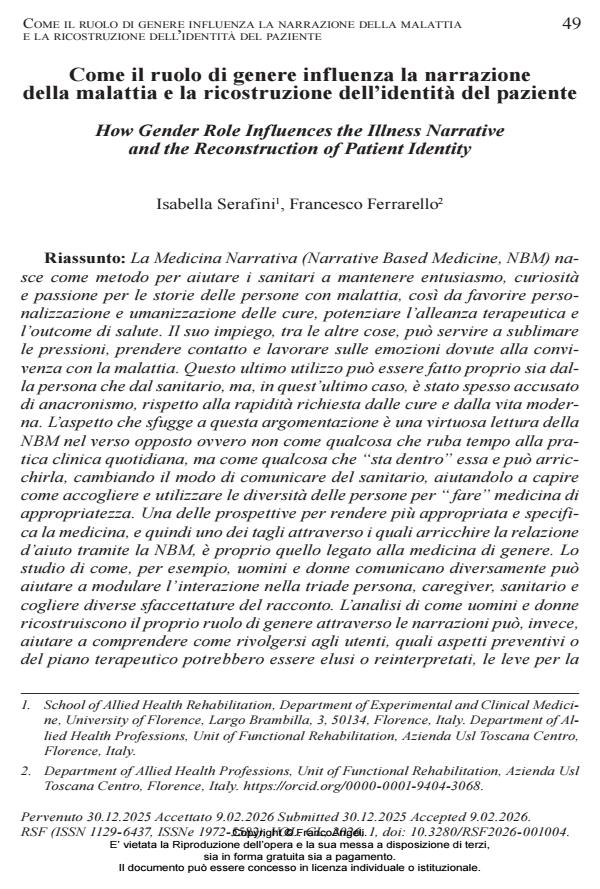
La Medicina Narrativa (Narrative Based Medicine, NBM) nasce come metodo per aiutare i sanitari a mantenere entusiasmo, curiosità e passione per le storie delle persone con malattia, così da favorire personalizzazione e umanizzazione delle cure, potenziare l’alleanza terapeutica e l’outcome di salute. Il suo impiego, tra le altre cose, può servire a sublimare le pressioni, prendere contatto e lavorare sulle emozioni dovute alla convivenza con la malattia. Questo ultimo utilizzo può essere fatto proprio sia dalla persona che dal sanitario, ma, in quest’ultimo caso, è stato spesso accusato di anacronismo, rispetto alla rapidità richiesta dalle cure e dalla vita moderna. L’aspetto che sfugge a questa argomentazione è una virtuosa lettura della NBM nel verso opposto ovvero non come qualcosa che ruba tempo alla pratica clinica quotidiana, ma come qualcosa che “sta dentro” essa e può arricchirla, cambiando il modo di comunicare del sanitario, aiutandolo a capire come accogliere e utilizzare le diversità delle persone per “ fare” medicina di appropriatezza. Una delle prospettive per rendere più appropriata e specifica la medicina, e quindi uno dei tagli attraverso i quali arricchire la relazione d’aiuto tramite la NBM, è proprio quello legato alla medicina di genere. Lo studio di come, per esempio, uomini e donne comunicano diversamente può aiutare a modulare l’interazione nella triade persona, caregiver, sanitario e cogliere diverse sfaccettature del racconto. L’analisi di come uomini e donne ricostruiscono il proprio ruolo di genere attraverso le narrazioni può, invece, aiutare a comprendere come rivolgersi agli utenti, quali aspetti preventivi o del piano terapeutico potrebbero essere elusi o reinterpretati, le leve per la motivazione e molto altro. In questo articolo presentiamo una breve sintesi della letteratura su questo argomento.

Parole chiave:Genere, Femminilità, Mascolinità, Illness, Narrativa, Autobiografie.

  1. [1.] Greenhalgh T, Hurwitz B. Narrative based medicine: why study narra-tive?. BMJ 1999; 318 7175: 48-50. DOI: 10.1136/BMJ.318.7175.48
  2. [2.] Launer J. Narrative based medicine: a narrative approach to mental health in general practice. BMJ 1999. 318 7176, 117-9.
  3. [3.] Remei C, Childs E, Pasco J, Trinquart L, Flynn D, Wingerter et al. Content and outcomes of narrative medicine programmes: a systematic review of the literature through 2019. BMJ Open, 10.
  4. [4.] Gallagher A, Brown J, Caroll C, Perkins E, Van Dore, C & McEntegart
  5. A. The potential of narrative-based medicine interventions targeting hospital practitioner burnout: findings from a scoping review. Arts & health 2024; 1-24. DOI: 10.1080/17533015.2024.2403607
  6. [5.] Charon R. Narrative medicine. Honoring the stories of illness. New
  7. York: Oxford University Press; 2006.
  8. [6.] Charon R. Narrative Medicine: A Model for Empathy, Reflection, Profession, and Trust. JAMA 2001; 286(15): 1897-1902.
  9. [7.] Zannini L. Medical Humanities e medicina narrativa. Milano: Raffael-lo Cortina Editore; 2008.
  10. [8.] Covelli V. Medicina narrative e ricerca. Lecce: Youcanprint; 2008. [9.] Balint M. Medico, paziente e malattia. Milano: Feltrinelli; 1961.
  11. [10.] Schieppati A. Progettare la cura con la medicina narrativa. Perugia: Cultura e salute editore Perugia; 2024.
  12. [11.] https://www.medicinanarrativa.network/wp-Content/uploads/2021/03/ Quaderno_n._7_02_CONSENSUS-CON-FINALE_compressed.pdf.
  13. [12.] Kleinman A. Culture, illness and care: clinical lessons from anthropo-lologic and cross-cultural research. Annals of internal medicine 1978; 88(2): 251-258. DOI: 10.7326/0003-4819-88-2-251.PMID:626456
  14. [13.] Vermeire E, Hearnshaw H, Van Royen P, Denekens J. Patient adher-ence to treatment: three decades of research. A comprehensive review. J Clin Pharm Ther. 2001; Oct; 26(5): 331-42.
  15. [14.] Becker J, Dickerman M. Impact of Narrative Medicine Curriculum on Burnout in Pediatric Critical Care Trainees. Critical Care Medicine 2020; 951 (49) 473-473.
  16. [15.] Lee E, Jacobson A, Maalouf M. Addressing Burnout: A Narrative Medicine Curriculum for Millennial Medical Students. Journal of Psychology Research 2020; 10(12): 507-511. DOI: 10.17265/2159
  17. [16.] Edwards L, Kim Y, Stevenson M, Johnson T, Sharp N, Reisman A, Srinivasan M. When it’s needed most: a blueprint for resident creative writing workshops during inpatient rotations. BMC Medical Education 2021. Oct 20; 21(1): 535.
  18. [17.] Winkel A, Feldman N, Moss H, Jakalow H, Simon J, Blank S. Narra-tive Medicine Workshops for Obstetrics and Gynecology Residents and Association With Burnout Measures. Obstetrics & Gynecology 2016. 128, 27S-33S. DOI: 10.1097/AOG.0000000000001619
  19. [18.] Dutta R. The limitations of narrative medicine. Theoretical Medicine and Bioethics 2025. 46: 247-264.
  20. [19.] Fox D, Hauser J. Exploring perception and usage of narrative medicine by physician specialty: a qualitative analysis. Philosophy, Ethics, and Humanities in Medicine 2021. 16.
  21. [20.] Xiao S, Yuan J, Lan H, Li Q, Cheng Y, Cao K, Zeng X. Investigation of clinical medicine undergraduates’ recognition of narrative medicine. BMC Medical Education 2024. 24.
  22. [21.] Milota M, Van Thiel G, Van Delden J. Narrative medicine as a medical education tool: A systematic review. Medical Teacher 2019. 41. 802-810. DOI: 10.1080/0142159X.2019.1584274
  23. [22.] France EF, Hunt K, Dow C, Wyke S. Do men’s and women’s accounts of surviving a stroke conform to Frank’s narrative genres? Qual Health Res. 2013 Dec; 23(12): 1649-59.
  24. 2013 Oct 24. PMID: 24159003; PMCID: PMC3938143.
  25. [23.] Kagawa Y, Ishikawa H, Son D, Okuhara T, Okada H, Ueno H, Goto, E et al23). Using patient storytelling to improve medical students’ empa-thy in Japan: a pre-post study. BMC Medical Education 2023. Jan 27; 23(1): 67.
  26. [24.] Purkiss A. Power of patient storytelling. Archives of Disease in Child-hood 2022. 108: 815-816.
  27. [25.] Assad M. Gender, illness and narrative: a rhetorical study of the amer-ican heart association’s go red for women campaign. Unpublished doc-toral dissertation 2014. Ohio: Case Western Reserve University.
  28. [26.] Baum N. Once Upon a Time: Storytelling to Connect with Your Pa-tients. Physician Leadership Journal 2024. 11(6): 41-43.
  29. [27.] Getchell L, Reich M, Allu S, Woods C, Atkinson T, Beaucage M, Stal-ke, L, Sparkes D, Turner C, L’Espérance A, Burns K, Elliott M, Chiu H, Rosenblum N, Sapir-Pichhadze R. Storytelling for impact: the creation of a storytelling program for patient partners in research. Research In-volvement and Engagement 2023. 9.
  30. [28.] Gucciardi E, Jean-Pierre N, Karam G, Sidani S. Designing and deliver-ing facilitated storytelling interventions for chronic disease self-management: a scoping review. BMC Health Services Research 2016.
  31. [29.] Lipsey A, Waterman A, Wood E, Balliet W. Evaluation of first-person storytelling on changing health-related attitudes, knowledge, behav-iors, and outcomes: A scoping review. Patient education and counseling 2020.
  32. [30.] Roberts A. A Two-Phase Qualitative Enquiry Into Storytelling’s Potential to Support Palliative Care Patient-Led Change, Using a Systematic Re-view Approach.. Omega 2024. Jan 9. DOI: 10.1177/00302228231223270
  33. [31.] Rushforth A, Ladds E, Wieringa S, Taylor S, Husain L, Greenhalgh T. Long Covid - The illness narratives. Social science & medicine 2021. 286: 114326.
  34. [32.] Bury M. Chronic illness as biographical disruption. Sociol Health Illn. 1982 Jul; 4(2): 167-82.
  35. [33.] Tokatli M, Sisti L, Marziali E, Nachira L, Rossi M, Amantea C et al. Hormones and Sex-Specific Medicine in Human Physiopathology. Bio-molecules, 2022. Mar 7; 12(3): 41312.
  36. [34.] Mauvais-Jarvis F, Merz N, Barnes P, Brinton R, Carrero J, Demeo D, Vries G et al. Sex and gender: modifiers of health, disease, and med-icine. Lancet (London, England) 2020; 396: 565-582. DOI: 10.1016/S0140-6736(20)31561-0
  37. [35.] Oertelt-Prigione, S. Putting gender into sex- and gender-sensitive med-icine. EClinicalMedicine 2020; Mar 4; 20: 100305.20.
  38. [36.] Di Nuovo F. Il valore aggiunto della medicina di genere. Ital J Gen-der-Specific Med 2020; 20:34-35.
  39. [37.] De Fiore, L. Toward a gender-oriented scientific communication. Journal of Sex-and Gender-Specific Medicine 2017; 3(3), 124. DOI: 10.1723/2882.29063
  40. [38.] ARS Toscana. (2023). La salute di genere in Tscana. Documenti ARS Toscana, numero speciale maggio 2023.
  41. [39.] Bhaloo T, Juma M, Criscuolo-Higgins C. A solution-focused approach to understanding patient motivation in diabetes self-management: Gen-der differences and implications for primary care. Chronic Illness 2018; 14(4), 243-255. DOI: 10.1177/1742395317736372
  42. [40.] Bueno MV et al. Differences in Adverse Psychosocial Outcomes among Family Caregivers: A Systematic Review. West J Nurs Res. 2023 Jan; 45(1):78-92. DOI: 10.1177/01939459221099672
  43. [41.] Wittenberg Y et al. Informal caregivers’ judgements on sharing care with home care professionals from an intersectional perspective: the influence of personal and situational characteristics. Scand J Caring Sci. 2019. Dec; 33(4): 1006-1016.
  44. [42.] Lippi, D, Bianucci, R, & Donell, S. Gender medicine: its historical roots. Postgraduate Medical Journa 2020; 96, 480-486.
  45. [43.] Piani F, Baffoni L, Strocchi E, Borghi C. Gender-Specific Medicine in the European Society of Cardiology Guidelines from 2018 to 2023: Where Are We Going?. Journal of Clinical Medicine 2024; 13.
  46. [44.] Delgado-Herrera M, Aceves-Gómez AC, Reyes-Aguilar A. Relation-ship between gender roles, motherhood beliefs and mental health. PLoS One 2024 Mar 20; 19(3): e0298750.
  47. [45.] Ullrich R, Becker M, Scharf J. The Development of Gender Role At-titudes During Adolescence: Effects of Sex, Socioeconomic Back-ground, and Cognitive Abilities. Journal of Youth and Adolescence 2022; 51: 2114-2129.
  48. [46.] Yilmaz Z, Yilmaz T, Tokman E. Views of healthcare professionals on gender roles: A qualitative study. Heliyon 2023; 9.
  49. [47.] Appleton D, Robertson N, Lesley R.. The Effect of Gender Ideal Ad-herence on Carer Burden and Help-Seeking in Male Carers of People With Multiple Sclerosis.. International journal of MS care 2025; 27: 8-14. DOI: 10.7224/1537-2073.2023-073
  50. [48.] Lennon J, Hevey D, Kinsella L. Gender role conflict, emotional ap-proach coping, self-compassion, and distress in prostate cancer pa-tients: A model of direct and moderating effects. Psycho-Oncology 2018; 27: 2009-2015.
  51. [49.] Seldomridge A, Wang D, Dryjanska L, Schwartz J. Adherence to Gender Roles on PTSD Symptoms of Hurricane Harvey Sur-vivors. Journal of Loss and Trauma 2024; 29: 803-827. DOI: 10.1080/15325024.2024.2345071
  52. [50.] Ahlsen B, Bondevik H, Mengshoel AM, Solbrække K N. (Un)doing gender in a rehabilitation context: A narrative analysis of gender and self in stories of chronic muscle pain.Disability and Rehabilitation: An International, Multidis-ciplinary Journal 2014, 36(5), 359-366. DOI: 10.3109/09638288.2013.793750
  53. [51.] Riessman, C. K. (2003). Performing identities in illness narrative: Mas-culinity and multiple sclerosis. Qualitative research, 3(1), 5-33. DOI: 10.1177/1468794103003001766
  54. [52.] Le Henaff Y, Héas S, Joly P. Taking care of oneself and others: The emotion work of women suffering from a rare skin disease. Health. 2023; 27(5): 738-755. DOI: 10.1177/13634593211064127
  55. [53.] Thompson EH Jr, Futterman AM. Body talk and resilience: Aging men’s experiences with mastectomy and prostatectomy. J Aging Stud.
  56. [54.] Solimeo S. Sex and gender in older adults’ experience of Parkinson’s disease. J Gerontol B Psychol Sci Soc Sci. 2008 Jan; 63(1): S42-8.
  57. [55.] Moè A. La motivazione: Teorie e processi. Bologna: il Mulino; 2020. [56.] Tannen D. You just don’t understand. Women and men in conversation. New York: Balantine Books, 1992.
  58. [57.] Saccà F, Rosalba Belmonte R. Sopravvissute. La violenza narrata dalle donne. Roma: Castelvecchi, 2022.
  59. [58.] Quaglia V. Men, masculinities and diabetes: ‘doing gender’ in Italian men’s narratives of chronic illness. Sociol Health Illn 2020 Nov; 42(8): 1902-1917. DOI: 10.1111/1467-9566.13176
  60. [59.] Poli EF. Le emozioni che curano. Stare bene con la nuova medicina delle emozioni. Milano:Mondadori, 2019.
  61. [60.] Arcand M, Juster R, Lupien S, Marin, M. Gender roles in re-lation to symptoms of anxiety and depression among students and workers. Anxiety, Stress, & Coping 2020; 33: 661-674. DOI: 10.1080/10615806.2020.1774560
  62. [61.] Pedulla R, Glugosh J, Jeyaseelan N, Prevost B, Velez, E., Winnitoy, B et al. Associations of Gender Role and Pain in Musculoskeletal Disor-ders: A Mixed-Methods Systematic Review. The journal of pain 2024; 104644.
  63. [62.] Stalling I, Gruber M, Bammann K. Sex differences in physical func-tioning among older adults: cross-sectional results from the OUT-DOOR ACTIVE study. BMC Public Health. 2024 Jul 2; 24(1): 1766.
  64. [63.] Zeidan RS, McElroy T, Rathor L, Martenson MS, Lin Y, Mankowski R T. Sex differences in frailty among older adults. Experimental Geron-tology 2023, 184.

Isabella Serafini, Francesco Ferrarello, Come il ruolo di genere influenza la narrazione della malattia e la ricostruzione dell’identità del paziente in "RIVISTA SPERIMENTALE DI FRENIATRIA" 1/2026, pp 49-71, DOI: 10.3280/RSF2026-001004