Competenze valutative degli insegnanti e recupero delle carenze: uno studio esplorativo nella scuola secondaria superiore della provincia autonoma di Trento

Titolo Rivista CADMO
Autori/Curatori Valeria Damiani, Franco Passalacqua
Anno di pubblicazione 2026 Fascicolo 2025/2
Lingua Italiano Numero pagine 27 P. 9-35 Dimensione file 340 KB
DOI 10.3280/CAD2025-002002
Il DOI è il codice a barre della proprietà intellettuale: per saperne di più clicca qui

Qui sotto puoi vedere in anteprima la prima pagina di questo articolo.

Se questo articolo ti interessa, lo puoi acquistare (e scaricare in formato pdf) seguendo le facili indicazioni per acquistare il download credit. Acquista Download Credits per scaricare questo Articolo in formato PDF
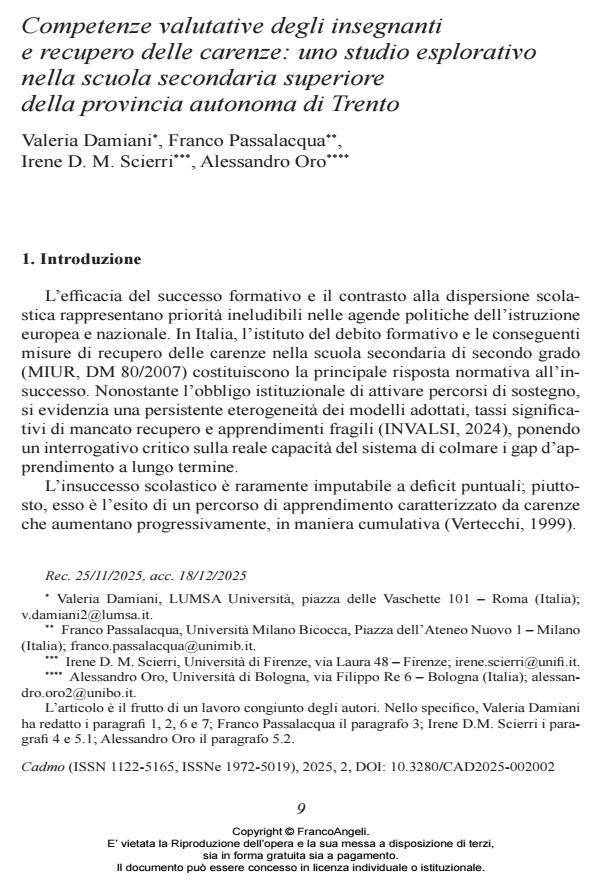
Anteprima articolo

FrancoAngeli è membro della Publishers International Linking Association, Inc (PILA), associazione indipendente e non profit per facilitare (attraverso i servizi tecnologici implementati da CrossRef.org) l’accesso degli studiosi ai contenuti digitali nelle pubblicazioni professionali e scientifiche.

In the Italian educational context, addressing learning gaps and preven-ting school dropout are top priorities. This exploratory study, part of the “Formative Assessment and Learning Recovery” project in the Autonomous Province of Trento, aims to map teachers’ assessment competences (asses-sment literacy) and their conceptions of assessment. Furthermore, it investi-gates how upper secondary schools organize and implement remedial tests for students with learning deficits. A questionnaire was administered to a sample of 481 teachers from 20 secondary schools. Data were analyzed using descriptive statistics, ANOVA, and mixed-effects models to estimate the variance at the school level. The findings indicate overall good levels of assessment literacy among teachers, particularly in direct assessment actions like formulating objectives and de-signing tests. However, a lack of proficiency was found in basic statistics and measurement. A conception of “assessment for learning” predominates across the sample. Regarding remedial practices, while test design and crite-ria definition often involve departmental collaboration, the analysis of results remains a largely individual task. Significant differences between schools emerged in the shared use of assessment criteria and the methods of provi-ding feedback to students. Future interventions should focus on strengthening data-driven asses-sment skills and promoting greater collegiality in the analysis of learning outcomes to ensure more effective recovery strategies.

Parole chiave:assessment literacy, formative assessment, learning recovery, se-condary education, teachers’ assessment competences

  1. Bennett, R. E. (2011), “Formative assessment: A critical review”, Assessment in Education: Principles, Policy & Practice, 18 (1), pp. 5-25, DOI: 10.1080/0969594X.2010.513678
  2. Black, P., Wiliam, D. (1998a), “Assessment and classroom learning”, Assessment in Education: Principles, Policy & Practice, 5 (1), pp. 7-74, DOI: 10.1080/0969595980050102
  3. Black, P., Wiliam, D. (1998b), “Inside the Black Box: Raising Standards Through Classroom Assessment”, Phi Delta Kappan, 80 (2), pp. 139-148.
  4. Brown, G. T. L. (2004), “Teachers’ conceptions of assessment: Implications for po-licy and professional development”, Assessment in Education: Principles, Policy & Practice, 11 (3), pp. 301-318, DOI: 10.1080/0969594042000304609
  5. Brown, G. T. L. (2006), “Teachers’ conceptions of assessment: Validation of an abridged instrument”, Psychological Reports, 99 (1), pp. 166-170, https://doi. org/10.2466/pr0.99.1.166-170.
  6. Brown, G. T. L., Gebril, A., Michaelides, M. P. (2019), “Teachers’ conceptions of assessment: A global phenomenon or a global localism”, Frontiers in Education, 4, 16,
  7. Calderhead, J. (1996), Teachers: Beliefs and knowledge. In Berliner, D. C., Calfee, R.
  8. C. (Eds), Handbook of educational psychology. New York: Macmillan, pp. 709-725. Ciani, A., Rosa, A. (2021), “CONVAL: validazione di una scala sulle concezioni degli insegnanti relative alla valutazione”, Lifelong, Lifewide Learning, 17 (39), pp. 94-113,
  9. Fives, H., Buehl, M. M. (2012), Spring cleaning for the “messy” construct of tea-chers’ beliefs: What are they? Which have been examined? What can they tell us? In Harris, K. R., Graham, S., Urdan, T., Graham, S., Royer, J. M., Zeidner,
  10. M. (Eds), APA educational psychology handbook, vol. 2. Individual differences and cultural and contextual factors. Washington: American Psychological Asso-ciation, DOI: 10.1037/13274-019
  11. Gotch, C. M., French, B. F. (2014), “A systematic review of assessment literacy measures”, Educational Measurement: Issues and Practice, 33 (2), pp. 14-18,
  12. Grion, V., Restiglian, E. (2021), “Il punto di vista degli insegnanti sulla valutazio-ne fra pari: risultati di una ricerca empirica”, RicercAzione, 13 (1), pp. 39-56, https://dx.doi.org/10.32076/RA13109.
  13. Guskey, T. R. (2002), “Professional development and teacher change”, Tea-chers and Teaching: Theory and Practice, 8 (3), pp. 381-391, DOI: 10.1080/135406002100000512
  14. Hattie, J., Timperley, H. (2007), “The power of feedback”, Review of Educational Research, 77 (1), pp. 81-112, DOI: 10.3102/003465430298487
  15. Heritage, M. (2010), Formative assessment: Making it happen in the classroom. Thousand Oaks: Corwin.
  16. INVALSI (2024), Rapporto Nazionale Prove INVALSI 2024, https://invalsi-area-prove.cineca.it/docs/2024/Rilevazioni_Nazionali/Rapporto/Rapporto%20 Prove%20INVALSI%202024.pdf.
  17. Pastore, S. (2019), Alla ricerca di una definizione di competenza valutativa. In Pa-store, S. (Ed), Competenza valutativa e formazione docente. Roma: Carocci, pp. 21-44.
  18. Pastore, S., Andrade, H. (2019), “Teacher assessment literacy: A three-dimensio-nal model”, Teaching and Teacher Education, 84, pp. 128-138,
  19. Scierri, I. D. M. (2023), “Per una valutazione centrata sull’allievo. Framework te-orico e primi risultati di un’indagine su concezioni e strategie valutative degli insegnanti”, Lifelong Lifewide Learning, 19 (42), pp. 83-101,
  20. Scierri, I. D. M. (2024), “Perché valuto? Costruzione e validazione della scala delle concezioni valutative degli insegnanti (CoVI)”, Ricerche di Pedagogia e Didat-tica, 19 (1), pp. 109-128,
  21. Shulman, L. S. (1987), “Knowledge and teaching: Foundations of the new reform”, Harvard Educational Review, 57 (1), pp. 1-22.
  22. Tammaro, R., Gragnaniello, D. (2024), “La sfida dei docenti: dalla valutazione tra-dizionale all’assessment for learning, tra concezioni e buone pratiche”, QTimes-Journal of Education, Technology and Social Studies, 16 (1), pp. 1-12.
  23. Vertecchi, B. (1999), Decisione didattica e valutazione. Firenze: La Nuova Italia. Xu, Y., Brown, G. T. L. (2016), “Teacher assessment literacy in practice: A recon-
  24. ceptualization”, Teaching and Teacher Education, 58, pp. 149-162, https://doi. org/10.1016/j.tate.2016.05.010.
  25. Yan, Z., Pastore, S. (2022), “Are teachers literate in formative assessment?”, Fron-tiers in Education, 7, 101183,

Valeria Damiani, Franco Passalacqua, Competenze valutative degli insegnanti e recupero delle carenze: uno studio esplorativo nella scuola secondaria superiore della provincia autonoma di Trento in "CADMO" 2/2025, pp 9-35, DOI: 10.3280/CAD2025-002002