Primo anno di vita e memoria

Titolo Rivista PSICOANALISI
Autori/Curatori David Rosenfeld
Anno di pubblicazione 2026 Fascicolo 2025/2
Lingua Italiano Numero pagine 15 P. 77-91 Dimensione file 63 KB
DOI 10.3280/PSI2025-002006
Il DOI è il codice a barre della proprietà intellettuale: per saperne di più clicca qui

Qui sotto puoi vedere in anteprima la prima pagina di questo articolo.

Se questo articolo ti interessa, lo puoi acquistare (e scaricare in formato pdf) seguendo le facili indicazioni per acquistare il download credit. Acquista Download Credits per scaricare questo Articolo in formato PDF
Anteprima articolo

FrancoAngeli è membro della Publishers International Linking Association, Inc (PILA), associazione indipendente e non profit per facilitare (attraverso i servizi tecnologici implementati da CrossRef.org) l’accesso degli studiosi ai contenuti digitali nelle pubblicazioni professionali e scientifiche.

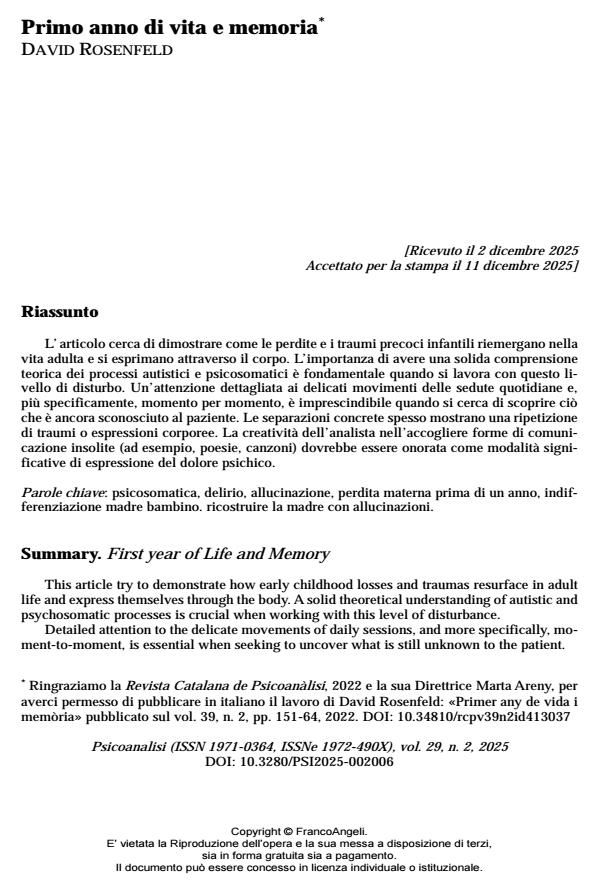
L’ articolo cerca di dimostrare come le perdite e i traumi precoci infantili riemergano nella vita adulta e si esprimano attraverso il corpo. L’importanza di avere una solida comprensione teorica dei processi autistici e psicosomatici è fondamentale quando si lavora con questo livello di disturbo. Un’attenzione dettagliata ai delicati movimenti delle sedute quotidiane e, più specificamente, momento per momento, è imprescindibile quando si cerca di scoprire ciò che è ancora sconosciuto al paziente. Le separazioni concrete spesso mostrano una ripetizione di traumi o espressioni corporee. La creatività dell’analista nell’accogliere forme di comunicazione insolite (ad esempio, poesie, canzoni) dovrebbe essere onorata come modalità significative di espressione del dolore psichico.

Parole chiave:psicosomatica, delirio, allucinazione, perdita materna prima di un anno, indifferenziazione madre bambino. ricostruire la madre con allucinazioni.

  1. Anzieu D. (1974). Skin ego. In: S. Lebovici & D. Widlocher (Eds.), Psychoanalysis in France pp. 17-32, New York: International Universities Press (trad. it. L’Io-pelle. Roma: Borla, 1987).
  2. Bick E. (1968). The experience of the skin in early object relations. International Journal of Psychoanalysis, 49, 3: 484-486.
  3. Freud S. (1896). Heredity and the aetiology of the neuroses. In: S.E., vol. 3, trans. James Strachey. New York: Basic Books (trad. it: Eredità ed eziologia nelle nevrosi. In: OSF, Vol. 1, Torino: Bollati Boringhieri).
  4. Freud S. (1896). Further remarks on the Neuro-Psychoses of defense. In: S.E., vol. 3, trans. James Strachey. New York: Basic Books (trad. it: Ulteriori osservazioni sulle neuropsicosi di difesa. In: OSF, Vol. 1, Torino: Bollati Boringhieri).
  5. Freud S. (1897). The etiology of hysteria. In: S.E., vol. 3, trans. James Strachey. New York: Basic Books (trad. it: Sull’etiologia dell’isteria. In: OSF, vol. 1, Torino: Bollati Boringhieri).
  6. Freud S. (1905). Three Essays on the Theory of Sexuality, In: S.E., vol. 4, trans. James Strachey. New York: Basic Books (trad. it: Tre saggi sulla sessualità. In: OSF, vol. 5, Torino: Bollati Boringhieri).
  7. Freud S. (1907). The sexual enlightenment of children. In: S.E., vol. 9, trans. James Strachey. New York: Basic Books (trad. it: L’istruzione sessuale dei fanciulli. In: OSF, vol. 5, Torino: Bollati Boringhieri).
  8. Freud S. (1908). Character and anal erotism. In: S.E., vol. 9, trans. James Strachey. New York: Basic Books (trad. it: Carattere ed erotismo anale. In: OSF, vol. 5, Torino: Bollati Boringhieri).
  9. Freud S. (1909). Analysis of a phobia of a five-year old boy. In: S.E., vol. 9, trans. James Strachey. New York: Basic Books (trad. it: Il caso del piccolo Hans. Analisi di una fobia di un bambino di cinque anni. In: OSF, vol. 5, Torino: Bollati Boringhieri).
  10. Freud S. (1914). Remembering, repeating and working-through (Further recommendations on the technique of psycho-analysis, II). In: S.E., vol. 12, trans. James Strachey. New York: Basic Books (trad. it: Nuovi Consigli sulla tecnica psicoanalitica. Ricordare, ripetere, rielaborare. In: OSF, vol. 7, Torino: Bollati Boringhieri).
  11. Freud S. (1924). The dissolution of the Oedipus complex. In: S.E., vol. 19, trans. James Strachey. New York: Basic Books (trad. it: Il tramonto del complesso edipico. In: OSF, vol. 10, Torino: Bollati Boringhieri).
  12. Freud S, (1930). Oceanic feelings. In: S.E., vol. 21, trans. James Strachey. New York: Basic Books.
  13. Houzel D., Emmanuelli M., Moggio F. (2000). Dictionnaire de psychopathologie de l’enfant et de l’adolescent. Paris: PUF.
  14. Klein M. (1935). A Contribution to the Psychogenesis of Manic-Depressive States. Int. J. Psycho-Anal., 16: 145-174.
  15. Klein M. (1940). Mourning and its Relationship with manic-depressive mechanisms. Int. J. Psycho-Anal., 21: 125-153.
  16. Klein M. (1945). The Oedipus complex in the Light of early anxieties. In: The Writings of Melanie Klein, vol. 1, London: Hogarth Press, pp. 370-419.
  17. Klein M. (1975). Envy and gratitude and other Works. In: The Writings of Melanie Klein, Vol. 3, London: Hogarth Press.
  18. Mahler M. (1968) On Human Symbiosis and the Vicissitudes of Individuation. New York: International Universities Press.
  19. Mahler M., Pine F. & Bergman A. (1975). The psychological birth of the human infant. New York: Basic Books.
  20. Marty P., M’Uzan M. & David C. (1963). L’investigation psychosomatique. Paris: PUF.
  21. Marty P. (1968). A mayor process of somatization: The progressive disorganization. International Journal of Psychoanalysis. 49: 246-249.
  22. Mc Dougall J. (1989). Theatres of the body. New York: W. W. Norton & Company.
  23. Meltzer D. (1978). The Kleinian Development. London: Clunie Press for The Roland Harris Trust Library.
  24. Ogden T.H. (1989b). On the concept of an autistic-contiguous position. International Journal of Psychoanalysis, 70: 127-140. DOI: 10.4324/9781315743882-1
  25. Rosenfeld D. (1992). The Psychotic: Aspects of the Personality. London: Routledge.
  26. Rosenfeld D. (2006). The Soul, the Mind, and the Psychoanalyst. London: Routledge.
  27. Rosenfeld D. (2014). The Body Speaks: Body Image Delusions and Hypochondria. London: Routledge.
  28. Spitz R. (1965). El primer año de vida del niño. Génesis de las relaciones objetales. México: Fondo de Cultura Económica.
  29. Tustin F. (1986). Autistic barriers in neurotic patients. London: Karnac.
  30. Tustin F. (1990). The protective shell in children and adults. London: Karnac.
  31. Shakespeare W. (1599). King Henry IV Part II. The Globe Illustrated Shakespeare, New York: Greenwich House, pp. 571-624, 1983.
  32. Winnicott D.W. (1962). Ego integration in child development. In: The Maturational Processes and the Facilitating Environment. New York: International Universities Press, pp. 56-63.

David Rosenfeld, Primo anno di vita e memoria in "PSICOANALISI" 2/2025, pp 77-91, DOI: 10.3280/PSI2025-002006