Social cohesion among rural women in Nigeria and resistance to gender-based traditional practices: implication to womanism in Africa, social justice and sustainable development
Titolo Rivista SOCIOLOGIA E RICERCA SOCIALE
Autori/Curatori Ogechi Akure Ikem, Samuel Okechi Okafor, Adaobi Chisom Egbe, Abel Stella Ugwu, Andrew Nnabuchi Ogbochie, Okezi Oghenethoja Obara
Anno di pubblicazione 2026 Fascicolo 2025/137
Lingua Inglese Numero pagine 20 P. 31-50 Dimensione file 230 KB
DOI 10.3280/SR2025-137002
Il DOI è il codice a barre della proprietà intellettuale: per saperne di più
clicca qui
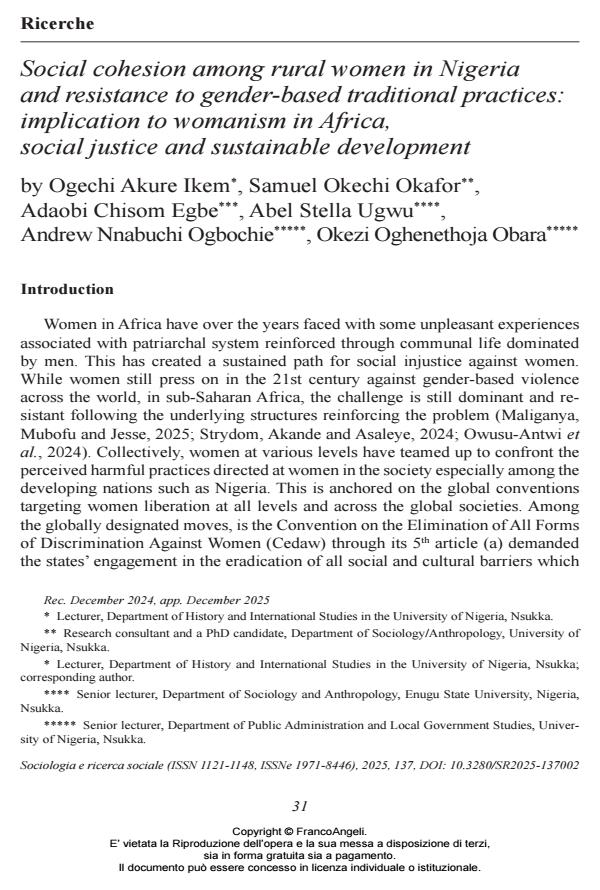
Qui sotto puoi vedere in anteprima la prima pagina di questo articolo.
Se questo articolo ti interessa, lo puoi acquistare (e scaricare in formato pdf) seguendo le facili indicazioni per acquistare il download credit. Acquista Download Credits per scaricare questo Articolo in formato PDF
FrancoAngeli è membro della Publishers International Linking Association, Inc (PILA), associazione indipendente e non profit per facilitare (attraverso i servizi tecnologici implementati da CrossRef.org) l’accesso degli studiosi ai contenuti digitali nelle pubblicazioni professionali e scientifiche.
Gender-based cultural practices against women are some of the enduring challenges with gender inequality and social justice implications in sub-Saharan Africa. Although womanism and feminism have penetrated sub-Saharan Africa, the polarisation between, and within the frameworks of womanism and feminism have prevailed against significant progress in women liberation in the region. This polarisation demonstrates the unseen disintegration within the women ranks mak-ing them vulnerable to cultural practices against women. As such, the present study examined the interaction between social cohesion and gender-based cultural practices against women in remote rural communities in southeast Nigeria. Sur-vey design was applied in the study, while questionnaire instrument (social cohe-sion scale) was used in collecting data from the respondents. The collected data was analysed using descriptive and inferential statistics. According to the findings from the study, there is a negative correlation between connection with social cohesion and vulnerability to Harmful traditional cultural practices (R -.680, P < .01), vulnerability to Harmful traditional cultural practices is predicted by socio-economic variables (R = 0.922, P < .05), while identification with social cohesion is predicted by socioeconomic variables (R = 0.965, P < .05).
Ogechi Akure Ikem, Samuel Okechi Okafor, Adaobi Chisom Egbe, Abel Stella Ugwu, Andrew Nnabuchi Ogbochie, Okezi Oghenethoja Obara, Social cohesion among rural women in Nigeria and resistance to gender-based traditional practices: implication to womanism in Africa, social justice and sustainable development in "SOCIOLOGIA E RICERCA SOCIALE " 137/2025, pp 31-50, DOI: 10.3280/SR2025-137002