Men’s involvement in preventing gender violence: socioeducational and cultural strategies for an integrated welfare?

Titolo Rivista WELFARE E ERGONOMIA
Autori/Curatori Giuseppe Masullo, Lucia Picarella
Anno di pubblicazione 2026 Fascicolo 2025/2
Lingua Inglese Numero pagine 12 P. 39-50 Dimensione file 59 KB
DOI 10.3280/WE2025-002003
Il DOI è il codice a barre della proprietà intellettuale: per saperne di più clicca qui

Qui sotto puoi vedere in anteprima la prima pagina di questo articolo.

Se questo articolo ti interessa, lo puoi acquistare (e scaricare in formato pdf) seguendo le facili indicazioni per acquistare il download credit. Acquista Download Credits per scaricare questo Articolo in formato PDF
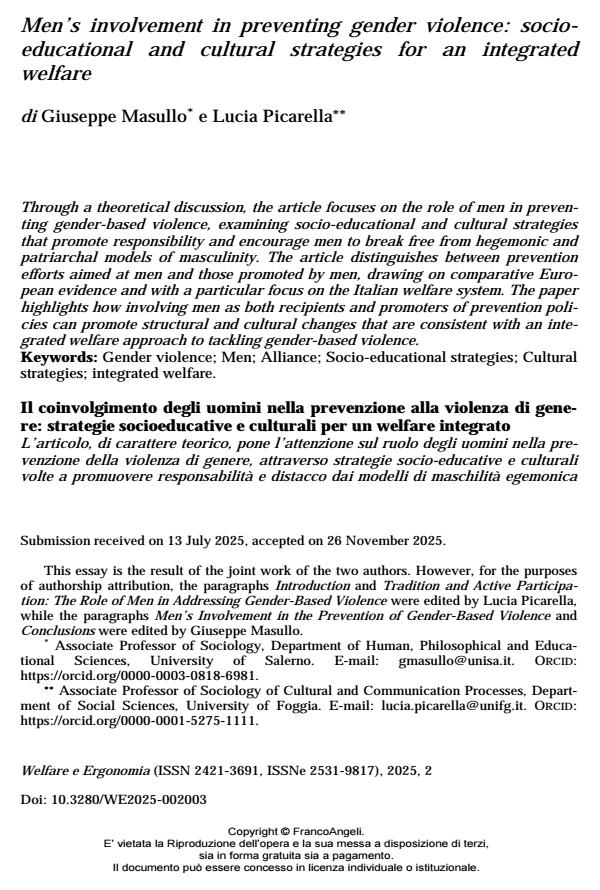
Anteprima articolo

FrancoAngeli è membro della Publishers International Linking Association, Inc (PILA), associazione indipendente e non profit per facilitare (attraverso i servizi tecnologici implementati da CrossRef.org) l’accesso degli studiosi ai contenuti digitali nelle pubblicazioni professionali e scientifiche.

Through a theoretical discussion, the article focuses on the role of men in preventing gender-based violence, examining socio-educational and cultural strategies that promote responsibility and encourage men to break free from hegemonic and patriarchal models of masculinity. The article distinguishes between prevention efforts aimed at men and those promoted by men, drawing on comparative European evidence and with a particular focus on the Italian welfare system. The paper highlights how involving men as both recipients and promoters of prevention policies can promote structural and cultural changes that are consistent with an integrated welfare approach to tackling gender-based violence.

L’articolo, di carattere teorico, pone l’attenzione sul ruolo degli uomini nella prevenzione della violenza di genere, attraverso strategie socio-educative e culturali volte a promuovere responsabilità e distacco dai modelli di maschilità egemonica e patriarcale. Si distinguono le azioni di prevenzione rivolte agli uomini da quelle promosse dagli stessi, sulla base di evidenze comparative europee e con particolare riferimento al sistema di welfare italiano. Il contributo evidenzia come il coinvolgimento degli uomini, sia come destinatari sia come promotori di politiche di prevenzione, possa favorire un cambiamento strutturale e culturale coerente con l’approccio del welfare integrato nel contrasto alla violenza di genere.

Parole chiave:Violenza di genere; Alleanza; Uomini; Strategie socioeducative; Strategie culturali; Welfare integrato.

  1. Barker G., Ricardo C. and Nascimento M. (2007). Engaging men and boys in changing gender-based inequity in health: Evidence from programme interventions. Geneva: World Health Organization.
  2. Benadusi L. (2013). Nascita e storia della mascolinità. Per un’analisi critica dei gender studies. In: Durst M. and Sabelli S., editors, Questioni di genere. Tra vecchi e nuovi pregiudizi e nuove o presunte libertà. Pisa: ETS.
  3. Berkowitz A.D. (2004). Working with Men to Prevent Violence Against Women: An Overview (Part One). National Resource Center on Domestic Violence, 9(2): 1-7.
  4. Bronfenbrenner U. (1989). Ecological systems theory Vol. 6. Greenwich CT: JAI.
  5. Burrell S.R. (2020). Male Agents of Change and Disassociating from the Problem in the Prevention of Violence against Women. In: Luyt R., and Starck K., editors, Masculine Power and Gender Equality: Masculinities as Change Agents. Cham: Springer.
  6. Burrell S.R. (2018). The contradictory possibilities of engaging men and boys in the prevention of men’s violence against women in the UK. Journal of Gender-Based Violence, 2(3): 447-464.
  7. Casey E.A. and Smith T. (2010). “How can I not?” Men’s pathways to involvement in anti-violence against women work. Violence Against Women, 16: 953-973.
  8. Ciccone S. (2023). La riflessione critica sulla maschilità e la pratica sociale maschile anti-patriarcale come risorse per progettare percorsi di contrasto della violenza di genere. CuSSoc – Culture e studi del sociale, 8(2): 44-58.
  9. Ciccone S. and Nardini K. (2017). Reading through Trans/formations, Resiliencies and Reconfigurations of Masculinities: Approaches and Practices. AG-About Gender, 6(11): I-XXVII.
  10. Cimagalli F., editor (2014). La politica contro la violenza di genere nel welfare che cambia. Milano: FrancoAngeli.
  11. Connell R.W. (1996). Maschilità. Identità e trasformazioni del maschio occidentale. Milano: Feltrinelli.
  12. Connell R.W. (1987). Gender and Power. Sydney: Allen & Unwin.
  13. Connell R.W. and Messerschmidt J.W. (2005). Hegemonic Masculinity: Rethinking the Concept. Gender and Society, 19(6): 829-859.
  14. Coulter R.P. (2003). Boys doing good: Young men and gender equity. Educational Review, 55: 135-145.
  15. Demurtas P. (2020). Così vicini, così lontani. I servizi specialistici di supporto alle donne vittime di violenza e i programmi rivolti ai maltrattanti. La Rivista delle Politiche Sociali, 2: 193-212.
  16. Di Grigoli A.R. (2020). Teorizzare la mascolinità tra passato e presente. Uno sguardo al posizionamento disciplinare degli Studi Critici sulle Mascolinità e prospettive future per la pedagogia. Teorie pedagogiche e pratiche educative, Bollettino della Fondazione “Vito Fazio-Allmayer”, XLIX(1-2): 115-134.
  17. Esping-Andersen G. and Duncan G., editors (2002). Why We Need a New Welfare State. Oxford, UK: Oxford University Press.
  18. European Commission (2023). The EU Mutual Learning Programme in Gender Equality. The role of men and boys in advancing gender equality and breaking gender stereotypes. Ireland, 16-17 February 2023. Summary Report. (Retrieved on 22 May at -- https://commission.europa.eu/publications/eu-mutual-learning-programme-gender-equality-role-men-and-boys-advancing-gender-equality-and_en).
  19. European Commission (2020). Communication from the commission to the european parliament, the council, the european economic and social committee and the committee of the regions. A Union of Equality: Gender Equality Strategy 2020-2025. (Retrieved on 5 June at -- https://eur-lex.europa.eu/legal-content/EN/TXT/?uri=celex:52020DC0152).
  20. European Commission (2012). Exchange of good practices on gender equality. The role of men in gender equality. Finland, 28-29 October 2014. Summary Report. (Retrieved on 3 June at -- https://commission.europa.eu/document/download/85d13914-f4ec-4fbd-84a4-952556044adb_en?filename=141218_fi_summary_report_en.pdf).
  21. FRA, EIGE and Eurostat (2024). EU gender-based violence survey – Key results. Experiences of women in the EU-27. Luxembourg: Publications Office of the European Union.
  22. Flood M. (2019). Engaging Men and Boys in Violence Prevention. London: Springer Nature.
  23. Flood M. (2005). Changing men: Best practice in sexual violence education. Women Against Violence, 18: 26-36.
  24. Funk R. (2008). Men's work: Men's voices and actions against sexism and violence. Journal of Intervention and Prevention in the Community, 36: 155-171.
  25. Hearn J. (2004). From Hegemonic Masculinity to the Hegemony of Men. Feminist Theory, 5(1): 49-72.
  26. Jewkes R., Flood M. and Lang J. (2015). From work with men and boys to changes of social norms and reduction of inequities in gender relations: A conceptual shift in prevention of violence against women and girls. The Lancet, 385(9977): 1580-1589.
  27. Mangone E. (2016). Implicazioni normative e istituzionali nello sviluppo integrato del welfare. In: M. Del Forno, editor, Nel complesso mondo del welfare. Idee, metodi e pratiche. Milano: FrancoAngeli.
  28. Messner M.A., Greenberg M.G. and Peretz T. (2015). Some men: feminist allies & the movement to end violence against women. New York, Oxford: University Press.
  29. Nardini K. (2015). Questioni non semplici: alcune domande a partire dai termini “uomini” e “femminismo”. Narrativa, 37: 109-118.
  30. Pease B. (2019). Facing Patriarchy. From a Violent Gender Order to a Culture of Pease. Dublin: Bloomsbury.
  31. Ruspini E. (2009). Le identità di genere. Roma: Carocci.
  32. Weldon S.L. (2002). Protest, policy and the problem of violence against women. Pittsburgh: University of Pittsburgh Press.
  33. Waling A. (2019). Problematising ‘Toxic’ and ‘Healthy’ Masculinity for Addressing Gender Inequalities. Australian Feminist Studies, 34(101): 362-375.
  34. Wells L. and Fotheringha S. (2022). A global review of violence prevention plans: Where are the men and boys? International Social Work, 65(6): 1232­1248.

Giuseppe Masullo, Lucia Picarella, Men’s involvement in preventing gender violence: socioeducational and cultural strategies for an integrated welfare?� in "WELFARE E ERGONOMIA" 2/2025, pp 39-50, DOI: 10.3280/WE2025-002003