GenAI e gestione dell’informazione nella GenZ: tra diffidenza e dipendenza

Titolo Rivista SOCIOLOGIA DELLA COMUNICAZIONE
Autori/Curatori Stefano Spillare, Michele Bonazzi
Anno di pubblicazione 2026 Fascicolo 2025/70
Lingua Italiano Numero pagine 19 P. 161-179 Dimensione file 716 KB
DOI 10.3280/SC2025-070009
Il DOI è il codice a barre della proprietà intellettuale: per saperne di più clicca qui

Qui sotto puoi vedere in anteprima la prima pagina di questo articolo.

Se questo articolo ti interessa, lo puoi acquistare (e scaricare in formato pdf) seguendo le facili indicazioni per acquistare il download credit. Acquista Download Credits per scaricare questo Articolo in formato PDF
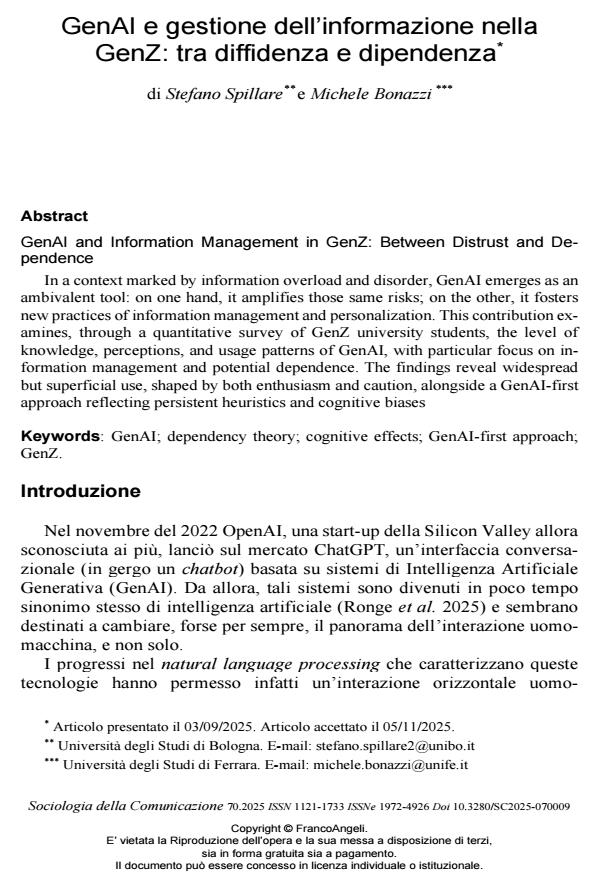
Anteprima articolo

FrancoAngeli è membro della Publishers International Linking Association, Inc (PILA), associazione indipendente e non profit per facilitare (attraverso i servizi tecnologici implementati da CrossRef.org) l’accesso degli studiosi ai contenuti digitali nelle pubblicazioni professionali e scientifiche.

In a context marked by information overload and disorder, GenAI emerges as an ambivalent tool: on one hand, it amplifies those same risks; on the other, it fosters new practices of information management and personalization. This contribution examines, through a quantitative survey of GenZ university students, the level of knowledge, perceptions, and usage patterns of GenAI, with particular focus on information management and potential dependence. The findings reveal widespread but superficial use, shaped by both enthusiasm and caution, alongside a GenAI-first approach reflecting persistent heuristics and cognitive biases

Parole chiave:GenAI; dependency theory; cognitive effects; GenAI-first approach; GenZ.

  1. Boccia Artieri G., Bartoletti R. (2023), Algoritmi e vita quotidiana: un approccio socio-comunicativo critico, in «Sociologia della Comunicazione» 66, pp. 5-20. DOI: 10.3280/SC2023-06600
  2. Brunetti I. (2020), Connessioni tra ricerca e politiche pubbliche, SINAPPSI X(3), pp. 48-63.
  3. Chiu T.K.F. (2024), The impact of generative AI (GenAI) on practices, policies and research direction in education: A case of ChatGPT and Midjourney, in «Interactive Learning Environments» 32(10), pp. 6187-6203. DOI: 10.1080/10494820.2023.225386
  4. Ciofalo G., Pedroni M., Setiffi F. (2023), ChatGPT Goes to Academia. Una ricerca esplorativa su usi e immaginari dell’intelligenza artificiale da parte di studenti e accademici, in «Sociologia della Comunicazione» 66, pp. 42-59. DOI: 10.3280/SC2023-06600
  5. Cristianini N. (2024), Machina sapiens. L’algoritmo che ci ha rubato il segreto della conoscenza, il Mulino, Bologna.
  6. DeFleur M.L., Ball-Rokeach S.J. (1976), Theories of Mass Communication, Longman, New York.
  7. Esposito E. (2022), Artificial communication. How algorithms produce social intelligence, MIT Press, Boston.
  8. Floridi L. (2014), The fourth revolution: How the infosphere is reshaping human reality, OUP, Oxford.
  9. Habermas J. (2023), Nuovo mutamento della sfera pubblica e politica deliberativa, Raffaello Cortina Editore, Milano.
  10. Hall S. (1973), Encoding and Decoding in the Televisual Discourse, Stencilled Paper No 7., CCCS Birmingham.
  11. Jenkins H. (2006), Convergence Culture: Where Old and New Media Collide, New York University Press, New York.
  12. Jungherr A., Schroeder R. (2023), Artificial intelligence and the public arena, in «Communication Theory» 33(2-3), pp. 1-10.
  13. Lévy P. (1997), L’intelligenza collettiva. Per un’antropologia del cyberspazio, Feltrinelli, Milano.
  14. Li X., Liu X., Liu Y., Nergadze N., Yao M., Zeng L. (2015), Media dependency in the digital age: Effects of perceived channel efficiency and motivation and orientation of information seeking, in X. Li (Ed.), Emerging media: Uses and dynamics, Routledge, New York-London, pp. 98-120.
  15. Mitchell M. (2019), Artificial Intelligence: A Guide for Thinking Humans, Penguin, London.
  16. Nah F.F., Zheng R., Cai J., Siau K., Chen L. (2023), Generative AI and ChatGPT: Applications, challenges, and AI-human collaboration, in «Journal of Information Technology Case and Application Research» 25(3), pp. 277-304. DOI: 10.1080/15228053.2023.223381
  17. Pariser E. (2011), The filter bubble: What the Internet is hiding from you, Penguin Press, London.
  18. Rainie L., Wellman B. (2012), Networked: The New Social Operating System, MIT Press, Cambridge.
  19. Riffe D., Lacy S., Varouhakis M. (2008), Media system dependency theory and using the Internet for in-depth, specialized information, in «Web Journal of Mass Communication Research» 11(1), pp. 1-14.
  20. Ronge R., Maier M., Rathgeber B. (2025), Towards a definition of generative artificial intelligence, in «Philosophy & Technology» 38, pp. 1-25.
  21. Ruffo A. (2025), Il disordine informativo e l’Intelligenza Artificiale; tra insidie e possibili strumenti di contrasto, in «Media Laws» 1, pp. 407-424.
  22. Sachu B., Sankaranaraynan K.B., Kadeswaran S. (2025), Beyond the headlines: Media dependency and social media news consumption among youth, in «International Journal of Research - GRANTHAALAYAH» 13(6), pp. 114-124.
  23. Shin D., Koerber A., Lim J.S. (2024), Impact of misinformation from generative AI on user information processing: How people understand misinformation from generative AI, in «New Media & Society» 27(7), pp. 4017-4047. DOI: 10.1177/1461444824123404
  24. Sorrentino C. (2025), Disordine informativo, in Balbi G., Comunello F., Pasquali F., Sorice M. (a cura di), Studiare i media. Prospettive disciplinari e parole chiave, Carocci, Roma.
  25. Spillare S., Bonazzi M., Degli Esposti P. (2024), AI Imaginaries and Narratives in the Italian Public Discourse: The Impact of ChatGPT, in «Im@go» 23, pp. 131-147. DOI: 10.7413/228181381959
  26. Srnicek N. (2017), Platform capitalism, Polity Press, Cambridge.
  27. Stokel-Walker C., O’Connor S. (2023), ChatGPT listed as author on research papers: many scientists disapprove, in «Nature» 613, pp. 620-621.
  28. Surowiecki J. (2004), The wisdom of crowds, Anchor, New York.
  29. Tredinnick L., Laybats C. (2023), The dangers of generative artificial intelligence, in «Business Information Review» 40(2), pp. 46-48. DOI: 10.1177/0266382123118375
  30. van Dijck J., Poell T., de Waal M. (2018), The platform society: Public values in a connected world, Oxford University Press, Oxford.
  31. van Slyke C., Johnson R.D., Sarabadani J. (2023), Generative artificial intelligence in information systems education: challenges, consequences, and responses, in «Communications of the Association for Information Systems» 53, pp. 1-21. DOI: 10.17705/1CAIS.0530
  32. Wang W., Zhang Y., Chua T. (2025), Recommendation in the era of generative artificial intelligence, in White R.W., Shah C. (eds.), Information access in the era of generative AI, Springer Nature, London.
  33. Wardle, C., Derakhshan, H. (2017), Information disorder: Toward an interdisciplinary framework for research and policymaking, Council of Europe, Strasbourg.
  34. White R.W., Shah C. (eds.) (2025), Information access in the era of generative AI, Springer Nature, London.
  35. Wolfe R., Mitra T. (2024), The impact and opportunities of generative AI in fact-checking, in «Proceedings of the 2024 ACM Conference on Fairness, Accountability, and Transparency», pp. 1531-1543. DOI: 10.1145/3630106.365898
  36. Zuboff S. (2019), The age of surveillance capitalism: The fight for the future at the new frontier of power, Routledge, New York-London.

Stefano Spillare, Michele Bonazzi, GenAI e gestione dell’informazione nella GenZ: tra diffidenza e dipendenza in "SOCIOLOGIA DELLA COMUNICAZIONE " 70/2025, pp 161-179, DOI: 10.3280/SC2025-070009