Violenza digitale di genere e logiche di piattaforma. Il ruolo delle folk theories e degli immaginari algoritmici nella percezione delle/gli utenti

Titolo Rivista SOCIOLOGIA DELLA COMUNICAZIONE
Autori/Curatori Mariacristina Sciannamblo, Chiara Carbone, Cosimo Marco Scarcelli, Lorenza Parisi, Francesca Comunello
Anno di pubblicazione 2026 Fascicolo 2025/70
Lingua Italiano Numero pagine 18 P. 57-74 Dimensione file 118 KB
DOI 10.3280/SC2025-070004
Il DOI è il codice a barre della proprietà intellettuale: per saperne di più clicca qui

Qui sotto puoi vedere in anteprima la prima pagina di questo articolo.

Se questo articolo ti interessa, lo puoi acquistare (e scaricare in formato pdf) seguendo le facili indicazioni per acquistare il download credit. Acquista Download Credits per scaricare questo Articolo in formato PDF
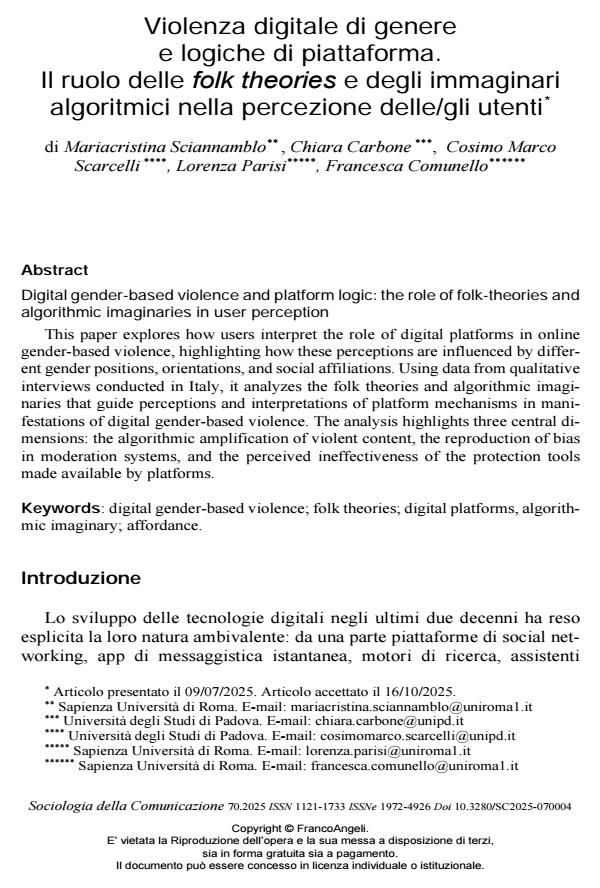
Anteprima articolo

FrancoAngeli è membro della Publishers International Linking Association, Inc (PILA), associazione indipendente e non profit per facilitare (attraverso i servizi tecnologici implementati da CrossRef.org) l’accesso degli studiosi ai contenuti digitali nelle pubblicazioni professionali e scientifiche.

This paper explores how users interpret the role of digital platforms in online gender-based violence, highlighting how these perceptions are influenced by different gender positions, orientations, and social affiliations. Using data from qualitative interviews conducted in Italy, it analyzes the folk theories and algorithmic imaginaries that guide perceptions and interpretations of platform mechanisms in manifestations of digital gender-based violence. The analysis highlights three central dimensions: the algorithmic amplification of violent content, the reproduction of bias in moderation systems, and the perceived ineffectiveness of the protection tools made available by platforms.

Parole chiave:digital gender-based violence; folk theories; digital platforms, algorithmic imaginary; affordance.

  1. Jane E.A. (2016), Misogyny online: A short (and brutish) history, Sage, London.
  2. Bonini T., Treré E. (2024), Algorithms of Resistance: the everyday fight against platform power, The MIT Press, Cambridge-London.
  3. boyd d. (2010), Privacy, publicity, and visibility, Microsoft Tech Fest, Redmond.
  4. Boczkowski P. J. (2004), The Mutual Shaping of Technology and Society in Videotex Newspapers: Beyond the Diffusion and Social Shaping Perspectives, in «The Information Society» 20(4), pp. 255-267. DOI: 10.1080/0197224049048094
  5. Braun V., Clarke V. (2012), Thematic analysis, in Cooper H., Camic P.M., Long D.L., Panter A.T., Rindskopf D., Sher K.J. (eds.), APA handbook of research methods in psychology, Vol. 2. Research designs: Quantitative, qualitative, neuropsychological, and biological, American Psychological Association, Washington DC, pp. 57-71. DOI: 10.1037/13620-00
  6. Bucher T. (2016), The algorithmic imaginary: exploring the ordinary affects of Facebook algorithms, in «Information, Communication & Society» 20(1), pp. 30-44. DOI: 10.1080/1369118X.2016.115408
  7. Corbetta P. (2014), Metodologia e tecniche della ricerca sociale, il Mulino, Bologna.
  8. D’Ignazio C., Klein L. (2020), Data Feminism, The MIT Press, Cambridge-London.
  9. DeVito M.A., Gergle D., Birnholtz J. (2017), “Algorithms ruin everything”: #RIPTwitter, folk theories, and resistance to algorithmic change in social media, in «Proceedings of the 2017 CHI Conference on Human Factors in Computing Systems», pp. 3163-3174. DOI: 10.1145/3025453.302565
  10. DeVito M.A., Birnholtz J., Hancock J. T., French M., Liu S. (2018), How people form folk theories of social media feeds and what it means for how we study self-presentation, in «Proceedings of the 2018 CHI conference on human factors in computing systems», pp. 1-12. DOI: 10.1145/3173574.3173694
  11. Dogruel L. (2021), Folk theories of algorithmic operations during Internet use: A mixed methods study, in «The Information Society» 37(5), pp. 287-298. DOI: 10.1080/01972243.2021.194976
  12. Dragiewicz M., Burgess J., Matamoros-Fernández A., Salter M., Suzor N.P., Woodlock D., Harris B. (2018), Technology facilitated coercive control: domestic violence and the competing roles of digital media platforms, in «Feminist Media Studies» 18(4), pp. 609-625. DOI: 10.1080/14680777.2018.144734
  13. European Institute for Gender Equality (2020), Gender-based violence enabled by digital technology: A new occupational hazard?, testo disponibile in https://eige.europa.eu/publications-resources/toolkits-guides/gender-equality-index-2020-report/gender-based-violence-enabled-digital-technology-new-occupational-hazard?language_content_entity=en (November 10, 2025)
  14. Gillespie T. (2018), Custodians of the Internet: Platforms, content moderation, and the hidden decisions that shape social media, Yale University Press, London.
  15. - (2010), The politics of ‘platforms’, in «New Media & Society» 12(3), pp. 347-364. DOI: 10.1177/1461444809342738
  16. Gregg M., Seigworth G.J. (eds.) (2010), The affect theory reader, Duke University Press, Durham, NC.
  17. Hall M., Hearn J., Lewis R. (2022), Digital gender-sexual violations: Violence, technologies, motivations, Routledge, London.
  18. Hargittai E. (ed.) (2021), Handbook of digital inequality, Elgar, Cheltenham.
  19. Henry N., Flynn A., Powell A. (2020), Technology-Facilitated Domestic and Sexual Violence: A Review, in «Violence Against Women» 26(15-16), pp. 1828-1854. DOI: 10.1177/1077801219875821
  20. Jiang X., Su M.H., Hwang J., Lian R., Brauer M., Kim S., Shah D. (2021), Polarization Over Vaccination: Ideological Differences in Twitter Expression About COVID-19 Vaccine Favorability and Specific Hesitancy Concerns in «Social Media + Society» 7(3). DOI: 10.1177/20563051211048413
  21. Karizat N., Delmonaco D., Eslami M., Andalibi N. (2021), Algorithmic folk theories and identity: How TikTok users co- produce knowledge of identity and engage in algorithmic resistance, in «Proceedings of the ACM on human-computer interaction» 5, pp. 1 - 44. DOI: 10.1145/347604
  22. Lackey C., Hardman Taylor, S. (2023), Algorithmic folk theories of online harassment: how social media algorithms enable online harassment and prevent intervention, in «AoIR Selected Papers of Internet Research».
  23. Leong C., Pan S.L., Bahri S., Fauzi A. (2018), Social media empowerment in social movements: power activation and power accrual in digital activism in «European Journal of Information Systems» 28(2), pp. 173-204. DOI: 10.1080/0960085X.2018.151294
  24. MacKenzie D., Wajcman J. (1999), The Social Shaping of Technology, Oxford University Press, Oxford.
  25. Maher J.M., McCulloch J., Fitz-Gibbon K. (2017), New forms of gendered surveillance? Intersections of technology and family violence, in Henry M., Powell A. (eds.), Gender, technology and violence, Routledge, London, pp. 1- 14.
  26. Matamoros-Fernández A., Farkas J. (2021), Racism, Hate Speech, and Social Media: A Systematic Review and Critique in «Television & New Media» 22(2), pp. 205-224. DOI: 10.1177/1527476420982230
  27. Nagy P., Neff G. (2015), Imagined Affordance: Reconstructing a Keyword for Communication Theory, in «Social Media + Society» 1(2). DOI: 10.1177/2056305115603385
  28. Noble S.U. (2018), Algorithms of oppression: How search engines reinforce racism, New York University Press, New York.
  29. Pariser E. (2011), The filter bubble: What the Internet is hiding from you, Penguin Press, New York.
  30. Parisi S., Firth E. (2024), «Il magico mondo dell'algoritmo». Immaginario, percezione e interazione degli utenti di TikTok con l'algoritmo di piattaforma, in «Sociologia della Comunicazione» 66, pp. 60-76. DOI: 10.3280/SC2023-066004.
  31. Pavan E. (2017), Internet intermediaries and online gender-based violence, in Henry M., Powell A. (eds.), Gender, technology and violence, Routledge, London.
  32. Saldivar J., Parra C., Alcaraz M., Arteta R., Cernuzzi L. (2019), Civic Technology for Social Innovation, in «Computer Supported Cooperative Work» 28, pp. 169-207.
  33. Segrave M., Vitis L. (eds.) (2017), Gender, technology and violence, Routledge, Abingdon.
  34. Siles I., Segura-Castillo A., Solís R., Sancho M. (2020), Folk theories of algorithmic recommendations on Spotify: Enacting data assemblages in the global South, in «Big Data & Society» 7(1). DOI: 10.1177/2053951720923377
  35. Shin B., Floch J., Rask M., Bæck P., Edgar C., Berditchevskaia A., Mesure P., Branlat M. (2024), A systematic analysis of digital tools for citizen participation in «Government Information Quarterly» 41(3).
  36. Sunstein C.R. (2017), #Republic: Divided democracy in the age of social media. Princeton University Press, Princeton.
  37. Young R., Kananovich V., Johnson B.G. (2023), Young Adults’ Folk Theories of How Social Media Harms Its Users, in «Mass Communication and Society» 26(1), pp. 23-46, DOI: 10.1080/15205436.2021.197018
  38. Ytre-Arne B., Hallvard M. (2020), Folk theories of algorithms: Understanding digital irritation, in «Media, Culture & Society» 43. DOI: 10.1177/0163443720972314.

Mariacristina Sciannamblo, Chiara Carbone, Cosimo Marco Scarcelli, Lorenza Parisi, Francesca Comunello, Violenza digitale di genere e logiche di piattaforma. Il ruolo delle folk theories e degli immaginari algoritmici nella percezione delle/gli utenti in "SOCIOLOGIA DELLA COMUNICAZIONE " 70/2025, pp 57-74, DOI: 10.3280/SC2025-070004