Exploring Firms’ Reaction to Sustainability Pressures and its Impact on Management Control Tools in a Stone District
Titolo Rivista MANAGEMENT CONTROL
Autori/Curatori Claudia Presti, Alessandra Rigolini, katia Corsi
Anno di pubblicazione 2026 Fascicolo 2025/3
Lingua Inglese Numero pagine 26 P. 39-64 Dimensione file 173 KB
DOI 10.3280/MACO2025-003003
Il DOI è il codice a barre della proprietà intellettuale: per saperne di più
clicca qui
Qui sotto puoi vedere in anteprima la prima pagina di questo articolo.
Se questo articolo ti interessa, lo puoi acquistare (e scaricare in formato pdf) seguendo le facili indicazioni per acquistare il download credit. Acquista Download Credits per scaricare questo Articolo in formato PDF
FrancoAngeli è membro della Publishers International Linking Association, Inc (PILA), associazione indipendente e non profit per facilitare (attraverso i servizi tecnologici implementati da CrossRef.org) l’accesso degli studiosi ai contenuti digitali nelle pubblicazioni professionali e scientifiche.
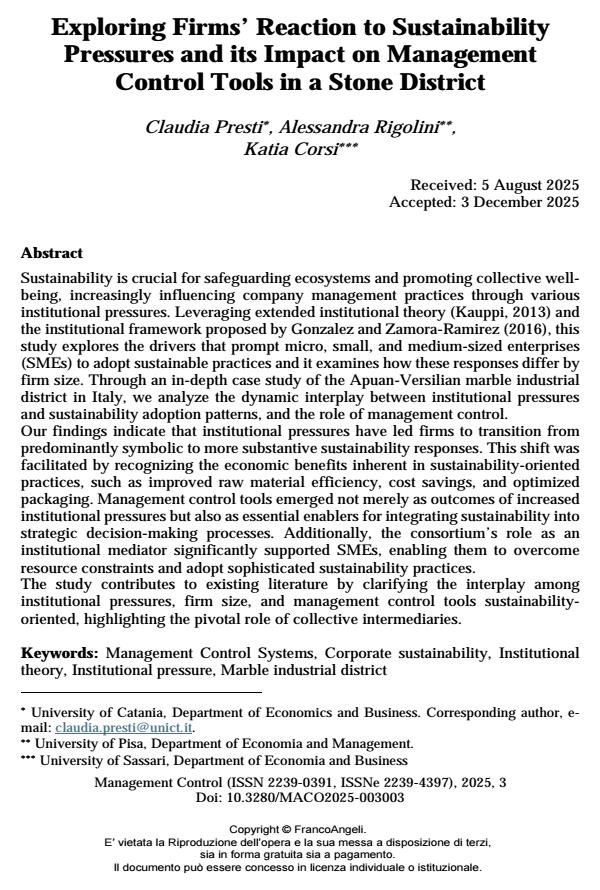
Sustainability is crucial for safeguarding ecosystems and promoting collective well-being, increasingly influencing company management practices through various institutional pressures. Leveraging extended institutional theory (Kauppi, 2013) and the institutional framework proposed by Gonzalez and Zamora-Ramirez (2016), this study explores the drivers that prompt micro, small, and medium-sized enterprises (SMEs) to adopt sustainable practices and it examines how these responses differ by firm size. Through an in-depth case study of the Apuan-Versilian marble industrial district in Italy, we analyze the dynamic interplay between institutional pressures and sustainability adoption patterns, and the role of management control. Our findings indicate that institutional pressures have led firms to transition from predominantly symbolic to more substantive sustainability responses. This shift was facilitated by recognizing the economic benefits inherent in sustainability-oriented practices, such as improved raw material efficiency, cost savings, and optimized packaging. Management control tools emerged not merely as outcomes of increased institutional pressures but also as essential enablers for integrating sustainability into strategic decision-making processes. Additionally, the consortium’s role as an institutional mediator significantly supported SMEs, enabling them to overcome resource constraints and adopt sophisticated sustainability practices. The study contributes to existing literature by clarifying the interplay among institutional pressures, firm size, and management control tools sustainability-oriented, highlighting the pivotal role of collective intermediaries.
Parole chiave:Management Control Systems, Corporate sustainability, Institutional theory, Institutional pressure, Marble industrial district
- Aragón-Correa, J. A., Hurtado-Torres, N., Sharma, S., García-Morales, V. J. (2008). Environmental strategy and performance in small firms: A resource-based perspective. Journal of environmental management, 86(1), pp. 88-103.
- Barney, J., Felin, T. (2013). What are microfoundations? Academy of Management Annals, 7(1), pp. 153-206.
- Bebbington, J., Higgins, C., Frame, B. (2009), Initiating sustainable development reporting: Evidence from New Zealand. Accounting, Auditing and Accountability Journal, 22(4), pp. 588-625.
- Becattini, G. (1979). Dal settore industriale al distretto industriale. Alcune considerazioni sull’unità di indagine dell’economia industriale. il Mulino.
- Bowen, F. E. (2002). Organizational slack and corporate greening: Broadening the debate. British Journal of Management, 13, pp. 305-316.
- Brammer, S., Hoejmose, S., Marchant, K. (2012), Environmental management in SME s in the UK: Practices, pressures and perceived benefits. Business strategy and the environment, 21(7), 423-434.
- Carrasco, A., Francoeur, C., Labelle, R. et al. (2015), Appointing Women to Boards: Is There a Cultural Bias?. Journal of Business Ethics, 129, pp. 429-444.
- Cormier, D., Gordon, I. M., Magnan, M. (2004), Corporate environmental disclosure: Contrasting management’s perceptions with reality. Journal of Business Ethics, 49(2), pp. 143-165.
- Cormier, D., Magnan, M.,Van Velthoven, B. (2005), Environmental disclosure quality in large German companies: Economic incentives, public pressures or institutional conditions?. European Accounting Review, 14(1), pp. 3-39.
- Corsi K., Arru B. (2021), Role and implementation of sustainability management control tools: critical aspects in the Italian context. Accounting, Auditing & Accountability Journal, 34(9), pp. 29-56.
- Crutzen, N., Zvezdov, D., Schaltegger, S. (2017), Sustainability and management control – exploring and theorizing control patterns in large European firms, Journal of Cleaner Production, 143, pp. 1291-1301.
- D’Onza G. (2022), L’orientamento delle aziende ad uno sviluppo sostenibile: quale contributo da parte dei sistemi di management e controllo? Management Control, 1, pp. 5-15.
- Darnall, N., Henriques, I., Sadorsky, P. (2010), Adopting proactive environmental strategy: The influence of stakeholders and firm size. Journal of management studies, 47(6), pp. 1072-1094.
- Della Porta A., Aufiero C., De Luca F. (2023), "Radicare" la sostenibilità nella strategia attraverso i sistemi di management control: un caso di studio relativo ad una Pmi. Management Control, 2, pp. 43-68.
- DiMaggio, P., Powell, W. (1983), The iron cage revisited: institutional isomorphism and collective rationality in organizational fields, American Sociological Review, 48, pp. 147-160.
- Durden, C. (2008), Towards a socially responsible management control system, Accounting, Auditingand Accountability Journal, 21, pp. 671-694.
- Eisenhardt, K.M. (1989), Building Theories from Case Study Research. Academy of Management Review 14, pp. 532-550.
- Eitrem A., Meidell A., Modell S. (2024), The use of institutional theory in social and environmental accounting research: a critical review, Accounting and Business Research.
- Epstein, M.J., Buhovac, A.R. (2014), Making Sustainability Work: Best Practices in Managing and Measuring Corporate Social, Environmental, and Economic Impacts, Berrett-Koehler Publishers, San Francisco.
- Etzion, D. (2007), Research on organizations and the natural environment, 1992-present: A review. Journal of Management, 33(4), pp. 637-664.
- Evans, S., Vladimirova, D., Holgado, M., et al. (2017), Business model innovation for sustainability: towards a unified perspective for creation of sustainable business models. Business Strategy and the Environment, 26, pp. 597-608.
- Giuliani, E., Rabellotti, R. (2017), Italian industrial districts today: between decline and openness to global value chains. In Local Clusters in Global Value Chains. pp. 21-32. Routledge.
- Gonzalez Gonzalez, J.M., Zamora Ramirez, C. (2016), Organisational communication on climate change: the influence of the institutional context and the adoption pattern. International Journal of Climate Change Strategies and Management, 8, pp. 286-316.
- Gopal, A., Gao, G. (2009), Certification in the Indian offshore IT services industry. Manufacturing & Service Operations Management, 11(3), pp. 471-492.
- Hervas-Oliver, J. L., Márquez García, J. A. A., Rojas-Alvarado, R. (2024). Are clusters and industrial districts really driving sustainability innovation?. Competitiveness Review: An International Business Journal, 34(5), pp. 896-915.
- Hahn, T., Pinkse, J., Preuss, L., Figge, F. (2014), Cognitive frames in corporate sustainability: Managerial sensemaking. Academy of Management Review, 39(4), pp. 463-487.
- Haunschild, P., Miner, A. (1997), Modes of interorganizational imitation: the effects of outcome salience and uncertainty. Administrative Science Quarterly, 42(3), pp. 472-500.
- Janesick, V. J. (1994), The dance of qualitative research design: Metaphor, methodolatry, and meaning. In N. K. Denzin & Y. S. Lincoln (Eds.), Handbook of qualitative research (pp. 209-219). Sage Publications.
- Johannisson, B., Caffarena, L. C., Cruz, A. F. D., et al. (2007), Interstanding the industrial district: contrasting conceptual images as a road to insight. Entrepreneurship & Regional Development, 19(6), pp. 527-554.
- Jorgensen, D.L. (1989), Participant observation: A methodology for human studies. Sage.
- Kauppi, K. (2013), Extending the use of institutional theory in operations and supply chain management research. International Journal of Operations & Production Management, 33(10), pp. 1318-1345.
- Kesidou, E., Demirel, P. (2012). On the drivers of eco-innovations: Empirical evidence from the UK. Research policy, 41(5), pp. 862-870.
- King, A. A., Shaver, J. M. (2001), Are aliens green? Assessing foreign establishments’ environmental conduct in the United States. Strategic Management Journal, 22(11), pp. 1069-1085.
- Klassen, R. D. (2000), Exploring the linkage between investment in manufacturing and environmental technologies. International Journal of Operations & Production Management, 20(2), pp. 127-147.
- Labelle R., Francoer C., Lakhal F. (2015), To Regulate Or Not To Regulate? Early Evidence on the Means Used Around the World to Promote Gender Diversity in the Boardroom, Gender, Work & Organization, 22, 4, pp. 339-363.
- Larson, A. L. (2000), Sustainable innovation through an entrepreneurship lens. Business Strategy and the Environment, 9, pp. 304-17.
- Levy, D. L. (1995), The environmental practices and performance of transnational corporations. Transnational Corporations, 4(1), pp. 44-67.
- Lyon, T.P., Maxwell, J.W. (2011), Greenwash: corporate environmental disclosure under threat of audit. Journal of Economics and Management Strategy, 20, pp. 3-41.
- Marchini I. (1995), Il governo della piccola impresa. Vol. I – Le basi delle conoscenze. Aspi/Ins-Edit, Genova.
- Meyer, J.W., Rowan B. (1977), Institutionalized Organizations: Formal Structure as Myth and Ceremony. American Journal of Sociology, vol. 83, no. 2, 1977, pp. 340-63.
- Otley D.T. (2008), The Contingency Theory of management Accounting: Achievement and Prognosis, Accounting, Organizations and Society, 5, 4, pp. 413-428.
- Otley, D.T., Berry, A.J. (1994), Case study research in management accounting and control. Management Accounting Research, 5, pp. 45-65.
- Perrini, F. (2006), SMEs and CSR theory: evidence and implications from an Italian perspective. Journal of Business Ethics, 67, pp. 305-16.
- Saha, D. C., Padhy, P. K. (2011), Effects of stone crushing industry on Shorea robusta and Madhuca indica foliage in Lalpahari forest. Atmospheric Pollution Research, 2(4), pp. 463-476.
- Schaltegger, S., Wagner, M. (2006), Integrative management of sustainability performance, measurement and reporting, International Journal of Accounting, Auditing and Performance Evaluation, Vol. 3, pp. 1-19.
- Scott, W. (1987), The adolescence of institutional theory, Administrative Science Quarterly, 32(4), pp. 493-511.
- Scott, W. (2008), Institutions and Organizations: Ideas and Interests, 3rd ed. Sage Publications, Los Angeles, CA.
- Sharma, S. (2000), Managerial interpretations and organizational context as predictors of corporate choice of environmental strategy. Academy of Management Journal, 43(4), pp. 681-697.
- Silva, A. D., Dionísio, A., Coelho, L. (2020), Improving Industry 4.0 through service science. International Journal of Services Sciences, 7(2), pp. 58-80.
- Thompson, J. (2022), A Guide to Abductive Thematic Analysis. The Qualitative Report, 27(5), pp. 1410-1421.
- Wijethilake, C., Ekanayake, A. (2018), Proactive strategic responses to corporate sustainability pressures: a sustainability control system framework, Advances in Management Accounting, Vol. 30, pp. 129-173.
- Wijethilake, C., Wijethilake, C., Munir, R., et al. (2017), Strategic responses to institutional pressures for sustainability: the role of management control systems, Accounting, Auditing and Accountability Journal, 30, pp. 1677-1710.
- Yin R.K. (2017), Case Study Research and Applications: Design and Methods, SAGE Publications.
Claudia Presti, Alessandra Rigolini, katia Corsi, Exploring Firms’ Reaction to Sustainability Pressures and its Impact on Management Control Tools in a Stone District in "MANAGEMENT CONTROL" 3/2025, pp 39-64, DOI: 10.3280/MACO2025-003003