Craftsmanship and the politics of craft preservation

Titolo Rivista STUDI ORGANIZZATIVI
Autori/Curatori Fabrizio Panozzo, Roberto Paladini
Anno di pubblicazione 2025 Fascicolo 2025/1
Lingua Inglese Numero pagine 25 P. 96-120 Dimensione file 196 KB
DOI 10.3280/SO2025-001004
Il DOI è il codice a barre della proprietà intellettuale: per saperne di più clicca qui

Qui sotto puoi vedere in anteprima la prima pagina di questo articolo.

Se questo articolo ti interessa, lo puoi acquistare (e scaricare in formato pdf) seguendo le facili indicazioni per acquistare il download credit. Acquista Download Credits per scaricare questo Articolo in formato PDF
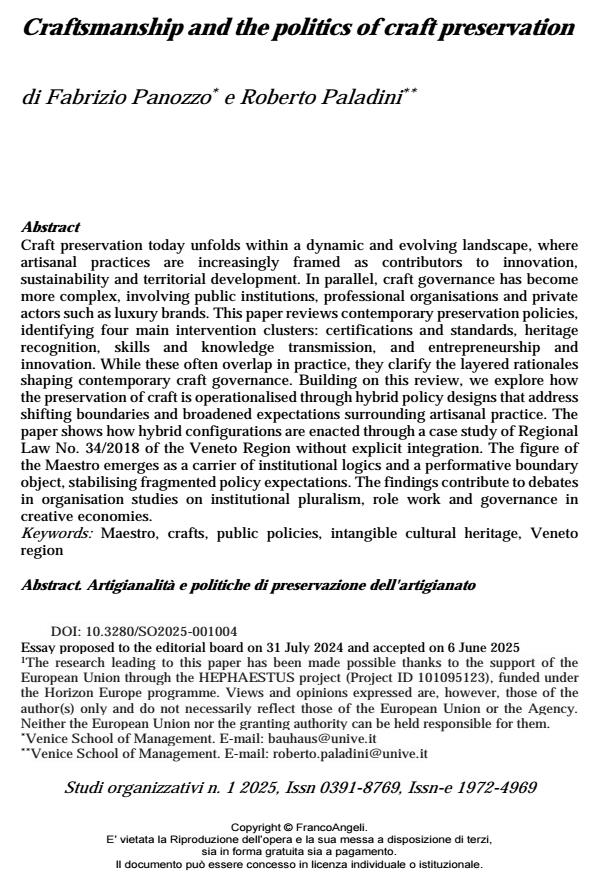
Anteprima articolo

FrancoAngeli è membro della Publishers International Linking Association, Inc (PILA)associazione indipendente e non profit per facilitare (attraverso i servizi tecnologici implementati da CrossRef.org) l’accesso degli studiosi ai contenuti digitali nelle pubblicazioni professionali e scientifiche

Craft preservation today unfolds within a dynamic and evolving landscape, where artisanal practices are increasingly framed as contributors to innovation, sustainability and territorial development. In parallel, craft governance has become more complex, involving public institutions, professional organisations and private actors such as luxury brands. This paper reviews contemporary preservation policies, identifying four main intervention clusters: certifications and standards, heritage recognition, skills and knowledge transmission, and entrepreneurship and innovation. While these often overlap in practice, they clarify the layered rationales shaping contemporary craft governance. Building on this review, we explore how the preservation of craft is operationalised through hybrid policy designs that address shifting boundaries and broadened expectations surrounding artisanal practice. The paper shows how hybrid configurations are enacted through a case study of Regional Law No. 34/2018 of the Veneto Region without explicit integration. The figure of the Maestro emerges as a carrier of institutional logics and a performative boundary object, stabilising fragmented policy expectations. The findings contribute to debates in organisation studies on institutional pluralism, role work and governance in creative economies.

La preservazione dell’artigianato contemporaneo è oggi un campo di policy articolato, attraversato da logiche istituzionali differenti che interagiscono e si sovrappongono. Le politiche recenti si organizzano attorno a quattro assi principali: certificazione delle competenze, riconoscimento patrimoniale, trasmissione dei saperi e promozione dell’imprenditorialità artigiana. Questi interventi, pur intrecciandosi nella pratica, rispondono a razionalità diverse, dal patrimonio culturale alla competitività economica, generando una governance multilivello in cui attori pubblici, privati e civici co-producono modelli regolativi ibridi. Il caso della Legge Regionale 34/2018 del Veneto e della figura del Maestro Artigiano esemplifica questa dinamica. La norma si propone di integrare valorizzazione culturale, formazione professionale e sviluppo economico, fungendo da dispositivo di traduzione tra mondi istituzionali differenti. Tuttavia, l’implementazione rivela alcune tensioni: la standardizzazione rischia di escludere saperi informali, mentre l’eterogeneità delle aspettative genera difficoltà operative. Esperienze come quella veneta suggeriscono che la vitalità dell’artigianato dipende da approcci flessibili, che sappiano combinare riconoscimento istituzionale e inclusione delle pratiche informali, sostegno all’imprenditorialità e salvaguardia dell’autenticità. In questo contesto, figure ibride come il Maestro Artigiano dimostrano il loro valore come “ponti” tra mondi istituzionali diversi, stabilizzando, anche se temporaneamente, un campo in costante ridefinizione. Preservare l’artigianato oggi significa quindi governarne le contraddizioni, trasformando le tensioni tra tradizione e innovazione, tra standardizzazione e diversità, in opportunità di rigenerazione. Le politiche più efficaci saranno quelle capaci di riconoscere il pluralismo dei valori in gioco, e di tradurlo in strumenti organizzativi adattivi, radicati nei contesti locali ma aperti alle dinamiche globali.

Parole chiave:Maestro, artigianato, politiche pubbliche, patrimonio culturale immateriale, Regione Veneto

  1. Adamson, G. (2019). Thinking through craft. Bloomsbury Publishing.
  2. Alessandrini, M. (2008). “Integration of intelligence into a semantic qos aware service retrieval application”, Proceedings of the 12th Conference on Artificial Intelligence and Soft Computing (ASC08).
  3. Battilani, P. (2020). The shaping of historic cities between creative industries and manufacturing: a case study of Bologna in Italy. In: Orioli, V., Inoue, N. (eds.) Bologna and Kanazawa, Protection and valorization of two historic cities. Bologna, Bononia University Press.
  4. Bell, E., Vachhani, S. (2020). “Relational encounters and vital materiality in the practice of craft work”, Organization Studies, 41(5): 681-701.
  5. Bendix, R. (2009). In search of authenticity: The formation of folklore studies. University of Wisconsin Press.
  6. Bendix, R., Eggert, A., Peselmann, A. (eds.) (2012). Heritage regimes and the state. Universitätsverlag Göttingen.
  7. Bertacchini, E., Segre, G. (2020). “Cultural commons and cultural entrepreneurship: Digital platforms and the creative industries”, Journal of Cultural Economics, 44(2): 181-203.
  8. Bertagna, G. (2010). “Saperi disciplinari e competenze”, Studium educationis, 3(2): 5-24.
  9. Bertagna, G. (2011). Lavoro e formazione dei giovani. Brescia: La scuola.
  10. Beverland, M.B., Farrelly, F.J. (2010). “The quest for authenticity in consumption: Consumers' purposive choice of authentic cues to shape experienced outcomes”, Journal of Consumer Research, 36(5): 838-856.
  11. Brogan, G.S., Dooley, K.E. (2024). “Weaving together social capital to empower women artisan entrepreneurs”, International Journal of Gender and Entrepreneurship, 16(1): 69-88.
  12. Brown, R. (2021). “Mission-oriented or mission adrift? A critical examination of mission-oriented innovation policies”, European Planning Studies, 29(4): 739-761.
  13. Busacca, M. (2020), The social innovation dispositif. In: Borrelli, G., Busacca, M. (eds.) Society and the city: The Dark Sides of Social Innovation. Mimesis International.
  14. Busacca, M., Paladini, R. (2022). “Creativity and social capital: The pillars of Venice’s success in the New European Bauhaus programme”, Social Sciences, 11(12): 545.
  15. Chan, C.S. (2014). “What Joss-Stick Community? Issues in the Inventory and Interpretation of Intangible Cultural Heritage in Macau”, East Asia beyond the Archives, 243.
  16. CNA, (2023). Venice Original e-commerce. Available at https://www.cna.it/tag/venice-original-e-commerce/ (www.veniceoriginal.it)
  17. Coombe, R.J., Weiss, L.M. (2015). Neoliberalism, heritage regimes, and cultural rights. In: Meskell L. (ed.) Global Heritage: A Reader. Wiley-Blackwell.
  18. Cossentino, F., Pyke, F., Sengenberger, W. (1997). Local and regional response to global pressure: The case of Italy and its industrial districts. International Institute for Labour Studies.
  19. Council of Europe. (2005). Framework Convention on the Value of Cultural Heritage for Society (Faro Convention). Strasbourg: Council of Europe.
  20. Crafts code. (2023). Final Report: Sharing solutions for better regional policies. Interreg Europe.
  21. Crouch, C. (1993). Industrial relations and European state traditions. Oxford University Press.
  22. Davies, R. (2017). Founding a Makerspace: A practical guide for space founders and community builders. Maker Media.
  23. De Almeida, A.R. (2025). “The new EU regime on geographical indications: opportunities and challenges”, The Future of Geographical Indications, 106-114. https://doi.org/10.4337/9781035309153.00016
  24. Dhar, B.K., Chawla, U., Mulchandani, D. (2025). “Sustainable Craft Culture: Socio-Cultural Drivers and Economic Impact on Sustainable Development”, Sustainable Development, 33(2): 3023-3042.
  25. Dougherty, D. (2012). “The Maker movement. Innovations: Technology, Governance, Globalization, 7(3), 11–14.
  26. Euler, D. (2013). Germany's dual vocational training system: a model for other countries? Bertelsmann Stiftung.
  27. Ferretti, S. (2024). “Unlocking Italy’s rich cultural heritage: a pathway to education”, Iceri2024 Proceedings.
  28. Gandini, A., Gerosa, A. (2023), “What is ‘neo-craft’ work, and why it matters”, Organization Studies, 46(4): 577-595.
  29. Gasparin, M., Quinn, M. (2021). “Designing regional innovation systems in transitional economies: A creative ecosystem approach”, Growth and Change, 52(2): 621–640.
  30. Gherardi, S. (2008). Situated knowledge and situated action: What do practice-based studies promise. In: Barry, D., Hansen, H. (eds.) The SAGE handbook of new approaches in management and organization. Sage.
  31. Goodwin, S.G. (2021). Artisanal Collaborations and the Preservation of Intangible Cultural Heritage. School of Professional and Continuing Studies Nonprofit Studies Capstone Projects, 15.
  32. Gorini, G., De Marco, A., Moretti, L. (2022). “Blockchain and cultural heritage: Innovations in craft authenticity and traceability”, Journal of Cultural Economics, 46(3): 489–506.
  33. Greenwood, R., Raynard, M., Kodeih, F., Micelotta, E.R., Lounsbury, M. (2011). “Institutional complexity and organisational responses”, Academy of Management Annals, 5(1): 317–371.
  34. Hafstein, V. (2009). Intangible heritage as a list: From masterpieces to representation. In: Smith, L., Akagawa, N. (eds.) Intangible heritage. Routledge.
  35. Hung, C.S., Chen, T.L., Lee, Y.C. (2021). “From cultural heritage preservation to art craft education: a study on Taiwan traditional lacquerware art preservation and training”, Education Sciences, 11(12): 801.
  36. Jansen, M., Malfatto, C. (2022). “Making value visible: Artisanal suppliers and brand co-creation in luxury fashion”, International Journal of Arts Management, 25(1): 44–56.
  37. Kurin, R. (2004). “Safeguarding intangible cultural heritage in the 2003 UNESCO Convention: A critical appraisal”, Museum International, 56(1-2): 66-77.
  38. Lash, S., Lury, C. (2007). Global culture industry: The mediation of things. Polity Press.
  39. Lawrence, T.B., Suddaby, R. (2006). Institutions and institutional work. In: Clegg, S.R., Hardy, C., Lawrence, T.B., Nord, W.R. (eds) The SAGE Handbook of Organization Studies. Sage.
  40. Levi Faur, D. (2005). “The global diffusion of regulatory capitalism”, Annals of the American Academy of Political and Social Science, 598(1): 12-32.
  41. Li, Z., Wang, Y., Zhang, N., Zhang, Y., Zhao, Z., Xu, D., ... Gao, Y. (2022). “Deep learning-based object detection techniques for remote sensing images: A survey”, Remote Sensing, 14(10): 2385.
  42. Luckman, S. (2015). Craft and the Creative Economy. Palgrave Macmillan.
  43. Maldini, I., Campos, P. (2022). “Crafting with data: The role of digital fabrication in new craft practices”, Journal of Material Culture, 27(2): 123-141.
  44. Martin, D., Grodach, C. (2022). “Placing production in urban cultural policy: The locational patterns of cultural industries and related manufacturing”, Journal of Urban Affairs, 44 (4-5):567-587.
  45. Martin, D., Grodach, C. (2022). “Placing production in urban cultural policy: The locational patterns of cultural industries and related manufacturing”, Journal of Urban Affairs, 44(4-5): 567-587.
  46. Mazzucato, M. (2018). Mission-oriented innovation policy: Challenges and opportunities. UCL Institute for Innovation and Public Purpose.
  47. Meloni, P. (2025). “The ambivalence of cultural heritage policies: Creative cities and gentrification in Florence”, International Journal of Heritage Studies, 31(5): 541-558.
  48. Menichinelli, M. (2020). “Makers as a new work condition between self-production and social innovation”, Sociology and Anthropology, 8(6): 199-210.
  49. Mignosa, A., Kotipalli, P. (2019). A cultural economic analysis of craft: Creating economic value and cultural significance. Palgrave Macmillan.
  50. Naudin, A., Patel, K. (2020). “Entangled expertise: Women's use of social media in entrepreneurial work”, European Journal of Cultural Studies, 23(5): 835-855.
  51. Orr, J. (2023). Practitioner perspectives on intangible cultural heritage. Taylor & Francis.
  52. Paladini, R. (2024). “L’artigianato artistico come motore di sviluppo territoriale”, Quaderni di ricerca sull’artigianato, 3/2024: 367-385.
  53. Pasquinelli, C., Rovai, S., Bellini, N. (2024). “Linking place brands and regional innovation: sustainable business strategies leveraging heritage”, Regional Studies, 58(10): 1921-1937.
  54. Peck, J., Theodore, N. (2015). Fast policy: Experimental statecraft at the thresholds of neoliberalism. University of Minnesota Press.
  55. Polec, W., Murawska, D. (2021). “The Social Constraints on the Preservation and Sustainable Development of Traditional Crafts in a Developed Society”, Sustainability, 14(1): 120.
  56. Regione Veneto. (2024). Atelier Aziendali: Progetti integrati d’impresa per la valorizzazione del patrimonio culturale.
  57. Ricciardi A., Cerrato D. (2020). “Family firms and entrepreneurial innovation in the manufacturing sector: Empirical evidence from Italy”, Management Decision, 58(6): 1073-1093.
  58. Rodrigues, A.O.A., Marques, C.S., Ramadani, V. (2024). “Artisan entrepreneurship, resilience and sustainable development: The quintuple helix innovation model in the low density and cross border territories”, Journal of Enterprise Information Management, 37(5): 1603-1626.
  59. Sánchez-Carretero, C. (2020). “Heritage Regimes and the Transmission of Craft Knowledge: Cases from Spain”, Journal of Material Culture, 25(3): 328-345.
  60. Scott, C. (2002). “Private regulation of the public sector: a neglected facet of contemporary governance”, Journal of Law and Society, 29(1): 56-76.
  61. Sennet, R. (2008). The Craftsman. Yale University Press.
  62. Seravalli, A. (2018). “Infrastructuring urban commons over time: Learnings from two cases”, International Journal of the Commons, 12(2): 570-597.
  63. Smagina, A., Ludviga, I. (2021). “What is crafts entrepreneurship? The development of its definition through entrepreneurs' and consumers' perceptions”, Rural Environment. Education. Personality, 14(1), 401–414. DOI: 10.22616/REEP.2021.14.04
  64. Smith, L., Akagawa, N. (2009). Intangible heritage. Routledge.
  65. Streeck, W., Schmitter, P. C. (1985). Private interest government: Beyond market and state. Sage Publications.
  66. Thornton, P.H., Ocasio, W., Lounsbury, M. (2012). The institutional logics perspective: A new approach to culture, structure, and process. Oxford University Press.
  67. Throsby, D. (2008). “Modelling the cultural industries”, International journal of cultural policy, 14(3): 217-232.
  68. Thurnell-Read, T. (2014). “Craft, Tangibility and Affect at Work in the Microbrewery”, Emotion, Space and Society, 13: 46-54.
  69. Unesco, (2003). Convention for the Safeguarding of the Intangible Cultural Heritage (2003). Available at https://ich.unesco.org/doc/src/15164-EN.pdf
  70. Vedovato, M., Costantini, A., Landi, S., Paladini, R. (2023). “The impact of external support on microbusinesses’ strategic renewal”, Management International Conference, University of Primorska Press.
  71. Voelzkow, H. (2023). “Associational governance in the cultural economy”, JCMS: Journal of Common Market Studies, 61(2): 1–18.

Fabrizio Panozzo, Roberto Paladini, Craftsmanship and the politics of craft preservation in "STUDI ORGANIZZATIVI " 1/2025, pp 96-120, DOI: 10.3280/SO2025-001004