Community-based approaches as a transformative framework for psychological intervention in the social and healthcare sector
Journal title PSICOLOGIA DI COMUNITA’
Author/s Fortuna Procentese
Publishing Year 2026 Issue 2024/2
Language Italian Pages 11 P. 11-21 File size 93 KB
DOI 10.3280/PSC2024-002002
DOI is like a bar code for intellectual property: to have more infomation
click here
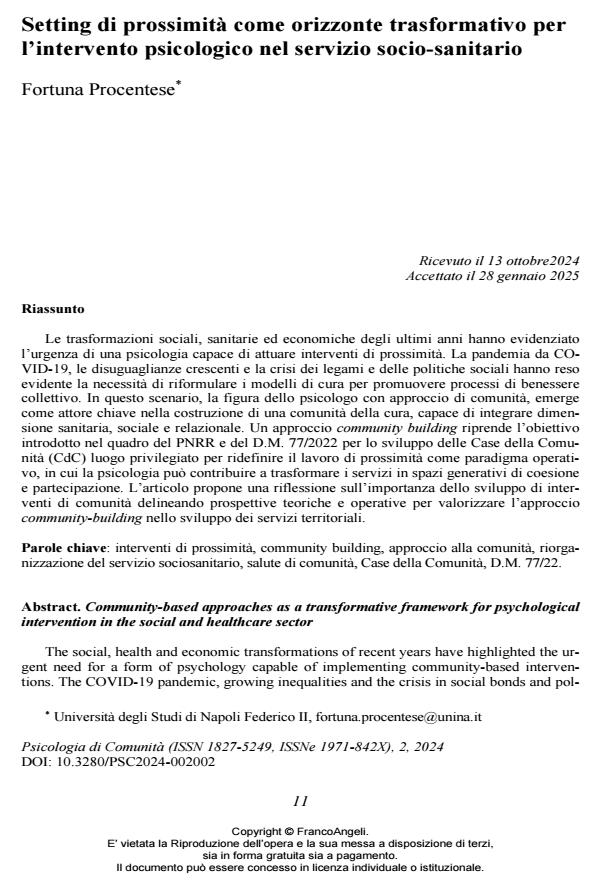
Below, you can see the article first page
If you want to buy this article in PDF format, you can do it, following the instructions to buy download credits
FrancoAngeli is member of Publishers International Linking Association, Inc (PILA), a not-for-profit association which run the CrossRef service enabling links to and from online scholarly content.
The social, health and economic transformations of recent years have highlighted the urgent need for a form of psychology capable of implementing community-based interventions. The COVID-19 pandemic, growing inequalities and the crisis in social bonds and policies have made it clear that care models need to be reformulated to promote processes of collective well-being. In this context, the role of the psychologist with a community-based approach emerges as a key player in building a community of care, capable of integrating health, social and relational dimensions. A community building approach takes up the objective introduced within the framework of the PNRR and Ministerial Decree 77/2022 for the development of Community Centres (CdC) – a privileged setting for redefining community-based work as an operational paradigm, in which psychology can help transform services into spaces that foster cohesion and participation. This article offers a reflection on the importance of developing community-based interventions, outlining theoretical and operational perspectives to enhance the community-building approach in the development of local services.
Keywords: proximity interventions, community building, reorganisation of social and health services, community health, Casa delle Comunità, Ministerial Decree 77/22.
- Arcidiacono, C. (2017). The community psychologist as a reflective plumber. Global Journal of Community Psychology Practice, 8(1), 1-16. DOI: 10.7728/080120170
- Bronfenbrenner, U. (1979). The ecology of human development: Experiments by nature and design. Harvard University Press.
- Chaskin, R. J. (2001). Building community capacity: A definitional framework and case studies from a comprehensive community initiative. Urban Affairs Review, 36(3), 291–323. DOI: 10.1177/1078087012218487
- Di Napoli, I., Guidi, E., Arcidiacono, C., Esposito, C., Marta, E., Novara, C., ... & Marzana, D. (2021). Italian community psychology in the COVID-19 pandemic: Shared feelings and thoughts in the storytelling of university students. Frontiers in Psychology, 12, 571257.
- Engel, G. L. (1977). The need for a new medical model: A challenge for biomedicine. Science, 196(4286), 129–136.
- Esposito, C., Di Napoli, I., Agueli, B., Marino, L., Procentese, F., & Arcidiacono, C. (2022). Well-being and the COVID-19 pandemic. European Psychologist, 285–297. https://doi. org/10.1027/1016-9040/a000468
- Fuks I. (2017). Como un puente sobre aguas turbulentas. La experiencia del Centro de Asistencia a la Comunidad de Rosario. Ed Rosario Argentina.
- Gatti, F., & Procentese, F. (2021). Local Community Experience as an Anchor Sustaining Reorientation Processes during COVID-19 Pandemic. Sustainability, 13(8), 4385.
- Ingrosso, M. (2022). Le Case della Comunità come comunità della cura. FrancoAngeli.
- Kelly, J. G. (1990). Changing contexts and the field of community psychology. American journal of community psychology, 18(6), 769-792. DOI: 10.1007/BF0093806
- Kelly, J. G. (2006). Becoming ecological: An expedition into community psychology. Oxford University Press.
- Longo, F., & Barsanti, S. (2021). Community building: logiche e strumenti di management: comunità, reti sociali e salute. Egea.
- Mannarini, T., & Salvatore, S. (2019). Making sense of ourselves and others: A contribution to the community-diversity debate. Journal of Community Psychology, 47(5), 1243–1254.
- McMillan, D. W., & Chavis, D. M. (1986). Sense of community: A definition and theory. Journal of Community Psychology, 14(1), 6–23.
- McNeely, J. (1999). Community building: Coming of age. Urban Institute Press.
- Orford, J. (2008). Community psychology: Challenges, controversies and emerging consensus. Wiley-Blackwell.
- Passos, M., & Camino, L. (2016). Community identity and well-being. In S. McKeown, R. Haji, & N. Ferguson (Eds.), Understanding peace and conflict through social identity theory: Contemporary global perspectives (pp. 137–154). Springer.
- Putnam, R. D. (2000). Bowling Alone: The Collapse and Revival of American Community. Simon & Schuster.
- Rappaport, J. (1977). Community Psychology: Values, Research, and Action. Holt, Rinehart & Winston.
- Prilleltensky, I. (2010). Well-being as fairness. American Journal of Community Psychology, 46(1–2), 129–146.
- Prilleltensky, I., & Prilleltensky, O. (2021). How people matter: Why it affects health, happiness, love, work, and society. Cambridge University Press.
- Procentese, F., Esposito, C., Gonzalez Leone, F., Agueli, B., Arcidiacono, C., Freda, M. F., & Di Napoli, I. (2021). Psychological lockdown experiences: Downtime or an unexpected time for being?. Frontiers in Psychology, 12, 577089.
- Procentese, F., & Gatti, F. (2019). Senso di Convivenza Responsabile: Quale Ruolo nella Relazione tra Partecipazione e Benessere Sociale? [Sense of responsible togetherness: Which role within the relationship between social participation and well-being?]. Psicologia Sociale, 14(3), 405-426. DOI: 10.1482/94942
- Procentese, F. (a cura di) (2011). Convivenza responsabile: prospettive di intervento. Psicologia di Comunità, 2, 5-8.
- Prilleltensky, I., & Nelson, G. (2013). Community psychology: In pursuit of liberation and well-being. Palgrave Macmillan.
- Sarason, S. B. (1974). The psychological sense of community: Prospects for a community psychology. Jossey-Bass.
- Società Italiana di Psicologia di Comunità (SIPCO) (2022). Promuovere salute di comunità nelle CdC. https://www.sipco.it/
- Sen, A. (1999). Development as freedom. Oxford University Press.
- World Health Organization (2018). A vision for primary health care in the 21st century: Towards universal health coverage and the Sustainable Development Goals. WHO Press.
Fortuna Procentese, Setting di prossimità come orizzonte trasformativo per l’intervento psicologico nel servizio socio-sanitario in "PSICOLOGIA DI COMUNITA’" 2/2024, pp 11-21, DOI: 10.3280/PSC2024-002002