Value Judgments and the Making of Economic History: From John Neville Keynes to Contemporary Debates
Titolo Rivista HISTORY OF ECONOMIC THOUGHT AND POLICY
Autori/Curatori Juan Antonio Giménez Espín
Anno di pubblicazione 2026 Fascicolo 2026/1
Lingua Inglese Numero pagine 34 P. 115-148 Dimensione file 171 KB
DOI 10.3280/SPE2026-001005
Il DOI è il codice a barre della proprietà intellettuale: per saperne di più
clicca qui
Qui sotto puoi vedere in anteprima la prima pagina di questo articolo.
Se questo articolo ti interessa, lo puoi acquistare (e scaricare in formato pdf) seguendo le facili indicazioni per acquistare il download credit. Acquista Download Credits per scaricare questo Articolo in formato PDF
FrancoAngeli è membro della Publishers International Linking Association, Inc (PILA), associazione indipendente e non profit per facilitare (attraverso i servizi tecnologici implementati da CrossRef.org) l’accesso degli studiosi ai contenuti digitali nelle pubblicazioni professionali e scientifiche.
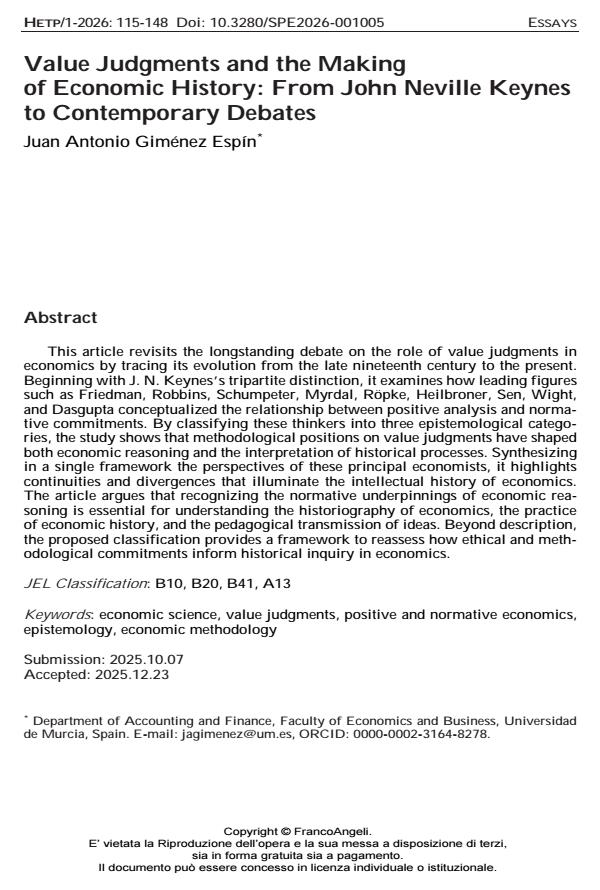
This article revisits the longstanding debate on the role of value judgments in economics by tracing its evolution from the late nineteenth century to the present. Beginning with J. N. Keynes’s tripartite distinction, it examines how leading figures such as Friedman, Robbins, Schumpeter, Myrdal, Röpke, Heilbroner, Sen, Wight, and Dasgupta conceptualized the relationship between positive analysis and normative commitments. By classifying these thinkers into three epistemological categories, the study shows that methodological positions on value judgments have shaped both economic reasoning and the interpretation of historical processes. Synthesizing in a single framework the perspectives of these principal economists, it highlights continuities and divergences that illuminate the intellectual history of economics. The article argues that recognizing the normative underpinnings of economic reasoning is essential for understanding the historiography of economics, the practice of economic history, and the pedagogical transmission of ideas. Beyond description, the proposed classification provides a framework to reassess how ethical and methodological commitments inform historical inquiry in economics.
Parole chiave:economic science, value judgments, positive and normative economics, epistemology, economic methodology
Jel codes:B10, B20, B41, A13
- Acemoglu D. and Robinson J.A. 2012. Why Nations Fail: The Origins of Power, Prosperity and Poverty. Crown Business, 109(2), 165247. https://scholarship.law.duke.edu/faculty_scholarship/2602.
- Aguayo P. 2010. John Dewey, Teoría de la Valoración. Revista de Filosofía, 66, 263266, DOI: 10.4067/S071843602010000100016
- Alkire S. 2002. Valuing Freedoms: Sen’s Capability Approach and Poverty Reduction. Oxford University Press. https://EconPapers.repec.org/RePEc:oxp: obooks:9780199245796.
- Arrow K.J. 1951. Social Choice and Individual Values. Yale University Press. Backhouse R.E. 2009. The Puzzle of Modern Economics: Science or Ideology? Cambridge University Press.
- Backhouse R.E. and Fontaine P. (eds.) 2010. The History of the Social Sciences Since 1945. Cambridge, Cambridge University Press, DOI: 10.1017/CBO9780511845260
- Backhouse R.E. and Medema S.G. 2009. Defining economics: The long road to acceptance of the Robbins definition. Economica, 76(s1), 805820,
- Baker E. 2025. The history of economics as science critique: Demystification and its limits. History of Political Economy, 57(Annual Supplement), DOI: 10.1215/0018270212134478.
- Belardi G.G. 2016. La incidencia de la tesis de neutralidad valorativa en la enseñanza de las ciencias económicas. Perspectivas Metodológicas, 17(1), 1428,
- Bergson A. 1938. A reformulation of certain aspects of welfare economics. Quarterly Journal of Economics, 52(2), 310334, DOI: 10.2307/1881737
- Bertrand R. 2010. Religión y ciencia. Fondo de Cultura Económica.
- Boulding K.E. 1969. Economics as a moral science. American Economic Review, 59(1), 112.
- Blaug M. 1985. Economic theory in retrospect. Cambridge University Press.
- Brown A. and Spencer D. 2012. The nature of economics and the failings of the mainstream: Lessons from Lionel Robbins’s Essay. Cambridge Journal of Economics, 36(4), 781798,
- Buchanan J.M. 1959. Positive economics, welfare economics, and political economy. Journal of Law & Economics, 2(1), 124138. https://www.jstor.org/stable/ 724934.
- Campbell W.F. 2010. Review of Wilhelm Röpke’s political economy. Journal of Markets and Morality, 13(2), 399401. https://www.proquest.com/docview/ 1438881982.
- Cartwright N. and De Neys W. 2023. Rationality and the lab: Exploring the boundaries of behavioral economics. Cambridge University Press.
- Chang H.J. 2002. Breaking the mould – An Institutionalist Political Economy alternative to the neoliberal theory of the market and the state. Cambridge Journal of Economics, 26(5), 539559,
- Chang H.J. 2007. Institutional Change and Economic Development. Anthem Press. Chang H.J. 2011. Institutions and economic development: Theory, policy and history. Journal of Institutional Economics, 7(4), 473498, S1744137410000378.
- Chaves J. 2002. Ética y economía: La perspectiva de Amartya Sen. Estudios Filosóficos, 51(146), 537.
- Colander D. and Su H.C. 2015. Making sense of economists’ positivenormative distinction. Journal of Economic Methodology, 22(2), 157170, DOI: 10.1080/1350178X.2015.1024877
- Cottier M. 2023. The end of irony: Emotions and criticism of capitalism in the United States in the global 1970s. New Global Studies, 17(2), 153170,
- Crespo R.F. 2021. Reinserting ethics in economics: Some thoughts springing from recent related contributions. Forum for Social Economics, 52(1), 114122, DOI: 10.1080/07360932.2021.1883089
- Dasgupta P. 2005. What do economists analyze and why: values or facts? Economics & Philosophy, 21(2), 221278, DOI: 10.1017/S026626710500057X
- Dasgupta P. 2021. The economics of biodiversity: The Dasgupta review. HM Treasury. Davis J. 2014. Economists’ odd stand on the positivenormative distinction: A behavioral economics view. In: G. DeMartino & D. McCloskey (Eds.). The Oxford handbook on professional economic ethics. Oxford University Press,
- Davis J.B. 2023. Objectivity in economics and the problem of the individual. Journal of Economic Methodology, 30(4), 276289, DOI: 10.1080/1350178X.2023.2181374
- Davis J.B. and Hands D.W. (Eds.) 2011. The Elgar Companion to Recent Economic Methodology. Cheltenham, UK: Edward Elgar Publishing. Retrieved Sep 24, 2025, DOI: 10.4337/9780857938077
- Dewey J. 2019. Teoría de la valoración. Biblioteca Nueva.
- Dilthey W. 1911 [1989]. Einleitung in die Geisteswissenschaften [Introduction to the Human Sciences]. Stuttgart: Reclam.
- Douglas H. 2009. Science, policy, and the valuefree ideal. University of Pittsburgh Press.
- Diekmann S. and Peterson M. 2013. The role of nonepistemic values in engineering models. Science and Engineering Ethics, 19(1), 207218,
- Drakopoulos S.A. 2024. Value judgements, positivism, and utility comparisons in economics. Journal of Business Ethics, 189(3), 423437,
- Echeverría J. 1995. El pluralismo axiológico de la ciencia. Isegoría, 12, 4479,
- Echeverría J. 2014. Los valores de las ciencias: Del ideal de neutralidad del siglo
- XIX a la supremacía actual de la innovación. Investigación y Ciencia, 452(mayo), 23.
- Feld L.P., Köhler E.A. and Nientiedt D. 2021. Ordoliberalism and the social market economy. Freiburger Diskussionspapiere zur Ordnungsökonomik, 21(5), Walter Eucken Institut https://www.econstor.eu/handle/10419/232067.
- Fourcade M., Ollion E. and Algan Y. 2015. The superiority of economists. Journal of Economic Perspectives, 29(1), 89114,
- Franco G. 2020. Religion, society, and the market: The contribution and the legacy of Wilhelm Röpke (18991966). Journal of Markets & Morality, 23(1), 77114. https://www.proquest.com/docview/2510295411.
- Friedman M. 1966. The methodology of positive economics. In: Essays in Positive Economics. University of Chicago Press, 343.
- Gómez R.J. 2002. El mito de la neutralidad valorativa de la economía neoliberal. Energeia: Revista Internacional de Filosofía y Epistemología de las Ciencias Económicas, 1(1), 3251. http://dspace.uces.edu.ar:8180/xmlui/handle/ 123456789/487.
- Hausman D.M. and McPherson M.S. 2006. Economic Analysis, Moral Philosophy, and Public Policy. Cambridge, Cambridge University Press.
- Heath J. 1994. Economics Without Illusions: Debunking the Myths of Modern Capitalism. London, Routledge.
- Heilbroner R.L. 1953. The Worldly Philosophers: The Lives, Times, and Ideas of Great Economic Thinkers. Simon & Schuster.
- Heilbroner R.L. 1969. Economic Means and Social Ends. PrenticeHall.
- Heilbroner R.L. 1989. Behind the Veil of Economics: Essays in the Worldly Philosophy. W.W. Norton & Company.
- Hilary P. and Walsh V. 2011. The End of ValueFree Economics. Routledge.
- Hirschman D. and Berman E.P. 2014. Do economists make policies? On the political effects of economics. SocioEconomic Review, 12(4), 779811,
- HoyningenHuene P. 2023. Objectivity, valuefree science, and inductive risk. European Journal for Philosophy of Science, 13(14),
- Hutchison T.W. 1971 [1964]. Economía positiva y objetivos de política económica
- (Original work published 1964). Editorial Vicens Vives.
- Intemann K. 2015. Distinguishing between legitimate and illegitimate values in climate modeling. European Journal for Philosophy of Science, 5(2), 217232,
- Katouzian H. 1982. Ideología y método en economía. H. Blume Ediciones.
- Keynes J.M. 1986 [1936]. Teoría general de la ocupación, el interés y el dinero.
- México D.F., Fondo de Cultura Económica.
- Keynes J.M. 2007 [1921]. A treatise on probability. London, Macmillan.
- Keynes J.N. 1891. The scope and method of political economy. London, Macmillan. Kolev S. 2018. Paleo and Neoliberals: Ludwig von Mises and the “OrdoInterventionists.” In: P. Commun & S. Kolev (Eds.), Wilhelm Röpke (18991966): A Liberal Political Economist and Conservative Social Philosopher. Cham, Springer, 6590, DOI: 10.1007/9783319683577_5
- Koopmans T.C. 1980. Tres ensayos sobre el estado de la ciencia económica. Antoni Bosch Editor.
- Kuhn T.S. 1962. The Structure of Scientific Revolutions. University of Chicago Press.
- Lawson T. 2015. The nature of social reality. Journal of Economic Methodology, 22(1), 115, DOI: 10.1080/1350178X.2014.995491
- Lazonick W. 2006. Corporate governance, innovative enterprise, and economic development. UNUWIDER Research Paper, 71.
- Lipsey R.G. 1973. Introducción a la economía positiva. Editorial Vicens Vives. Lizárraga Gómez A. 2000. JeanJacques Rousseau y el binomio moderno economía política. Economía y Sociedad, 5(8), 164172.
- Lynn A. 2022. Ethics, economics, and the specter of naturalism: The enduring relevance of the harmony doctrine school of economics. Journal of Business Ethics, 178(3), 661673,
- Makkreel R.A. 2015. Orientation and Judgment in Hermeneutics. University of Chicago Press,
- Mäki U. 2009. Realistic realism about unrealistic models. In: D. Ross & H. Kincaid (Eds.). The Oxford Handbook of Philosophy of Economics (pp. 6898). Oxford: Oxford University Press,
- Mäki U. 2018. Rights and wrongs of economic modelling: Refining Rodrik. Journal of Economic Methodology, 24(2), 166176, DOI: 10.1080/1350178X.2018.1488475
- Malecka M. 2021. Values in economics: A recent revival with a twist. Journal of Economic Methodology, 28(1), 8897, DOI: 10.1080/1350178X.2020.1868776.
- Masini F. 2009. Economics and Political Economy in Lionel Robbins’s Writings. Journal of the History of Economic Thought, 31(4), 421436, DOI: 10.1017/S105383720999023X
- Masini F. 2018. Decisionmaking processes and multilayered institutional order: Lionel Robbins’s legacy. Cambridge Journal of Economics, 42(5), 14591471,
- Matson E.W. 2023. Ethical economics or economical ethics? Considerations out of Carl Menger. Review of Austrian Economics, 36(2), 311330,
- Mongin P. 2006. Value judgments and value neutrality in economics. Economica, 73(290), 257286,
- Myrdal G. 2014. The political element in the development of economic theory. Harvard University Press (Original work published 1930; reprint 2014).
- Nelson J.A. 2008. Economists, value judgments, and climate change: a view from feminist economics. Ecological Economics, 65(3), 441447,
- Nussbaum M.C. 2011. Creating Capabilities: The Human Development Approach. Harvard University Press.
- Orozco L.A. and Chavarro D.A. 2010. Robert K. Merton. Revista de Estudios Sociales, 37, 121142,
- Peart S.J. and Levy D.M. 2005. The “Vanity of the Philosopher”: From Equality to Hierarchy in PostClassical Economics. Ann Arbor: University of Michigan Press, DOI: 10.3828/9780472114962
- Pinto M. 2000. A world on economic method. In: Symposium Proceedings: Economics and Public Policy. Sydney.
- Rawls J. 1971. A Theory of Justice. Harvard University Press.
- Reinert E.S. 2004. Globalization, Economic Development and Inequality: An Alternative Perspective. Edward Elgar Publishing.
- Reiss J. 2021a. Values in economics. In: S. O. Hansson (Ed.). The Role of Science in a Democracy. Cham, Springer, DOI: 10.1007/9783030627627_7
- Reiss J. 2021. The factvalue distinction: Theoretical reflections. Cambridge Journal of Economics, 45(2), 353368,
- Reis Mourao P. 2008. Hechos y valores en el pensamiento económico. Revista de Economía Institucional, 10(18), 381394.
- Robbins L. 1981[1932]. An Essay on the Nature and Significance of Economic Science. London, Macmillan.
- Robinson J. 2021[1979]. Economic Philosophy. Routledge, DOI: 10.4324/9781003090373
- Rodrik D. 2000. Institutions for highquality growth: What they are and how to acquire them. Studies in Comparative International Development, 35(3), 331, DOI: 10.1007/BF02699764
- Rodrik D. 2010. Diagnostics before prescription. Journal of Economic Perspectives, 24(3), 3344,
- Röpke W. 2015[1941]. A value judgment on value judgments. Journal of Markets & Morality, 18(2), 497514.
- Röpke W. 1996[1958]. Beyond Supply and Demand. Unión Editorial.
- Runde J. 1990. Keynesian Uncertainty and the Weight of Arguments. Economics and Philosophy, 6(2), 275292, DOI: 10.1017/S0266267100001255
- Samuelson P.A. 1947. Foundations of Economic Analysis. Harvard University Press. Sandel M.J. 2012. What Money Can’t Buy: The Moral Limits of Markets. Farrar, Straus and Giroux.
- Scarattino A. 2009. On the role of values in economic science: Robbins and his critics. Journal of the History of Economic Thought, 31(4), 449473, DOI: 10.1017/S1053837209990253
- Sen A. 1970. Collective Choice and Social Welfare. HoldenDay.
- Sen A. 1979. Utilitarianism and welfarism. Journal of Philosophy, 76(9), 463489, DOI: 10.2307/2025934
- Sen A. 1987. On Ethics and Economics. Blackwell.
- Sen A. 2009. The Idea of Justice. Harvard University Press.
- Scharff R.C. 2013. Becoming a philosopher: What Heidegger learned from Dilthey, 191925. British Journal for the History of Philosophy, 21(1), 122142, DOI: 10.1080/09608788.2012.689753
- Schumpeter J.A. 2015 [1954]. Historia del análisis económico. Barcelona, Ariel. Shionoya Y. 1997. Schumpeter and the Idea of Social Science: A Metatheoretical Study. Cambridge, Cambridge University Press, DOI: 10.1017/CBO9780511521959
- Svetlova E. 2014. Modelling beyond application: Epistemic and nonepistemic values in modern science. International Studies in the Philosophy of Science, 28(1), 7998, DOI: 10.1080/02698595.2014.915656
- Thaler R.H. 2015. Misbehaving: The making of behavioral economics. W.W. Norton & Company.
- Toye J. 2000. Fiscal crisis and fiscal reform in developing countries. Cambridge Journal of Economics, 24(1), 2144,
- Tribe K. 2015. The Economy of the Word: Language, History, and Economics. Oxford University Press.
- van Bavel B. 2025. Back to the future: How economic history can gain more relevance by abandoning modernization thinking. Economic History Review, 78(2), 401423,
- Wight J.B. 2009. Economics and ethics: A review of the literature. Journal of Economic Surveys, 23(3), 527553,
- Wight J.B. 2013. The ethics of economic policy. Journal of Economic Issues, 47(2), 291302, DOI: 10.2753/JEI00213624470205
- Wight J.B. 2015. Ethics in Economics: An Introduction to Moral Frameworks. Stanford University Press.
- Witztum A. 2011. Ethics and the science of economics: Robbins’s enduring fallacy. Journal of the History of Economic Thought, 33(4), 541562, DOI: 10.1017/S1053837211000289
Juan Antonio Giménez Espín, Value Judgments and the Making of Economic History: From John Neville Keynes to Contemporary Debates in "HISTORY OF ECONOMIC THOUGHT AND POLICY" 1/2026, pp 115-148, DOI: 10.3280/SPE2026-001005