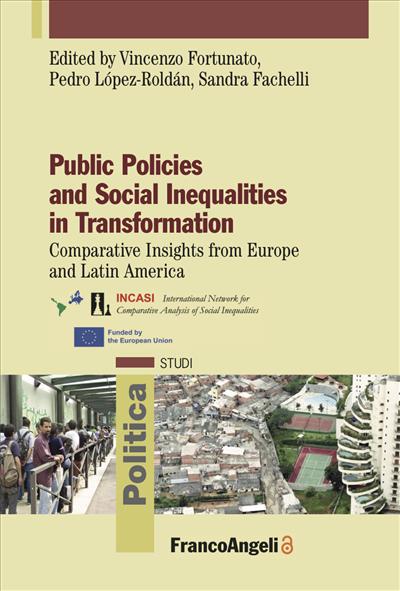
Public Policies and Social Inequalities in Transformation

A cura di: Vincenzo Fortunato, Pedro López-Roldán, Sandra Fachelli

Public Policies and Social Inequalities in Transformation

Comparative Insights from Europe and Latin America

This volume examines the transformations of public policies and welfare institutions in Europe and Latin America from a comparative and interdisciplinary perspective. Drawing on the theoretical and empirical advances of the INCASI Project, it explores how states, social actors, and policy regimes have reconfigured their responses to inequality in the face of multiple crises - economic, social, environmental, and technological.

Pagine: 304

ISBN: 9788835189213

Edizione:1a ediz 2025

Codice editore: 11136.4

Informazioni sugli open access
This volume examines the transformations of public policies and welfare institutions in Europe and Latin America from a comparative and interdisciplinary perspective. Drawing on the theoretical and empirical advances of the INCASI Project, it explores how states, social actors, and policy regimes have reconfigured their responses to inequality in the face of multiple crises - economic, social, environmental, and technological.
The chapters gathered here offer a multidimensional view of public policy, combining macro-structural analyses of welfare and labour regimes with micro-level studies of care, education, and digital work. They reveal the persistent tensions between state intervention, market dynamics, and social demands for equality, as well as the emergence of new institutional complementarities between predistributive and redistributive policies.
Bringing together contributions from researchers across Europe and Latin America, the book provides a critical dialogue on the future of welfare, the redefinition of social rights, and the governance of inequality in an era of digitalisation, migration, and global uncertainty. It invites readers to rethink the role of public policy as a field of democratic innovation and transnational cooperation.

Vincenzo Fortunato is Full Professor at the Department of Political and Social Sciences, University of Calabria, in the field of Sociology of work and economic processes. PhD in Sociology (Science, Technology and Society). 1996/1997 University of Warwick Coventry (UK) – Master in European industrial relations. At present, Director of the School of Public Administration Sciences, University of Calabria. His research interests include industrial relations, human resources management, work organization, social work and international social policies, non-profit organizations.

Pedro López-Roldán is Associate Professor at the Department of Sociology, Universitat Autònoma de Barcelona (UAB). Researcher at the Center for Sociological Studies on Everyday Life and Work and the Institute of Labour Studies of the UAB. Main coordinator of INCASI (International Network for Comparative Analysis of Social Inequalities) between Europe and Latin America. Main lines of research: methods and techniques of social research, and sociology of work and social inequality.

Sandra Fachelli is Associate Professor at the Department of Sociology at Pablo de Olavide University (accredited as a Full Professor). Postdoctoral degree in Social Sciences from the University of Buenos Aires. PhD in Sociology from the Autonomous University of Barcelona. She is currently vice-president of RC55 “Social Indicators” of the International Sociological Association and member of the Board of RC28 Social Stratification. She is president of CI41 Comparative Sociology between Europe and Latin America of the Spanish Federation of Sociology.

Vincenzo Fortunato, Pedro López-Roldán, Sandra Fachelli, Public Policies and Social Inequalities in Transformation: Comparative Insights from Europe and Latin America

  • Presentation
  • Structure of the book

Part I. Reconfiguring the State: Welfare Institutions and Policy Transformations

Vincenzo Fortunato, Pedro López-Roldán, Sandra Fachelli, Bringing back the State. The role of public policies to reduce inequalities across European and Latin American countries

  • Introduction of this book
  • From Collaborative Learning to Policy Articulation: The Evolution from INCASI 1 to INCASI 2
  • Transforming Inequality: From Compensation to Coordinated, Capability-Building Policy
  • References

Antonio Martín Artiles, Social order and socioeconomic institutions: New or old trends?

  • Introduction
  • Premise
  • Predistributive institutions and social actors
  • Tripartism and collective bargaining
  • Institutional complementarity
  • Coordinated versus uncoordinated economies
  • Post-distributive institutions
  • Trends in change
  • Some conclusions
  • References

Olga Salido Cortés, Assessing the role of welfare states in reducing inequality: Evidence from EU15 countries in the face of recent global crises (2008-2023)

  • Introduction
  • State of the Art and Theoretical Background
  • Objectives and research questions
  • Data and variables
  • The Distributive Effect of the Great Recession on EU15 (2008-2013)
  • The Distributive Impact of the COVID-19 Crisis on EU15
  • A Shifting Landscape of Redistribution in Europe (2008-2023)?
  • Conclusions
  • References

Emmanuelle Barozet Measuring Poverty Across Contexts: A Comparative Policy Lens

  • Introduction
  • A new context for poverty measurement
  • Types of poverty lines and their limitations
  • A more multifaceted elaboration: the reasons for extending the measurement to multidimensional poverty
  • Which dimensions and indicators best assess multidimensional poverty? Different responses depending on the continent
  • Old and new challenges
  • Conclusion
  • References

Vicente Espinoza, The institutional production of inequality. Non-compliance and extractive institutions in local services provision

  • Introduction
  • The effects of institutions on the population wellbeing
  • Patron-client relationships as extractive institutions
  • Flexibility and bad practices. A study on extractive institutions and non-compliance
  • Methodology
  • Results
  • Discussion: Narratives that trigger the relaxation of the rule
  • Implications of the results
  • Conclusions: Need to build institutions
  • References

Part II. Labour, Wages, and Regulation: Old Challenges, New Risks

Eduardo Chávez Molina, The minimum wage as a political impetus in the face of distributive inequality processes

  • The legitimacy of inequality
  • Equality
  • The importance of the minimum wage
  • Conclusion
  • References

Victoria Matozo, Pablo Molina Derteano, Artificial Intelligence and Labor Regulation. Regulating the risks

  • Introduction
  • Theoretical considerations
  • Analysis
  • Legislation comparison
  • Conclusions
  • References

Patricia Mariel Sorribas, María Celeste Gómez, Neither too much nor too little. Advances in the measurement of digital platform work in Latin America and Europe

  • Introduction: Platform economy and platformisation of work
  • Official statistics on work on digital platforms
  • Discussions and proposals
  • References

Luca Novelli, Renata Semenza, Promoting eco-social-grow policies: The case of the steel sector in Italy, the Netherlands and Argentina

  • Introduction
  • Section one. Literature review and analytical background
  • Section two. Three case studies
  • Preliminary conclusions
  • References

Part III.Care, Welfare and Social Rights: Policies and Everyday Inequalities

Leticia Muñiz Terra, Eugenia Roberti, Matías Iucci, Welfare and Care policies in Latin America: theoretical and methodological discussions and persistent challenges for comparative analysis

  • Introduction
  • Methodological approaches and challenges in comparative studies
  • Welfare and care policies in Latin America
  • Comparing care policies in Latin America: macrosocial perspectives
  • Comparing care policies in Latin America: microsocial perspectives
  • Conclusions
  • References

Màrius Domínguez-Amorós, Carme Vivancos-Sánchez, Elisabet Almeda Samaranch, The Social Reorganization of Care in Pandemic Times: Public Policies, Gender Inequalities, and Community Strategies in the Spanish State

  • Introduction
  • Care Work as a Structural Pillar in Crisis Contexts
  • Methodology
  • Findings: Shifts in Family, Work, and Community Dynamics
  • Policy Gaps and Institutional Shortcomings
  • A Transformative Vision for Care Policy
  • Policy Responses, Tensions and Limitations
  • Conclusion
  • References

Blanca Barco, Manuel Ángel Río Ruiz, Inequalities and Early Childhood Education and Care Policies for Children Aged 0–3 in Spain and Chile: Governance, Availability, Accessibility and Affordability

  • Introduction
  • Factors for Comparison
  • Comparing Spain and Chile in ECEC03
  • Conclusion
  • References

Ileana D. Ibáñez, Juliana Huergo, M. Eugenia Rausky, Care, Childhood, Adolescence and Ict’s: a qualitative study in the cities of La Plata and Cordoba (Argentine)

  • Introduction
  • Methodology
  • Migration, poverty and childcare
  • Results
  • Conclusions
  • References

Anitta Kynsilehto, Undocumented migrants’ access to social rights in a dismantling welfare state

  • Introduction
  • Recognizing and responding to migrant irregularity
  • Multi-level migrant registration and the production of illegality
  • Access to rights in a dismantling welfare state
  • References

Part IV. Social Stratification, Inequality Pathways and Local Policy Challenges

Pablo Dalle, Sandra Fachelli, Persistent Inequality or Increasing Class Barriers? The pattern of intergenerational class mobility in Argentina in historical perspective

  • Introduction
  • Debates on the features of mobility regime: The core model
  • Differences between Core model approaches for Early and Late Industrialized Countries
  • Data and methodological strategy
  • Adaptation of the Matrices used in Erikson and Goldthorpe (1992) and Ishida et al. (2008, 2011) for 5x5 mobility tables
  • Exploring the pattern of intergenerational class mobility
  • Conclusions

Paula Boniolo, Sebastián Lemos, Transitions from secondary to higher education in Argentina. Social Inequality Guidelines for Regional Education Policy Formulation

  • Introduction
  • Theoretical approach
  • Data and methods
  • The transition to higher education in Argentina
  • Educational stratification determinants and Language and mathematics performance as indicators of inequality at the secondary level
  • Conclusions
  • References

Emilio Ayos, Tatiana Jack, Guadalupe López, Lucía Ibarra Ruoredda, Social Protection in youth social policies: towards an assessment of the last decade in Argentina

  • Introduction
  • Social Protection in Argentina: tendencies, ruptures, and continuities
  • State interventions towards youth in recent Argentina: the case of Progresar and the Envión Program
  • References

Matías S. Ballesteros, Betina Freidin, Josefina Roques, Sugar-sweetened beverage consumption in urban areas of Argentina: a public health problem and an intermediary determinant of health inequalities

  • Introduction
  • Methodology
  • Analysis
  • Conclusions and recommendations
  • References

Nadia Rizzo, A journey through the plots of a social policy

  • Introduction: the trend of state-individual connection
  • The appropriation plots
  • Final reflections on the concept of appropriation
  • References

Contributi: Elisabet Almeda Samaranch, Antonio Martín Artiles, Emilio Ayos, Matías S. Ballesteros, Blanca Barco, Emmanuelle Barozet, Paula Boniolo, Eduardo Chávez Molina, Pablo Dalle, Màrius Domínguez-Amorós, Vicente Espinoza, Sandra Fachelli, Betina Freidin, María Celeste Gómez, Juliana Huergo, Ileana D. Ibáñez, Lucía Ibarra Ruoredda, Matías Iucci, Tatiana Jack, Anitta Kynsilehto, Sebastián Lemos, Guadalupe López, Victoria Matozo, Pablo Molina Derteano, Leticia Muñiz Terra, Luca Novelli, M. Eugenia Rausky, Manuel Ángel Río Ruiz, Nadia Rizzo, Eugenia Roberti, Josefina Roques, Olga Salido Cortés, Renata Semenza, Patricia Mariel Sorribas, Carme Vivancos-Sánchez

Collana: Politica - Studi - Open Access

Argomenti: Politica, diritto - Sociologia

Potrebbero interessarti anche