La produzione dello spazio come storia dell’urbano
Titolo Rivista ARCHIVIO DI STUDI URBANI E REGIONALI
Autori/Curatori Rolando Espinosa Hernández
Anno di pubblicazione 2026 Fascicolo 2025/143
Lingua Italiano Numero pagine 27 P. 140-166 Dimensione file 208 KB
DOI 10.3280/ASUR2025-143008
Il DOI è il codice a barre della proprietà intellettuale: per saperne di più
clicca qui
Qui sotto puoi vedere in anteprima la prima pagina di questo articolo.
Se questo articolo ti interessa, lo puoi acquistare (e scaricare in formato pdf) seguendo le facili indicazioni per acquistare il download credit. Acquista Download Credits per scaricare questo Articolo in formato PDF
FrancoAngeli è membro della Publishers International Linking Association, Inc (PILA), associazione indipendente e non profit per facilitare (attraverso i servizi tecnologici implementati da CrossRef.org) l’accesso degli studiosi ai contenuti digitali nelle pubblicazioni professionali e scientifiche.
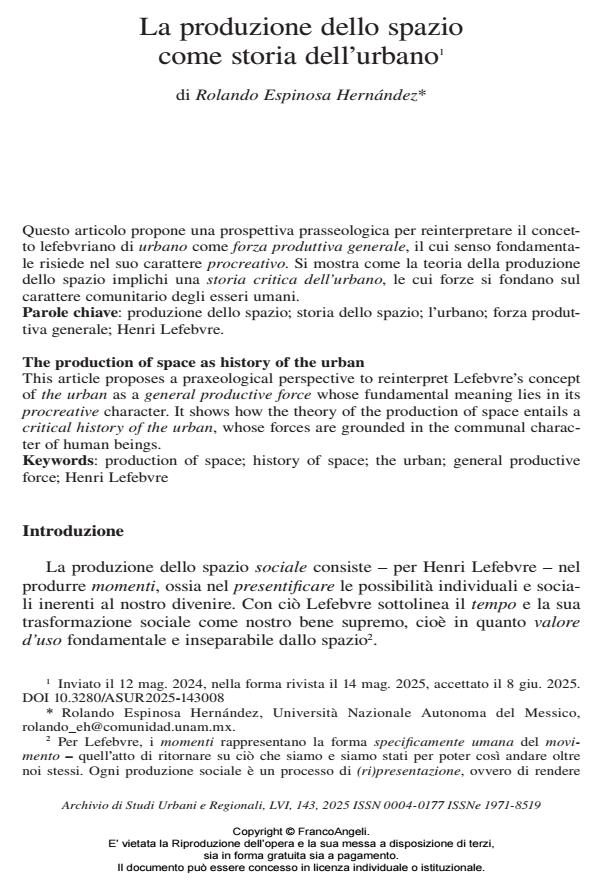
Questo articolo propone una prospettiva prasseologica per reinterpretare il concetto lefebvriano di urbano come forza produttiva generale, il cui senso fondamentale risiede nel suo carattere procreativo. Si mostra come la teoria della produzione dello spazio implichi una storia critica dell’urbano, le cui forze si fondano sul carattere comunitario degli esseri umani.
Parole chiave:produzione dello spazio; storia dello spazio; l’urbano; forza produttiva generale; Henri Lefebvre.
- Alessandri A. (2007). O lugar no/do mundo. São Paulo: FFLCHUSP. Anderson K. (2010). Marx at the Margins. Chicago: Chicago University Press. Anderson K. (2025). The Late Marx’s Revolutionary Roads. London: Verso.
- Brenner N. (2000). The Urban Question: Reflections on Henri Lefebvre. IJURR, 24(2): 361378. Brenner N. and Schmid C. (2015). Towards a New Epistemology of the Urban? City, 19(23): 151182.
- de Vaan M. (2008). Etymological Dictionary of Latin and the other Italic Languages. Berlin: de GruyterBrill.
- Lefebvre H. et Hannebert J. (1985). De l’urbain à la ville. Techniques et architecture, 359: 112113.
- Delgado M. (2013). El espacio público como representación. Espacio urbano y espacio social en Henri Lefebvre. Observatorio del Espacio Público de Bogotá, 16. Testo disponibile al sito: http://observatorio.dadep.gov.co/ documento/elespaciopublicocomorepresentacionespaciourbanoyespaciosocialenhenrilefebvre.
- Delgado M. (2017). El urbanismo contra lo urbano. La ciudad y la vida urbana en Henri Lefebvre. Revistarquis, 7(1).
- Echeverría B. (2017). El discurso cri´tico de Marx. Ciudad de México: Editorial Itaca.
- Engels F. (1967). Briefe. Januar 1888Dezember 1890. Dietz: MEW 37 (ed. or. 1890).
- Engels F. (1990). Der Ursprung der Familie, des Privateigentums und des Staats. Dietz: MEGA² I/29 (ed. or. 18841891).
- Espinosa R. (2020). El proyecto de espaciologi´a de Henri Lefebvre. Cuadernos de Geografi´a, 29(2): 505525.
- Espinosa R. (2022). Moments et formants de la production de l’espace social. La Pensée, 410(2): 8293.
- Espinosa R. (2023). La teori´a de la produccio´n del espacio, de Henri Lefebvre. Un proyecto de espaciología cri´tica. Tesis de Doctorado en Geografía. Mejico: Universidad Nacional Autónoma de México. Testo disponibile al sito: https:// ru.atheneadigital.filos.unam.mx/jspui/handle/FFYL_UNAM/8148.
- García Á. (2015). Forma valor y forma comunidad. Madrid: IAEN/Traficantes de Sueños.
- Hess R. (2009). Henri Lefebvre et la pensée du possible. Paris: Anthropos.
- Keikhaee A. (2023). The historical and the transhistorical in Marx’s dialectical method. Philosophy and Social Criticism, 49(3): 356382.
- Kipfer S., Saberi P. and Wieditz T. (2013). Henri Lefebvre: Debates and Controversies. Progress in Human Geography, 37(1): 115134.
- Lefebvre H. (1955). La notion de totalité dans les sciences sociales. CIS, 18: 5577.
- Lefebvre H. (1969). La sexualité. In: Id., Dimensions neurophysiologique et neuropsychologique. SaintRémylesChevreuse: RAUC, 137144.
- Lefebvre H. (1970a). La révolution urbaine. Paris: Gallimard. Lefebvre H. (1970b). Le manifeste différentialiste. Paris: Gallimard. Lefebvre H. (1971a). Audelà du structuralisme. Paris: Anthropos. Lefebvre H. (1971b). Vers le cybernanthrope. Paris: DenoëlGonthier. Lefebvre H. (1973a). La survie du capitalisme. Paris: Anthropos.
- Lefebvre H. (1973b). Le mondial et le planétaire. Espaces et sociétés, 8: 1522. Lefebvre H. (1976). De l’État 1. Paris: UGE.
- Lefebvre H. (1978a). De l’État 4. Paris: UGE.
- Lefebvre H. (1978b). La pensée marxiste et la ville. Paris: Casterman. Lefebvre H. (1980). La présence et l’absence. Paris: Casterman.
- Lefebvre, H. (1984). La splendeur de la ville. Archivari, 2: 1416.
- Lefebvre H. (1985a). Fragments d’un discours politique. Révolution, 268: 5455. Lefebvre H. (1985b). Qu’estce que penser? Paris: Publisud.
- Lefebvre H. (1986). Le retour de la dialectique. Paris: Messidor – Les Éditions Sociales.
- Lefebvre H. (2000a). Espace et politique. Paris: Anthropos (ed. or. 1972). Lefebvre H. (2000b). La production de l’espace. Paris: Anthropos (ed. or. 1974). Lefebvre H. (2001). La fin de l’histoire. Paris: Anthropos (ed. or. 1970).
- Lefebvre H. 2014). Les communautés paysannes pyrénéennes. Paris: Société RamondCHAR (ed. or. 1954).
- Lefebvre H. (2016). Le droit à la ville. Paris: Anthropos (ed. or. 1968).
- Lefebvre H. (2023). Socialisme industriel et socialisme paysan. Actuel Marx, 74(2): 1311441 (ed. or. 1959).
- Mallory J. and Adams D. (2006). The Oxford Introduction to ProtoIndoEuropean and the ProtoIndoEuropean World. Oxford: Oxford University Press.
- Martínez E. (1996). Para una crítica del Urbanismo Normal: La teoría de la apropiación del espacio en H. Lefebvre. Sociedad Urbana, 3: 4367.
- Marx K. (1982). Ökonomischphilosophische Manuskripte. Dietz: MEGA² I/2 (ed. or. 1844).
- Marx K. (1987). Das Kapital. Dietz: MEGA² II/6 (ed. or. 1872).
- Marx K. (2006). Ökonomische Manuskripte. Dietz: MEGA² II/1 (ed. or. 18571858).
- Marx K. (2013). Zur Kritik der politischen Ökonomie (Manuskript). Dietz: MEGA² II/3 (ed. or. 18611863).
- Marx K. (2015). Escritos sobre la comunidad ancestral. Quito: VPEB/BAHALP. Testo disponibile al sito: www.marxists.org/espanol/me/selecciones/marxescritossobrelacomunidaancestral.pdf.
- Marx K. und Engels F. (1970). Die deutsche Ideologie. MEGA² I/5. Detlev Auvermann (ed. or. 184546).
- Marx K. und Engels F. (1985). Mai 1875 bis Mai 1883. Dietz: MEGA² I/25. Merrifield A. (2006). Henri Lefebvre. A Critical Introduction. New York: Routledge.
- Merrifield A. (2013). The Urban Question under Planetary Urbanization. International Journal of Urban and Regional Research, 37(3): 909922.
- Musto M. (2016). L’ultimo Marx, 18811883. Roma: Donzelli.
- Musto M. (2020). Las investigaciones tardías de Marx sobre los países no europeos. In: Torres E. et al., Marx, 200 años: Presente, pasado y futuro. Buenos Aires: CLACSO, 105156.
- Palero S. (2016). El derecho a la ciudad, según Henri Lefebvre. Vivienda y Ciudad, 3: 8592.
- Pokorny J. (1959). Indogermanisches etymologisches Wörterbuch. Bern: A. Francke.
- Renaudie S., Guilbaud P., Lefebvre H. et al. (2009). Autogestion, or Henri Lefebvre in New Belgrade. Vancouver: Fillip – Sternberg Press (ed. or. 1986).
- Renaudie S., Lefebvre H. et al. (1988). Une nouvelle positivité de l’urbain. M. Mensuel, marxisme, mouvement, 17: 6266.
- Saito K. (2016). Natur gegen Kapital. Weinheim: Campus.
- Saito K. (2022). La naturaleza contra el capital. Manresa: Bellaterra.
- Schmid C. (2010). Stadt, Raum und Gesellschaft. Stuttgart: Franz Steiner Verlag. Schmid C. (2022). Henri Lefebvre and the Theory of the Production of Space. London: Verso.
- Smith W. (2013). A Dictionary of Greek and Roman Antiquities. Cambridge: Cambridge University Press (ed. or. 1842).
- Stanek L. (2011). Henri Lefebvre on Space. Minneapolis: Minnesota University Press.
- Thom R. (1983). Paraboles et catastrophes. Paris: Flammarion.
- Veraza J. (2012). Karl Marx y la técnica desde la perspectiva de la vida. Ciudad de México: Editorial Itaca.
Rolando Espinosa Hernández, La produzione dello spazio come storia dell’urbano in "ARCHIVIO DI STUDI URBANI E REGIONALI" 143/2025, pp 140-166, DOI: 10.3280/ASUR2025-143008