Binge drinking e ubriachezza. Problemi di definizione culturale
Titolo Rivista PSICOBIETTIVO
Autori/Curatori Franca Beccaria, Sara Rolando
Anno di pubblicazione 2016 Fascicolo 2015/3
Lingua Italiano Numero pagine 17 P. 77-93 Dimensione file 152 KB
DOI 10.3280/PSOB2015-003005
Il DOI è il codice a barre della proprietà intellettuale: per saperne di più
clicca qui
Qui sotto puoi vedere in anteprima la prima pagina di questo articolo.
Se questo articolo ti interessa, lo puoi acquistare (e scaricare in formato pdf) seguendo le facili indicazioni per acquistare il download credit. Acquista Download Credits per scaricare questo Articolo in formato PDF
FrancoAngeli è membro della Publishers International Linking Association, Inc (PILA), associazione indipendente e non profit per facilitare (attraverso i servizi tecnologici implementati da CrossRef.org) l’accesso degli studiosi ai contenuti digitali nelle pubblicazioni professionali e scientifiche.
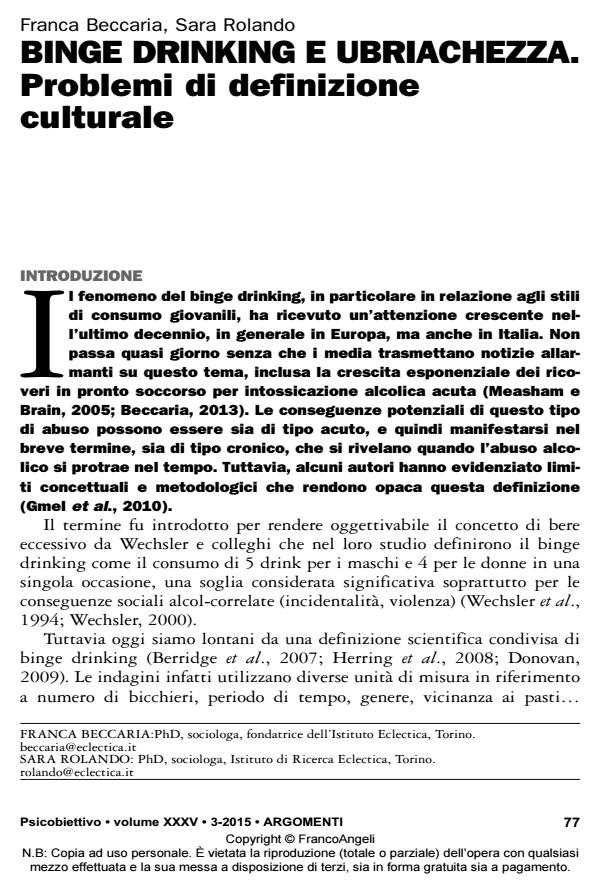
Il termine binge drinking viene sempre più impiegato dalla comunità scientifica per misurare il bere eccessivo e dai media per descrivere il bere giovanile e una presunta crescente propensione dei giovani ad ubriacarsi. Le statistiche mostrano però discrepanze e sollevano interrogativi cui si è cercato di rispondere attraverso una ricerca qualitativa mixed-method basata su 134 interviste individuali e un forum web rivolti a giovani (15-24 anni). I risultati mostrano che la categoria binge drinking include stili di consumo molto differenti non necessariamente orientati all’ubriachezza e che non è corretto parlare di "normalizzazione" del bere eccessivo in quanto permane una concezione negativa dell’ubriachezza anche tra i giovani.
Parole chiave:Binge drinking; ubriachezza; bere eccessivo; bere giovanile; culture del bere
- Laghi F., Liga F., Baumgartner E., Baiocco R. (2013) “Identity and conformism among Italian adolescents who binge eat and drink”, Health, Risk & Society, 14(4): 361-376
- Lamont M., Molnár V. (2002) “The Study of Boundaries in the Social Sciences”, Annual Review of Sociology, 28: 167-195
- Martinic M., Measham F. (2008) “Extreme Drinking”, in Martinic M., Measham F. (eds.) Swimming with crocodiles: The culture of extreme drinking, Routledge, New York
- McAlaney J., McMahon J. (2006) “Establishing rates of binge drinking in the UK: anamalies in the data. Commentary”, Alcohol & Alcoholism, 41(4): 355-357
- McKenna K.Y.A., Green A.S. (2002) “Virtual Group Dinamics”, Group Dynamics: Theory, Research, and Practice, 6(1): 116-127
- Measham F. (2004) “Play space: historical and socio-cultural reflection on drugs, licensed leisure locations, commercialisation and control”, The International Journal of Drug Policy, 5/6: 337-345
- Measham F. (2008) “The turning tides of intoxication: young people’s drinking in Britain”, Health Education, 108(3): 207-222
- Measham F., Brain K. (2005). ‘‘’Binge’ drinking, British alcohol policy and the new culture of intoxication”, Crime Media Culture, 1(3): 262-283
- Molinaro S., Chiellini P. (2013) In dipendenza, 121 risposte sulle dipendenze in Italia, Tangram Edizioni Scientifiche, Trento
- Morgan D.L. (2008) “Focus Groups”, in Given M. (ed.), The SAGE encyclopaedia of qualitative research methods, SAGE Publications, Thousand Oaks, pp. 353-355
- Norman P., Armitage C.J., Quigley C. (2007) “The theory of planned behavior and binge drinking: Assessing the impact of binge drinker prototypes”, Addictive Behaviors, 32(9): 1753-1768
- Rolando S., Katainen A. (2014) “Images of alcoholism among adolescents in individualistic and collectivistic geographies”, NAD – Nordic Studies on Alcohol and Drugs, 31(2): 189-205
- Rolando S., Törrönen J., Beccaria F. (2014) “Boundaries between adult and youth drinking as expressed by young people in Italy and Finland”, YOUNG, 22(3): 227-252
- Room R. (2010) “Culture ‘asciutte’ e culture ‘bagnate’ nell’epoca della globalizzazione”, Salute e Società, 9(3): 231-240
- Salomon E. (2012) “Gli Italiani e l’alcool”, in Tempesta E., Contel M. (a cura di), Giovani e alcol: cosa è cambiato in vent’anni?, Carocci, Roma
- Scalese M., Simi E., Fortunato L., Chiellini P., Doveri C., Trivellini G.,
- Molinaro S. et al. (2012) Espad-Italia. Ricerca sul consumo di alcol e altre sostanze nella popolazione scolastica, Consiglio Nazionale delle Ricerche, Pisa
- Törrönen J., Maunu A. (2005) “Going out, sociability, and cultural distinctions”, Nordic Studies on Alcohol and Drugs, 22: 25-43 (English Supplement)
- Wechsler H. (2000) Binge Drinking on America’s College Campuses: Findings from the Harvard School of Public Health College Alcohol Study, Monograph. http://archive.sph.harvard.edu/cas/Documents/monograph_2000/cas_mono_2000.pdf
- (consultazione 3/12/2015) Wechsler H., Davenport A., Dowdall G., Moeykens B., Castillo S. (1994) “Health and behavioural consequences of binge drinking in college: A national survey of students at 140 campuses”, Journal of the American Medical Association, 272: 1672-1677
- Beccaria F. (2013) Alcol e giovani. Riflettere prima dell’uso, Giunti, Firenze
- Beccaria F., Prina F. (1996) “Le dimensioni culturali e sociali dell’alcol”. In Ruggenini Moiraghi A. (a cura di), Alcologia, Masson, Milano, pp. 17-58
- Beccaria F., Prina F. (2010) “Young people and alcohol in Italy: an evolving relationship”, Drugs: Education, Policy, 17(2): 99-122
- Beccaria F., Petrilli E., Rolando S. (2014) “Binge drinking vs. drunkenness. The questionable threshold of Italians”, Journal of Youth Studies, (ahead-of-print), 1-16
- Berridge V., Thom B., Herring R. (2007) The normalisation of binge drinking? An historical and cross cultural investigation with implications for action, Alcohol Education and Research Council. http://alcoholresearchuk.org/downloads/finalReports/AERC_FinalReport_0049.pdf (consultazione 1/12/2015)
- Charrier L., Cavallo F. (2010) “I dati quantitativi su consumi e abuso di alcol tra i giovani: una rassegna critica”, Salute e Società, 9(3): 47-62
- D’Alessio M., Baiocco R., Laghi F. (2006) “The problem of binge drinking among Italian university students: A preliminary investigation”, Addictive Behavior, 31: 2328-2333
- Demant J., Østergaard J. (2007) “Partying as Everyday Life: Investigations of Teenagers’ Leisure Life”, Journal of Youth Studies, 10(5): 517-537
- Demant J., Wissmann C. (2010) A qualitative analysis of drinking culture(s) among Danish and German young adults, Paper presented at the 36th Annual Alcohol Epidemiology Symposium of the Kettil Bruun Society, Losanne, May 31-June 4
- Gmel G., Rehm H., Kuntsche E. (2003) “Binge drinking in Europe: definitions, epidemiology andconsequences”, Sucht, 49: 105-16
- Gmel G., Kuntsche E., Rehm J. (2010) “Risky single-occasion drinking: bingeing is not bingeing”, Addiction, 106: 1037-1045
- Guerrini I., Gentili C., Guazzelli M. (2006) “Alcohol consumption and heavy drinking: a survey in three Italian villages”, Alcohol & Alcoholism, 41(3): 336-340
- Herring R., Berridge V., Thom B. (2008) “Binge drinking: an exploration of a confused concept”, Journal of Epidemiology and Community Health, 62: 476-479
- Hibell B., Guttormsson U., Ahlström S., Balakireva O., Bjarnason T.,
- Kokkevi A., Kraus L. (2012) The 2011 ESPAD report: Substance use among students in 36 European countries, The Swedish Council for Information on Alcohol and Other Drugs (CAN), Stockholm ISTAT (2015) L’uso e l’abuso di alcol in Italia. Anno 2012, Statistiche Report, Roma. http://www.istat.it/it/archivio/117897
- Järvinen M., Room R. (2007) “Youth drinking cultures: European experiences”, in Järvinen M., Room R. (eds.), Youth Drinking Cultures: European Experiences, Ashgate, Surrey
Franca Beccaria, Sara Rolando, Binge drinking e ubriachezza. Problemi di definizione culturale in "PSICOBIETTIVO" 3/2015, pp 77-93, DOI: 10.3280/PSOB2015-003005