“Plausible” subjects and missing resources: An intersectional reading of gender-based violence in LGBT relationships

Journal title WELFARE E ERGONOMIA
Author/s Elisa Begnis, Maria Urso, Simone Tuzza, Martina Lo Cascio, Sandra Sicurella, Cirus Rinaldi
Publishing Year 2026 Issue 2025/2
Language Italian Pages 16 P. 51-66 File size 130 KB
DOI 10.3280/WE2025-002004
DOI is like a bar code for intellectual property: to have more infomation click here

Below, you can see the article first page

If you want to buy this article in PDF format, you can do it, following the instructions to buy download credits

Article preview

FrancoAngeli is member of Publishers International Linking Association, Inc (PILA), a not-for-profit association which run the CrossRef service enabling links to and from online scholarly content.

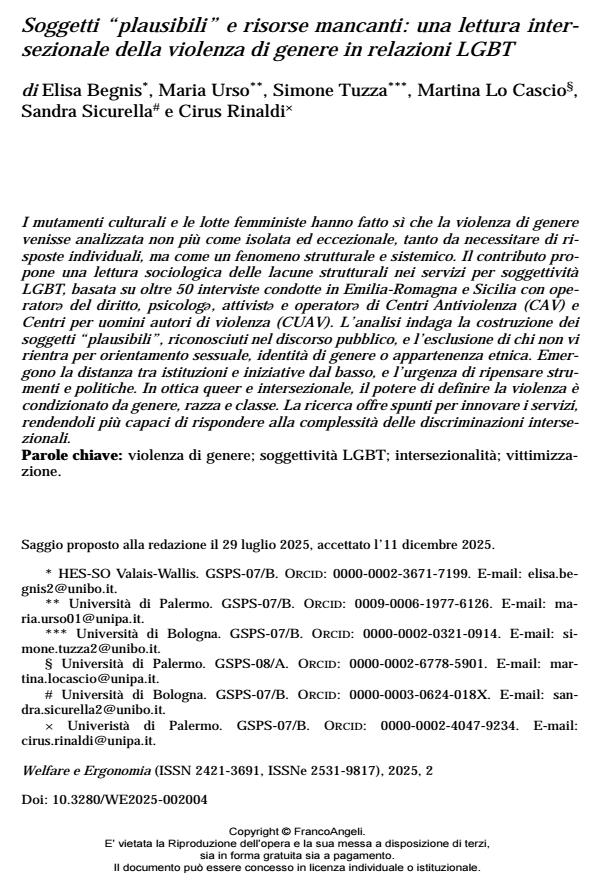
Cultural shifts and feminist political struggles have led to a transformation in the analysis of gender-based violence, moving from its earlier conceptualization as an ‘exception’ ‒ to be addressed through individual responses ‒ toward an understanding of it as a structural and systemic phenomenon. This paper offers a sociological analysis of systemic gaps and innovative strategies to address the emerging needs of LGBT subjects, based on fieldwork conducted in Emilia-Romagna and Sicilia. The study explores how “plausible subjects” are constructed and recognized in public discourse and services addressing violence. Over 50 in-depth interviews were carried out with legal professionals, psychologists, activists, and staff at anti-violence and perpetrator intervention centers. Findings reveal a gap between institutional responses and grassroots initiatives, as well as a lack of adequate resources for “non-plausible” subjects ‒ those excluded due to sexuality, gender identity, or ethnicity. Adopting a queer and intersectional lens, the analysis highlights how class and race shape the very definition of violence, offering insights to reconfigure services and policies toward greater inclusivity.

Keywords: gender-based violence; LGBT subjectivities; intersectionality; victimisation.

  1. Bermea A.M., van Eeden-Moorefield B. and Khaw L. (2018). A systematic review of research on intimate partner violence among bisexual women. Journal of Bisexuality, 18(4): 399-424. DOI: 10.1080/15299716.2018.1482485
  2. Buist C. L. and Lenning E. (2016). Queer criminology, New York: Routledge.
  3. Butler J. (2023). Questione di genere: il femminismo e la sovversione dell’identità, Gius. Laterza & Figli Spa.
  4. Cannon C., Lauve-Moon K. and Buttell F. (2015). Re-theorizing intimate partner violence through post-structural feminism, queer theory, and the sociology of gender. Social Sciences, 4(3): 668-687.
  5. Cavanagh S.L. (2010). Queering bathrooms: Gender, sexuality, and the hygienic imagination. University of Toronto Press.
  6. Cavanagh S.L. and Sykes H. (2006). Transsexual bodies at the Olympics: The International Olympic Committee's policy on transsexual athletes at the 2004 Athens Summer Games. Body & Society, 12(3): 75-102.
  7. Cavarero A. e Restaino F. (2002). Le filosofie femministe: due secoli di battaglie teoriche e pratiche, Pearson Italia Spa.
  8. Christie N. (1986). Ideal victim. In: Fattah E.A. editor, From crime policy to victim policy: Reorienting the justice system, 17-30. London: Macmillan. DOI: 10.1007/978-1-349-08305-3_2.
  9. Clevenger S., Kelley S. and Ratajczak K., editor, (2023). Queer victimology: understanding the victim experience. Taylor & Francis. DOI: 10.4324/9781003400981
  10. Connell R.W. (1996). Maschilità. Identità e trasformazioni del maschio occidentale, Vol. 207, Feltrinelli Editore.
  11. Coppola M., Guizzardi L. and Monaco S. (2025). Introduction Queer(ing) (and) the social sciences: challenges and perspectives. The Lab’s Quarterly, XXVII(2).
  12. Creazzo G. (2008). La costruzione sociale della violenza contro le donne in Italia. Studi sulla questione criminale, 3(2): 15-42. DOI: 10.7383/70696
  13. Donovan C. and Barnes R. (2018). Being ‘ideal’ or falling short? The legitimacy of lesbian, gay, bisexual and/or transgender victims of domestic violence and hate crime. In: M. Duggan, a cura di, Revisiting the ‘Ideal Victim’: Developments in Critical Victimology, 83-102. Bristol: Policy Press.
  14. Duggan M., a cura di (2018). Revisiting the ‘Ideal Victim’: Developments in Critical Victimology. Bristol: Policy Press.
  15. Finneran C.T. and Stephenson R. (2013). Intimate partner violence among men who have sex with men. Journal of Interpersonal Violence, 28(4): 801-829. DOI: 10.1177/1524838012470034
  16. Fusco B. (2023). La città delle donne: sicurezza, spazio pubblico e strumentalizzazione del corpo femminile nel contesto urbano: una prospettiva di genere. Red Star Press.
  17. Giomi E. e Magaraggia S. (2017). Relazioni brutali. Genere e violenza nella cultura mediale, Bologna: il Mulino.
  18. Goodson A. (2023). Police officers’ attributions of victim culpability in scenarios of same-sex intimate partner violence. Journal of interpersonal violence, 38(5-6): 4945-4969. DOI: 10.1177/08862605221120916
  19. GREVIO – Group of Experts on Action against Violence against Women and Domestic Violence (2020). Rapporto di valutazione di base sulla legislazione e le misure adottate dall’Italia per dare attuazione alla Convenzione di Istanbul. Strasbourg: Council of Europe.
  20. Guadalupe-Diaz X.L. (2019). Transgressed: Intimate partner violence in transgender lives. NYU Press.
  21. Guadalupe-Diaz X.L. and Yglesias J. (2013). Who’s protected? Exploring perceptions of domestic violence law by lesbians, gays, and bisexuals. Journal of Gay & Lesbian Social Services, 25(4): 465-485. DOI: 10.1080/10538720.2013.806881
  22. Ingraham C. (1994). The heterosexual imaginary: Feminist sociology and theories of gender. Sociological theory, 203-219. DOI: 10.2307/201865
  23. Jackson S. (2006). Interchanges: Gender, sexuality and heterosexuality: The complexity (and limits) of heteronormativity. Feminist theory, 7(1): 105-121. DOI: 10.1177/1464700106061462
  24. Lucal B. (1999). What it means to be gendered me: Life on the boundaries of a dichotomous gender system. Gender & society, 13(6): 781-797. DOI: 10.1177/089124399013006006
  25. Mathers Lain A.B. (2017). Bathrooms, boundaries, and emotional burdens: Cisgendering interactions through the interpretation of transgender experience. Symbolic Interaction, 40(3): 295-316.
  26. Murray C.E. and Mobley A.K. (2009). Empirical research about same-sex intimate partner violence: A methodological review. Journal of homosexuality, 56(3): 361-386. DOI: 10.1080/00918360902728848
  27. Nash S.T., Shannon L.M., Himes M. and Geurin L. (2023). Breaking Apart Intimate Partner Violence and Abuse. Routledge. DOI: 10.4324/9781003176961
  28. Oddone C. (2020). Uomini normali: Maschilità e violenza nell’intimità. Rosenberg & Sellier.
  29. Panfil V.R. and Miller J. (2014). Beyond the strait and narrow: the import of queer criminology for criminology and criminal justice. The Criminologist, 39(4). --https://www.asc41. org/wp-content/uploads/ASC-Criminologist-2014-07.pdf.
  30. Poggi F. (2017). Violenza di genere e Convenzione di Istanbul: un'analisi concettuale. Diritti umani e diritto internazionale, 1: 51-76. DOI: 10.12829/86203
  31. Rinaldi C. (2024). Diventare pensabili? Quali spazi e sguardi per le persone LGBTAQI+. Un esercizio di sociologia pubblica/becoming thinkable? Spaces and gazes for LGBTAQI+ people. An exercise in public sociology. Cartografie sociali, IX(17): 81-93. -- https://universitypress.unisob.na.it/ojs/index.php/cartografiesociali/article/viewFile/1919/1554.
  32. Rinaldi C. (2023). Posizionamenti inquieti: approcci e metodologia queer. In F. de Nardis, A. Petrillo, A. Simone (a cura di), Sociologia di posizione. Prospettive teoriche e metodologiche. Milano: Meltemi.
  33. Ristock J.L. (2011). Intimate partner violence in LGBTQ lives. Routledge.
  34. Russell B. (2018). Police perceptions in intimate partner violence cases: The influence of gender and sexual orientation. Journal of Crime and Justice, 41(2): 193-205. DOI: 10.1080/0735648X.2017.1282378
  35. Russell B. and Kraus S. (2016). Perceptions of partner violence: How aggressor gender, masculinity/femininity, and victim gender influence criminal justice decisions. Deviant Behavior, 37: 679-691. DOI: 10.1080/01639625.2015.1060815
  36. Russell B., Kraus S.W., Chapleau K.M. and Oswald D. (2019). Perceptions of blame in intimate partner violence: The role of the perpetrator’s ability to arouse fear of injury in the victim. Journal of Interpersonal Violence, 34(5): 1089-1097. DOI: 10.1177/0886260516646999
  37. Sciurba A. (2024). Non nei nostri nomi: La strumentalizzazione culturalista della difesa dei diritti delle donne e la violenza di genere delle politiche migratorie. AG About Gender-International Journal of Gender Studies, 13(25): 50-73. DOI: 10.15167/2279-5057/AG2024.13.25.2258
  38. Scott J.W. (1986). Gender: A Useful Category of Historical Analysis. The American Historical Review, 91(5): 1053-1075. DOI: 10.2307/1864376
  39. Tarasconi E. (2016). Sul margine. L’ontologia del soggetto nelle teorie «queer». Quaderni Materialisti, 15: 281-286.
  40. Tuana N. (2017). Feminist epistemology: The subject of knowledge. In: The Routledge Handbook of Epistemic Injustice, 125-138. Taylor and Francis. DOI: 10.4324/9781315212043
  41. Walker L.E. (1979). The Battered Woman. New York: Harper & Row.
  42. Walters S. (2011). Everyday Life, Everyday Death: Race, gender, and third-wave cultural activism on Six Feet Under's online fansite. Feminist Media Studies, (11)3: 363-378. DOI: 10.1080/14680777.2010.542341
  43. Westbrook L. and Schilt K. (2014). Doing gender, determining gender: Transgender people, gender panics, and the maintenance of the sex/gender/sexuality system. Gender & society, 28(1): 32-57. DOI: 10.1177/0891243213503203
  44. World Health Organization, Regional Office for Europe (2012). Environmental health inequalities in Europe. Copenhagen.

Elisa Begnis, Maria Urso, Simone Tuzza, Martina Lo Cascio, Sandra Sicurella, Cirus Rinaldi, Soggetti “plausibili” e risorse mancanti: una lettura intersezionale della violenza di genere in relazioni LGBT in "WELFARE E ERGONOMIA" 2/2025, pp 51-66, DOI: 10.3280/WE2025-002004