Cinema that heals. Film narratives and self-transformation
Journal title RIVISTA SPERIMENTALE DI FRENIATRIA
Author/s Matteo Balestrieri
Publishing Year 2026 Issue 2026/1
Language Italian Pages 29 P. 189-217 File size 880 KB
DOI 10.3280/RSF2026-001010
DOI is like a bar code for intellectual property: to have more infomation
click here
Below, you can see the article first page
If you want to buy this article in PDF format, you can do it, following the instructions to buy download credits
FrancoAngeli is member of Publishers International Linking Association, Inc (PILA), a not-for-profit association which run the CrossRef service enabling links to and from online scholarly content.
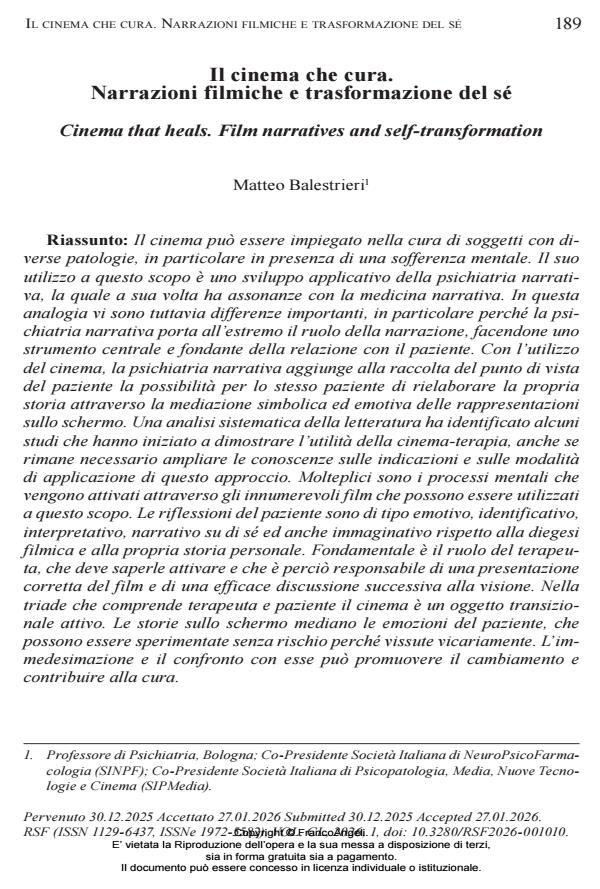
Cinema can be used in the treatment of individuals with various pathologies, particularly in cases of mental health conditions. Its use for this purpose is an application of narrative psychiatry, which in turn has similarities with narrative medicine. However, there are important differences in this analogy, particularly because narrative psychiatry takes the role of storytelling to the extreme, making it a central and fundamental tool in the relationship with the patient. Through the use of cinema, narrative psychiatry not only gathers the patient’s point of view, but also offers them the opportunity to rework their own story through the symbolic and emotional mediation of on screen representations. A systematic analysis of the literature has identified a several studies that begin to demonstrate the usefulness of cinema therapy, although further work is needed to clarify the indications for, and methods of applying, this approach.. There are many mental processes that are activated through the numerous films that can be used for this purpose. Patients’ reflections can be emotional, identificatory, interpretative, and self narrative, as well as imaginative in relation both to the film’s diegesis and to their own personal history. The role of the therapist is fundamental, as they must be able to activate these processes and are therefore responsible for presenting the film appropriately and leading an effective post viewing discussion. In the triad comprising therapist and patient, cinema functions as an active transitional object. The stories on the screen mediate the patient’s emotions, which can be experienced safely because they are lived vicariously. Identification with, and confronting, these emotions can foster change and contribute to the healing process.
Keywords: Narrative Medicine, Narrative Psychiatry, Cinema, Storytelling, Cinema Therapy, Diegesis, Transitional Object, Emotions, Identifications, Interpretations, Empathy, Mentalisation.
- [1.] Charon, R. Narrative Medicine: Honoring the Stories of Illness. Oxford University Press; 2006.
- [2.] Istituto Superiore di Sanità. Conferenza di consenso. Linee di indirizzo per l’utilizzo della Medicina Narrativa in ambito clinicoassistenziale per le malattie rare e cronicodegenerative. Quaderni di Medicina. Il Sole 24ore Sanità (https://personemagazine.it/wpcontent/uploads/2024/05/LineeIndirizzoMNISS.pdf); 2015.
- [3.] Moja E. & Vegni E. La visita medica centrata sul paziente. Milano: Raffaello Cortina Editore; 2000.
- [4.] Fonda F, Chiappinotto S, Visintini E, D’Elia D, Ngwache T, Peghin M, Tascini C, Balestrieri M, Colizzi M, Palese A. PostCOVID19 syndrome as described by patients: a qualitative study. Healthcare (Basel) 2025; 13:757.
- [5.] Stanghellini, G. Lost in Dialogue: Anthropology, Psychopathology, and Care. Oxford University Press; 2017.
- [6.] MehlMadrona, L. Narrative Medicine: The Use of History and Story in the Healing Process. Bear & Company; (2007).
- [7.] Groleau D., Young A., Kirmayer L.J. The McGill Illness Narrative Interview (MINI): an interview schedule to elicit meanings and modes of reasoning related to illness experience. Transcult Psychiatry 2006; 43: 67191. Versione Italiana:https://www.mcgill.ca/tcpsych/files/tcpsych/ mini_italian.pdf.
- [8.] Chesi P, Mencacci C, Balestrieri M, Pompili M, Varia S, Sagripanti U, Reale L, Marini MG. Multicentre narrative research on major depression to integrate the experiences of patients, their caregivers and healthcare providers in Italy. BMJ Open 2022; 12: e052744.
- [9.] Balestrieri M. Psicologia delle relazioni umane. Teoria, clinica e narra zioni cinematografiche. FrancoAngeli; 2019.
- [10.] Solomon, G. The Motion Picture Prescription: Watch This Movie and Call Me in the Morning. Aslan Publishing; 1995.
- [11.] Solomon, G. Reel Therapy: How Movies Inspire You to Overcome Life’s Problems. Aslan Publishing; 2001.
- [12.] Sharp C, Smith J.V., Cole A. Cinematherapy: metaphorically promoting therapeutic change. Counselling Psychology Quaterly 2002; 15, 269276.
- [13.] PérezSánchez, R., et Al. Film therapy and depression: A Clinical Experience. Journal of Mental Health Counseling 2014; 36, 125140.
- [14.] Ruiz, M. Filmoterapia: el cine como herramienta emocional y terapéutica. Madrid: Ediciones Pirámide; 2012.
- [15.] Collins MKR, Lazard AJ, Dillman Carpentier F, Comello ML, Benedict C, Kent EE, Yu C. Reel reflections: the role of entertainment media narratives in coping among young adult cancer survivors. J Psychosoc Oncol. 2024; 42 (6): 822843.
- [16.] Reddan M.C., Garcia S.B., Golarai G., Eberhardt J.L., Zaki J. Film intervention increases empathic understanding of formerly incarcerated people and support for criminal justice reform, Proc. Natl. Acad. Sci. U.S.A. 2024; 121, e2322819121.
- [17.] Aghaeepour Gavasaraee M., Mohammadi M., Naziri G., Davoodi A. Effectiveness of integrated treatment focused on schema and cinema therapy in the treatment of avoidant personality disorder. Razi Journal of Medical Sciences 2023; 30:112.
- [18.] Chieffo D.P.R., Lafuenti L., Mastrilli L., De Paola R., Vannuccini S., Morra M., Salvi F., Boškoski I., Salutari V., Ferrandina G., Scambia G. Medicinema: a pilot study on cinematherapy and cancer as a new psychological approach on 30 gynecological oncological patients. Cancers (Basel) 2022; 14: 3067.
- [19.] Kwon H., and Lee SookJa The effect of a moviebased nursing intervention program on rehabilitation motivation and depression in stroke patients. Journal of Korean Academy Nursing 2017; 47, 345.
- [20.] Powell, M. L., & Newgent, R. A. Improving the empirical credibility of cinematherapy: a singlesubject interrupted timeseries design: a singlesubject interrupted timeseries design. Counseling Outcome Research and Evaluation 2010; 1, 4049.
- [21.] Lee S.E., Ko S. The Effects of Cinema Therapy on Depression and SelfEsteem in People with Schizophrenia. Journal of Digital Convergence 2013; 11, 1.
- [22.] Azios M., Irani F., BellonHarn M., Swartz E., Benson C. The utility of cinematherapy for stuttering intervention: an exploratory study. Semin Speech Lang 2020; 41: 400413.
- [23.] García del Castillo I., López M.M., Caballero Martínez L. Estudio de una nueva técnica psicoterapéutica grupal en esquizofrenia basada en el cine de ficción: efectos sobre síntomas positivos y negativos. Psiquiatría Biológica 2019; 26, 6672.
- [24.] Peña J., Sánchez P., Elizagárate E., IbarretxeBilbao N., Ezcurra J., Ca ballero L., Magariños M., García Del Castillo I., Gutiérrez M., Ojeda N. Clinical (but not cognitive) recovery in schizophrenia through the experience of fictional cinema. Schizophr Res Cogn. 2015; 17: 189194.
- [25.] Gürcan MB, Yildiz M, Patir K, Demir Y. The effects of narrative and movie therapy on the theory of mind and social functioning of patients with schizophrenia. Noro Psikiyatr Ars. 2021; 58: 108114.
- [26.] Wen Zhang. 3 research on the effect of movie therapy and improvement of social function in special groups of schizophrenia patients. Schizophrenia Bulletin 2025; 51, Supplement 1, S2.
- [27.] Drebing C.E., Mamon D., Calixte R.M., TuvalMashiach R., Patton B., Scoglio A.A.J., Girouard C., Fukuda S., Gao W., Penk W.E. Pilot outcomes of a filmmaking intervention designed to enhance treatment entry and social reintegration of veterans. Psychol Serv. 2023; 20: 585595.
- [28.] TuvalMashiach R., Patton B., Drebing C. When you make a movie, and you see your story there, you can hold it: qualitative exploration of collaborative filmmaking as a therapeutic tool for veterans. Frontiers in Psychology 2018; 16: 1954.
- [29.] Gunasekera H, Chapman S, Campbell S. Sex and drugs in popular movies: an analysis of the top 200 films. J Royal Soc Med 2005; 98: 464470.
- [30.] Cape G.S. Addiction, Stigma and Movies. Acta Psych Scand 2003; 107: 163169.
- [31.] Brandfon S. & Perron B. Movies. In: Encyclopaedia of Drugs, Alcohol and Addictive Behavior (eds. Rosalyn CarsonDeWitt). MacMillan, New York, 2001.
- [32.] Balestrieri M., Caracciolo S., Dalle Luche R., Iazzetta P., Senatore I. Vero come la Finzione. La Psicopatologia al Cinema. Vol. 12. SpringerVerlag Italia: Milano; 2010.
- [33.] Gabbard G.O., Gabbard K. Cinema e psichiatria. Milano: Raffaello Cortina; 2000.
- [34.] Wedding D. Movies and mental illness. Using films to understand psychopathology. 5th ed. Firenze: Hogrefe; 2023.
Matteo Balestrieri, Il cinema che cura. Narrazioni filmiche e trasformazione del sé in "RIVISTA SPERIMENTALE DI FRENIATRIA" 1/2026, pp 189-217, DOI: 10.3280/RSF2026-001010